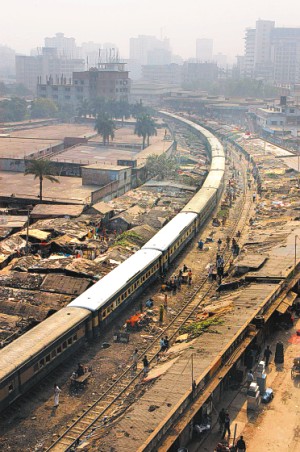
Rail lines and surroundings an eyesore
Kausar Islam Ayon
Contrary to beautified roads, medians and footpaths, the rail lines in the city are dirty, and the bad odour gives a negative impression to passengers. The track from Kamlapur railway station to Mohakhali crossing is in a very bad condition that passengers usually keep the window shutters down. The same goes for the rail line between Kamlapur and Narayangonj. Kamlapur railway station has more than 13,000 passengers on weekdays and the number exceeds 20,000 on weekends. It is impossible for one cross the city area without hold their noses and shutting their eyes. "The bad odour and view compels me to keep the windows shut. If one dares to look out, a scene of toilets, garbage and other dirt which are intolerable is visible," said Rafiq Ahmed, a weekly passenger of Bangladesh Rail. "When I enter the city by road, feel proud as a citizen but when I take the train, I feel sad," said Badruzzaman Khan, another weekly passenger on Dhaka-Mymensingh route. A look from a train window is the same throughout the journey a large number of slums with 10 times more dwellers, a number of dirty kitchen markets, lines of open toilets, dumping grounds and others. "Open toilets and dumping grounds compel us not to look out of the window till the train passes Tongi," said Rokanuddin, another passenger. The journey from Kamlapur to the Airport station is a common stretch to all parts of the country except Narayangonj, with the Khilgaon kitchen market first followed by the Khilgaon Bishwa road slum, that continues to the Malibagh and Maghbazar kitchen markets and the Maghbazar slum. This slum glides into the slums on the Sonargaon road. The situation is deplorable after the Film Development Corporation (FDC) crossing where Karwan Bazar, the biggest wholesale and kitchen market is situated followed by the Tejgaon then Nakhalpara slums, whose density and pollution is at its highest. "Evenings are the worst, especially crossing the Karwan Bazar fish wholesale market. It stinks! Businessmen dry containers, mats and the awful smell of drying fish reach at its peak at this time," said Riaz Uddin, a regular passenger. Water bodies alongside the railway lines in this area are now used only as toilets and dumping ground spreading bad odour round the clock. "Every inch on the both sides of the railway lines is highly contaminated. We cannot bear all this, but are compelled to do so as fares are cheap," said Rafiqul Islam, a Dhaka-Chittagong passenger. The destination of the stools from enormous number of open toilets is either the open spaces or water bodies making adjoining areas unbearable for living. "I cannot open the windows on the southern side of my house because of bad smell and unpleasant sight of the rail lines," said Rokeya Akter, a resident of Boro Maghbazar. Slum children use the rail lines as toilets and there is none to check such misdeeds. "The shortest route to my residence is along the rail lines, which I use with much caution as they are dirty with human faeces," said Kasem, a retail green grocer who buys his vegetables from Karwan Bazar and sells them at Nakhalpara. Passengers too, are responsible for making the situation bad. Although the railway authorities have requested passengers not to use toilets within the city limits most of them do not pay heed to the request. "The use of toilets is forbidden when the train is in the station but passengers ignore the rule, thus making the station dirty," said Nitentra Chandra Shaha Station master- 2, Kamlapur station. The Bangladesh Railway (BR) authorities too want to improve the situation but cannot do so due to various obstacles. "Long term planning and a big sum of funds are required to improve the situation, along with attention from high level government authorities," said M Abdullah, additional director (infrastructure) BR. Another BR official said the slums are considered as a 'vote bank' and for many other reasons this issue has been politicised. "Whenever we plan to evict slums alongside the rail tracks, high levels of government authorities forbid the action. There is no possibility of eviction this year because of the forthcoming elections and we have already been unofficially notified not to do so," said the official. On the other hand, members of Dhaka City Beautification Cell (DCBC) -- the supervising body for the beautification of the capital -- said they could try to improve the situation if they are assigned to do so. "The entire property is owned by the railway. If they ask us and get support from various governmental departments, we can take steps to bring the railways within the city beautification project," said Comm-odore Sohel Farouquie, member secretary DCBC. But, he added that the project could be complicated and demands a concrete decision from the government.
|