Mounting traffic hazards
Dhaka city likely to be abandoned soon?
Karar Mahmudul Hassan
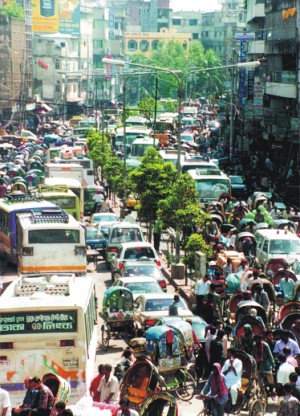
A news item published recently in different dailies of Dhaka says that "Vehicle import increases 54.78 percent in fiscal year 2005" commenting that the country's motor vehicle import increased by 54.78 percent in 2004-2005 fiscal year. Quoting the Chief Controller of Export and Import statistics, it states that dealers imported all kinds of new and old motor vehicles worth of US$117.70 million (equivalent to Taka 765 crore) during the period against US$76.04 million import in 2003-2004 fiscal.It has been reported that during 2004-05, vehicles such as scooter, human haulers and three wheelers worth of US$43.99 million were imported, clocking over 300 percent growth. Side by side, cars worth of US$15.32 million, buses worth of US$11.47 million, trucks worth of US$15.95 million and motor cycles valued at US$26.19 million posting 20.54 percent, 19.89 percent, 15 percent and 16.58 percent growth respectively, were imported. The statistics further reveal that the import of minibuses decreased as dealers imported minibuses valued at US$4.79 million in 2004-05 fiscal year against US$7.96 million in 2003-04. Another important aspect of road transportation vis-á-vis traffic and related other issues very closely related to each other is: issuance of route permits for presently available 740 routes all over the country, to different categories of motorised vehicles like bus, minibus etc. Statistical data of route permits issued in Bangladesh from BRTA Headquarters, Narayanganj Zone and 19 circles all over the country in 2004 has been collected from BRTA recently. Traffic and transportation issues of Dhaka city have been dealt at length by different quarters which include Dhaka Integrated Transport Study (DITS), DUTP/DTCB, DCC, Bangladesh Planning Commission, consultants, experts, different researchers, development partners and others since '90s or earlier, but unfortunately the route permit related matters did hardly get any importance in their studies/recommendations. To my knowledge, none including myself hardly gave any indepth attention to Route Permit affairs and its intricacies. Without appropriate attention to this issue, steps to reduce traffic hazards vis-á-vis environment issues of Dhaka city and the country, are bound to remain incomplete and incomprehensive. I understand, there is no appropriately designed standard procedure of issuing route permits to different categories of vehicles by BRTA. The statistics relating to year wise registered motorized vehicle all over the country in general and the Dhaka city in particular, reveal that Dhaka city's total registered vehicles is 44.72 percent of the country's total. In the calendar year 1996, a total of 12476 motor cars (highest number in a single year) were registered in Bangladesh-- whereas the share of Dhaka city in it was 8366 motor cars. In the calendar year 2004, a total of 5410 motor cars were registered in Bangladesh in which the Dhaka city's share was 4734, which is 87.5 percent of the total. The trend of other calendar years starting from 1997 to 2003 is almost the same, i.e. of the total registered motor cars in Bangladesh, Dhaka's share was about 85 percent or more in every year. It means that, Dhaka city is abnormally being crowded with influx of different types of motor cars and without any planning by the authorities concerned. Further, the report of 300 percent increase of smaller vehicles like scooters, human haulers, and three wheelers during 2004-05 fiscal year in comparison to previous fiscal year is alarming. And if this trend goes unabated (and there is no reason why this trend will not continue), major portion of Dhaka city roads will be occupied by these categories of vehicles before the next general election likely to be held in 2007. Many of the sensible people of Dhaka city and the country as well, are confused whether there is, or was, any appropriate authority to look after this 'danger' which is getting manifested in so many dimensions creating hazards like environmental pollutions, road blockades, economic stagnation and standstill situation of 'development-forward-march' of thousands of entrepreneurs etc. working in Dhaka city at present. Similarly, the number of taxicabs registered in Bangladesh in 2003 was 5020 and Dhaka city's share in it was 4980 i.e. 99 percent of the taxicabs were, as it appears, meant for Dhaka city. The total number of taxicabs registered in the country till December, 2004, is 11472 (and Dhaka city's share in it was 9892). Of the total taxicabs in operation in the country, about 70 percent were of Indian origin, mostly of low/bad quality responsible for air-pollution. The taxicabs service has not been reviewed by any relevant authority since 1997-98 when it started operation in massive way, to find out its positive and negative aspects for taking appropriate measures. Interestingly, as record shows, there were 27510 registered buses in the country till 1994 and during periods starting from 1995 calendar year to 2004 calendar year (10 years), only 3964 buses were added to the 'Bus-fleet'. And during these 10 calendar years, Dhaka city's share was 3124 buses. Similarly, during fiscal year 1995-2004 period, 9979 minibuses were registered in the country in which Dhaka city's share was 5819. Of the registered buses in operation in Dhaka city and the country, possibly 70-80 percent are more than 15-20 years old, and many of them are responsible for environment pollutions, road accidents, road blockades and so on. The above is one side of the story. Statistics collected from relevant sources state that the metropolitan city area is about 220 sq km and total length of roads, of different categories, within metropolitan area is 1286 km which is narrated below: - Primary Roads - 61.44 Kilometers
- Secondary Roads - 108.20 Kilometers
- Connector Roads - 221.35 Kilometers
- Local Roads - 573.74 Kilometers
- Narrow Roads - 331.27 Kilometers
Source: RMMS: 2003 (DTCB) During 1996, the total length of Dhaka City Roads was about 5 percent less than what it is now (2005). During last one decade, or to be more specific, from 1999 to 2005 (June) -- a large number of Dhaka City roads namely a) Progoti Sarani, b) Hare Road, Kamal Ataturk Avenue, Phoenix Road, College Road, Gulshan Road, c) Mazar Road, Darus Salam Road, Shaymoly Road, Mirpur 1 to Mirpur 10, Shamoli-Russel Square, Sonargaon Road, d) Mirpur 11, Mirpur 12 and Mirpur 10, Taltola, e) Tongi Bridge to Bypass including 107 Bridge, f) Saidabad-Rampura, g) Mohakhali-Mogbazar intersection and Gulshan Avenue, h) Russel Square-Azimpur and Mazar Road-Gabtoli Bus Terminal, i) Taltola to Hotel Sonargaon via Khamar Bari, Farmgate, j) Staff Road to Farmgate intersections: Kakoli, Chairman Bari, Jahangir Gate, Allenburi and Bijoy Sarani, k) Zero point-North South Road-Nayabazar-Chittranjan Avenue-Bahadur Shah Park and Dholai Khal Road, 1) Bangla Motor-Mogbazar-Malibag-Kamlapur-Atish Dipankar Road and Bangla Motor-Shahbag-Matsha Bhaban-Curzon Hall, were developed under DUTP (Dhaka Urban Transport Project) and appreciable and improved roads are visible in almost all corners of the capital city at present. Besides, 22 intersections alongwith 7.5 km adjacent roads to different intersections at different points were improved vigorously. In addition, footpaths measuring 158.01 km in total all over Dhaka City Corporation area at different points were improved substantially. Three Inter District Bus Terminals (at Saidabad, Gabtoli and Mohakhali) were improved (re-constructed) at the cost of Tk 47.81 crores. In Motijheel and Dilkhusha area 22000 sqm parking space was improved. Flood damaged roads measuring 41.50 km were repaired during 1999 to 2003 fiscal years. Nine foot over bridges were constructed during 2002 to 2005. For Non-motorised Transport (NMT) lanes measuring 19.47 km were improved. Besides, Mohakhali flyover (1011.797m) was constructed (total construction cost Tk 126 crore only) and completed in November 2004. Besides, 59 nos. intersections were signalised (works completed in fiscal year 2004-2005) at the cost of Tk 13.62 crore only. All these development activities were carried out under DUTP funded out of loan money received from the World Bank. The total costs for all these road-related physical development activities were Tk 546.58 crores only till June 2005. Roads and Highway Department (RHD) and Dhaka City Corporation (DCC) are the implementing agencies of DUTP. Besides, the second flyover (2.2 km) was constructed at Khilgaon recently at a cost of Tk. 80 crore only out of GOB fund and the implementing agency was Local Govt. Engineering Department (LGED). In the above paragraphs, an exhaustive and almost a full picture of development works on Dhaka city roads have been narrated. But in spite of all these physical developments, the movement of vehicles on different city roads (including VIP roads) are continuously getting complicated and more and more hazardous, day by day. The government in the Ministry of Communication or Ministry of LGRD&C appears to be least concerned about the worsening road traffic/transport movement situation in Dhaka city. The Ministry of Finance (Board of Revenue) or the Ministry of Commerce, (Chief Controller of Exports & Imports), as it appears, are doing routine works facilitating import of small motorised vehicles (new and old) every year, which is continuously adding to traffic jams of serious nature every day on Dhaka and other city roads. The problem is, the Ministry of Communication or its Chief Executive has been giving declarations after declarations, since early 2002 that magnetic train service would be introduced between Dhaka-Chittagong which tantamounts to mockery to the city dwellers of both Dhaka and Chittagong. This is very 'helpless' situation for country. The authorities responsible to facilitate traffic movement in Dhaka city (and in the country as well) are least bothered or almost unconcerned as to the fast deteriorating traffic system which may collapse at any time almost in totality. The apprehended 'dooms day' is heavily knocking at the door spontaneously and continuous import of motorised vehicle every year (about 85% for Dhaka city) at an increasing rate, is fast adding to the traffic hazards problem at an increasing speed. Removal of rickshaws from the city roads will hardly be helpful in improving traffic movements in the city at present. Import of small vehicles like motor cars, jeeps, taxicabs, scooters, three wheelers, motor cycles or even minibus, may be stopped for Dhaka city at least for next five years as a first step to address the already saturated traffic hazards complications. Then regorous and meticulous technical examination of the 'road-worthyness' of all the buses and minibuses (which are more than ten years old) needs to be carried out (not by BRTA alone) with the help of appropriate technical teams, and non-road worthy buses/minibuses may be removed from operation on any road. The estimated 300 nos. of illegal rickshaw making factories, situated mainly in old Dhaka, may be dismantled immediately and at least 50 percent of the total rickshaws now in operation on secondary and connector roads, in Dhaka city, may be removed within next few months. CNG-three wheelers may be limited to 10,000 nos. on Dhaka city roads by June 2006. Side by side, the government may create facilities for import of duty-free 500 CNG buses by private entrepreneurs. Side by side, as per proposal of the IAP (Immediate Action Plan) suggested in DITS some twelve years back (1993), there is a dire necessity to expand bus services, but at the same time it is equally necessary to involve rationalisation of services to ensure that optimal vehicle sizes are used on all routes. The transport industry is very fragmented in its structure. This possibly explains the lack of coherent service planning and innovation within the industry as a whole. In all forms, public transport owners operate a few vehicles leading to fierce competition on the street without even little concern for the real needs of the users. A balance is needed to encourage competition between providers on the one hand and use of government intervention to force industry restructuring on the other. There is a need to recognise that none of the parties wins in an environment where public resources, roads, and bus pick-up areas -- become a chaotic marketplace for service providers to jostle for customers. Inadequate past investment in the transport sector has not only caused the infrastructure capacity to increasingly lag behind the growth of transport demand, but also exposed this transport system to a serious rate of deterioration. There are recommendations from the experts for restructuring of the industry to encourage the formation of a small number of large operators, rather than a large number of very small operators as at present, and at the same time, increased enforcement of regulations aimed at eradicating inefficient, unsafe and ineffective practices which prevail in the current industry. Some view Bangladesh to be a fledgling democracy which is still trying to find out a workable balance between the government and opposition co-existence and political deliberations. Strikes and demonstrations are common feature of political expression and often these activities spill over to vandalistic destruction of transport assets. The city wide transport strikes, which occur from time to time, are often called for reasons totally unrelated to concerns in the transport industry. Because of the risk of mob violence, investors in the industry, bus owners are hardly willing to outlay large sums on high quality vehicles on Dhaka city roads, for fear of losing their investments through wanton destruction at times by some politically motivated violent mob. Until law and order can be better guaranteed, the level of investment required to upgrade bus services in Dhaka is not likely to come from the private sector. In all these endeavours, the role of the government is paramount. The government has invested hundreds of crores of taka (mainly loan money) for vigorous improvement of city roads, but the issue of the proportion of the number of motorised vehicles vis-a-vis availability of road-area in Dhaka city has been overlooked so long, which has resulted to the present traffic complications of serious magnitude. Will the government find out some time to attend these issues? If not, there are apprehensions that the capital city of Dhaka will have to be abandoned within next few years. Karar Mahmudul Hassan is former Secretary, Ministry of Science & ICT.
|
|

