In quest of freedom
Somaratne Dissanayake on Sri Lankan films
Fayza Haq
Sri Lankan Somaratne Dissanayake of Saroja fame, who has put in 20 years in the film industry, has been directing and writing scripts for films for 10 years. He has done his Masters in film study from Sydney University, Australia. He had a superb professor and lecturers to guide and inspire him in 1997, although his original degree was in radiology from London, UK. "I always wanted to study arts. Being involved in stage theatre in my early youth and as a stage director and playwright in Sri Lanka, theatre is my passion."Asked about his films that he has made, and the problems and pleasures that he faced making them, Dissanayake said that the technical aspect of blending music, dancing, acting and lighting didn't ever bother him. However, he said, that as most of his films dealt with socio-economic and political problems, especially as at times he dealt with controversial matters, he faced a problematic situation, as regards the censor-board and the media organisations. His outspoken and iconoclastic approach led to eye-brow raising and censorious comments. Dissanayake, being a modern person, is not tied down by Buddhism though he comes from a Buddhist family or by any other "race or creed", as he puts it. Also, he is apolitical. At times, his feelings get touched by the local political turbulence. Consequently, his stage plays and films have sometimes been banned, such as when his plays dealt with Sri Lankan youth's political conflicts, in 1971 and 1979. At the same time, some of his films won awards such as Saroja, which won its first awards in 2000 in the Dhaka International Film Festival (eight international awards and national awards). The story line was the friendship between two little girls, one Sinhalese, and the other a Tamil. He depicts how they face problems from the army and police. His question was why should such inhuman situations arise. He does not move with the masses, he said, as he wished to depict the realistic point of view. "I want the Sinhalese to identify me as a Tamil supporter -- I take the moderate stand. Extremist Tamils also criticise me for following the middle path. But I'm happy to be there," he said. His second film was Little Angel, again depicted the friendship of children from the two communities in Sri Lanka. The finale of Little Angel bore a loaded question. When political killings began, the girl's father was killed in the ensuing racial riots so that she was compelled to leave the home that had sheltered her for years. His fourth film that won an international award was Fire Fighters, which received the Silver Remi award from Houston, USA. Butterfly Wings, 2005, yet again focused on child labour, poverty and political and socio-economic dissentions. Commenting on Sri Lankan films, Dissanayke said that there were a number of good quality art films, which can compete well with their counterparts in the subcontinent, and which have won international acclaim.
|
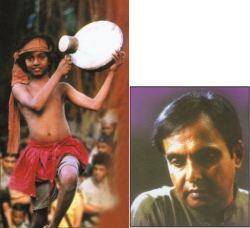
A scene from Butterfly Wings (left) and Somaratne Dissanayake |

