Monstrous parasites!
Isaac Robinson writes from Sri Lanka
When she first approached us for a job, we did not have a vacancy for our office. After I looked at her CV with a not so unusual negligence of an uninterested employer, my eye balls tarted to grow bigger and bigger. Top of her class in law school, grade A in almost all the papers she wrote. Even if it was not her academic feat, the quality in her was so evident in the very first meeting that I eventually felt the pressure to pursue my HQ to create a new position for her. Her name is "AA", a Tamil, Muslim by religion, lawyer by profession. Today attorney AA married fellow attorney "SK", the General Secretary of the Municipal Bar Association. The dowry for the marriage is seven and half lakh Rupees cash, and of course a brand new two storied house in town. Not surprisingly, the dower (Mahr) was fixed at one thousand and one Rupees. What a great sacrifice of a generous bridegroom! My way back home from the wedding place is an hour and half drive alongside the coastal lines of the Indian Ocean. Today I do not notice the beauty of the ocean or the devastation of Tsunami, I only see parasites on both sides of the road. It's astounding to see Palmyra trees gotten entirely swallowed up by parasites. Some of the parasites grow so big and strong that you will not even notice the existence of the Palmyra itself. Palmyra trees divulged by parasites often do not produce fruits. After all the years of hard work and achievements, top notch attorney AA is nothing more than a Palmyra divulged by a monstrous parasite. A parasite lives off the rich of its host without contributing anything to the survival of its host. Women in our society are surrounded by parasites. In every aspect of a family life, including and not limiting to, inheritance, raising children, maintaining home and family, handling dissolution of marriage, male dominated society wants advantage against women. Dowry is only an economic element of the whole. Dowry money is more likely to come from another man, the father of the bride. It's probably a compensation for equating woman with man. Clearly recognition of woman as human being is at the centre of the equation. However, there are indications that recognition is not the only thing in play. The determination of men to live at the cost of women, irrespective of whether they recognise women's rights or not, is also an important factor. The Sri Lankan situation exemplifies this a bit. Women there are literate, they have access to employment, the town where I live has almost as many female bicycle and motorcycle riders as male riders, and to surprise many of you, in the eastern and northern parts of the country more women hold property than men. In Jaffna, 80 percent of land properties are owned by women. Empowerment means a little when society continues to seek unjust advantages from women. In the case of AA, very few male lawyers of her district can match her qualities. As a human rights lawyer, she protects rights of other people. But when it comes to protecting her own rights, she is just another woman susceptible to repressive and degrading social practices. Two more examples are due here. LTTE has a long established practice of using child soldiers. Before the ceasefire agreement was signed in 2003, LTTE used to abduct Tamil teenagers from government controlled areas and use them as child soldiers. Only exception was that LTTE would not abduct anybody who was married. To avoid LTTE abduction, thousands of teenaged boys and adults got married. After the ceasefires agreement LTTE continues to use child soldiers, but they no longer abduct them from government controlled areas. At that point legal aid offices like ours got flooded by divorce cases. What we noticed was that many of these teenaged boys and adults who got married to avoid LTTE abduction were divorcing their wives at a wholesale rate. It becomes evident that they just used women to avoid something they did not want. Second event happened right after Tsunami. In the first six month running after Tsunami each Tsunami affected family was granted a monthly government subsistence allowance of around five thousand Rupees. The head of household received the money for the family. Not surprisingly the head of household was invariably a man. This money, though granted for the family, allowed the male household head to spend on buying alcohol. Eventually alcohol abuses and drinking related domestic violence saw the biggest rise ever in the Tsunami affected areas. This time, however, the legal aid offices were not flooded by cases. Wives are too generous to bring their husbands to the book! Lucky parasites! They can deprive wives and kids from the precious relief money, beat up their wives, but yet enjoy the blessing of the society and a de facto immunity from justice. The first example is quite interesting. There is nothing illegal in marrying or divorcing provided that the rules and procedures are followed correctly. Law can only make things worse by entering into the venture of detecting the ulterior intentions of the parties to the marriage. The London-Sylhet 'marriage industry' is probably the most famous example that we know of. How far law can intrude in personal affairs if one party with an appetite for root- culture and the other party with greed come up with a mutual solution? Neither the appetite nor the greed is illegal per se. May be law can intrude if physical force is applied to the girl to agree. Then what about emotional blackmail? Law does not have authority to stop the mother from crying or force the father to eat who vowed to starve to death until the daughter agrees? The whole issue is more social than legal. Whether you are utterly dogmatic in your belief or as enlightened as Ram Mohan Roy, law cannot punish you for your beliefs. But society can punish or reward. Unfortunately, our societies are still too primitive in relation to women's right. Imagine a Bar General Secretary in a western country taking improper advantages of his marriage. He would not only be lowered in the esteem of his peers; in a more materialistic way, his chance to get reelected in the next Bar election would be virtually zero. Good fortune for SK that when he will go to the court after wedding, he will not get any sort of admonition whatsoever from his peers. All his fellow male lawyers got dowry anyway. The only question he might face is his failure to secure a higher cash dowry. In that town (Kalmunai), the standard rate of cash dowry for lawyer is 15 lakh, and 50 lakh for doctors (Sounds like a conspiracy against lawyers!). SK got only seven and half lakh cash. He also got a house which every groom gets whether he is a lawyer or a fisherman, thanks to the matrilineal practice of the eastern coast that ties Hindu, Christian and Muslim Tamils together amidst their communal violence against each other. Surprisingly, Sri Lankan law does not have criminal sanction against dowry. In fact there is a popular saying that at marriage a bride is expected to bring with her a "house and a well". When law suppresses its own morality, society can only be expected to strengthen the interests of its dominant forces. LTTE which has established a parallel administrative, judicial and legal system in the north and the east has, however, banned dowry through legislation in their controlled areas. That can be seen as an end of one problem but the beginning of a bigger problem. The problem is with their method of dispensation of justice. Their reputation for extra-judicial killings even for issues like dowry is frightening, except that they are less hypocritical and do not try to cover the killings under the pretence of "crossfire"! Where law prohibits dowry, as in LTTE controlled areas and in Bangladesh, the practice goes on in the disguise of gifts. Social problems should be cured by the society. Law will provide the support. Social reform requires education and awareness for the widest possible section of the people, and in this context a dialogue between men and women. Did we start that process in Bangladesh? Once we are in the reform process, I am sure men will find enough reasons to give up this practice. Whether you are enlightened enough to believe in women's right or not, you would not certainly like to embrace the disgrace of a parasite life, would you? Isaac Robinson is a lawyer
|
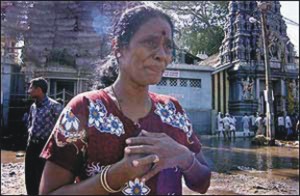
Victim of parasites! |

