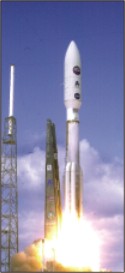
First Pluto mission blasts into space
Reuters, Cape Canaveral
The world's first mission to Pluto blasted into space on Thursday after its launch aboard an unmanned Atlas 5 rocket to begin a 9 and a half-year journey to the only unexplored planet in the solar system. "It's now our job to be good stewards of the spacecraft. and to learn to fly it in the real environment that it was built for," Alan Stern, the mission's lead scientist from the Southwest Research Institute in Boulder, Colorado, told a post-launch news conference. "The launch team did a great job of getting us on our way," added project manager Glen Fountain, with the Johns Hopkins University's Applied Physics Laboratory, which designed the spacecraft. After two days of delays due to poor weather and a power outage, the 197-foot-tall (60-metre-tall) rocket, built by Lockheed Martin Corp., lifted off at 2 p.m. (1900 GMT) from Cape Canaveral Air Force Station. The launch team remained on edge until 45 minutes later when the plutonium-powered spacecraft finally and successfully separated from the Atlas' second and last upper-stage rocket booster. The engine firings made the probe, called New Horizons, soar at more than 10 miles per second, or 36,000 mph (58,000 kph) -- the fastest man-made object ever to leave Earth's orbit. If the Apollo astronauts had been launched at that speed, the trip to the moon would have taken about nine hours instead of three days, according to Colleen Hartman, Nasa's associate administrator for space science. Even so, New Horizons, which is about the size of a baby-grand piano, will need to bounce off Jupiter's gravity field, in a "slingshot" manoeuvre that will give it added velocity, to make its 3 billion mile journey to Pluto in less than a decade. High winds at the Florida launch site forced the first scrub of the launch of the New Horizons spacecraft on Tuesday, followed on Wednesday by a storm-triggered power outage at the mission control centre in Laurel, Maryland. With an unprecedented five solid-fuel strap-on boosters, the largest expendable rocket in the US fleet sent the relatively small spacecraft hurtling into the sky and it quickly disappeared over the Atlantic Ocean. The launch sparked a small protest and was overseen by the Department of Energy because the spacecraft carried 24 pounds (10.9 kg) of radioactive plutonium that will decay over time, providing heat that the probe's generator can turn into electricity to power instruments and systems. Nasa has used the non-weapons-grade plutonium, processed into ceramic pellets, for 24 previous science missions which, like New Horizons, travel too far to tap the sun's energy for solar power. Next year, the spacecraft is expected to pick up an additional 9,000 mph (14,500 kph) when it bounces off Jupiter's massive gravity field. If successful, New Horizons will reach Pluto and its largest moon, Charon, in July 2015. Seven science instruments aboard the probe will transmit images and data back to Earth, shedding light on the bodies' surface properties, geology, interior makeup and atmospheres, according to Nasa. Pluto is the largest and best known of a relatively new type of planetary body called a Kuiper Belt object. The Kuiper Belt is located beyond Neptune's orbit, which is 30 times farther away from the sun than Earth. It contains frozen objects believed to be leftovers from the formation of the solar system 4.6 billion years ago. While not much is known about Pluto, by the time the probe arrives, scientists may have a better idea of what to look for. A capsule containing samples of a Kuiper Belt-formed comet were returned to Earth on Sunday. "For all the ideas and theories that people might have, we have some real ground truth," said University of Washington's Donald Brownlee, the principal investigator for the so-called Stardust mission. "We have some actual samples of the material that the solar system was formed from," he said. In a symbolic gesture Stern, the Pluto mission's lead scientist, said ashes from the cremated remains of Clyde Tombaugh, the astronomer who discovered Pluto in 1930, had been placed aboard the New Horizons spacecraft. Tombaugh died in 1997 when scientists were still working to win approval and funding for a Pluto mission.
|