Right to fly
Photographs of birds in Bangladesh
Fayza Haq
The recent exhibit of coloured photographs, called Right to fly by Dr. Reza Khan, seen at the Photo Journalists' Association was admirable indeed. It brought together the pictures and habitats of the 700 species of birds that live in our country and visit it from time to time, specially in winter. Half of the birds, Dr Khan says, are visitors. "Putting aside professionals and regular bird-watchers, one sees less than a hundred species of birds in residential areas, countrysides, wetlands, and brackish water environments."All these birds, he says, are, in one way or another, useful to us, as they eat insects and harmful animals such as rats and mice that ruin crops, fruits and gardens. These birds, he says, pollinate our flowers and scatter seeds of crops and fruits that are vital for us. He says that birds are very important entries in zoos and form a vital part of our environment. Their importance, and beauty, in short cannot be belittled or ignored." The birds' numbers and species are fast disappearing. So in order to preserve them the exhibition was being held to raise awareness of the birds' visual beauty and importance. The photographs were of a good quality although they may not have held a quality of remarkable excellence, judged on an international level. However, the number of entries and the detailed information about the different species surely required the knowledge and patience of an academic. The exhibit was a labour of love. And "love's labour" was not lost. Birds of exotic and conventional lure have been depicted in the display. These include the jade and jet-black presentation of the Java peafowl, which has been locally extinct since the 1940s. Its wings, breast and head tuft have been shown in close quarters with the details of the jewel like spots on the feathers that appear like some dazzling gems from some legendary treasury. The jade green waves that surround the common teal has brought in the steady semicircular waves of the quiet water that hold up a gray, white and black bird. It has a graceful neck and beak, with its wings neatly folded. Thus the photographer sees art in the simplicity of nature. The Crimson-breasted Barbet, which is found both in towns and the countryside, has been shown as merging with the foliage and branches of a leaf-laden tree. The tiny bird, with its copper crest and rust-colured flecked head. The Avocet-Sandpiper with its curious upturned bill, the Ruddy Ternstone with its strange short legs and small, rounded brown and black body, along with the Sanderling, another migrant bird that visits our shores in sinter ,with its slender bill and jet-black legs, have been capture with care and an eye for detail. The three pictures bring in the waves and marshes in all their lyrical details. Viewers came away overwhelmed by the precision of the photographic details of the carefully collected images of our local birds.
|
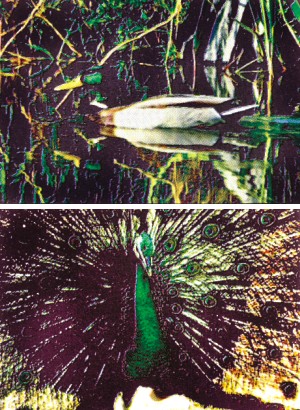
Neelshir(top), Green or Java Peafowl(bottom) |

