Short Story
Time Out
Neram (translated by V. Surya)
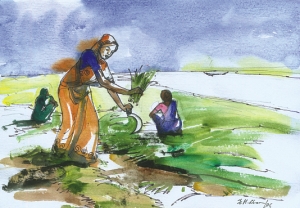
She felt uncomfortable all over. The touch of the sun overhead made her whole body feel sticky. She loosened the end of her sari and mopped herself.Sullen with the tedium of planting, her mind would not run along with the teasing chatter of the women working in the rows nearby. The landlady who owned these wetlands sat under the neem tree near the well, her legs stretched out. How could any creature sit all day in one place like that, as if hammered down into the ground? One woman asked, "What, Annaamalai, looks like you're thinking hard about something." She scratched herself where the murungai weeds had poked her and raised an itch. "Thinking! What's the use of it?" 'No use..." Another cut in. "Why, di, are you pregnant?" "Who knows? Could be..." "Baby's not even sitting up yet. Fine thing it'll be if you start being sick all over again." They all snickered. The fields were criss-crossed with rows of women, as though hung with festoons. Down by the canal, a row of palmyras stretched all the way to the upper irrigation channel. There, too, swarms of women moved about in the low-lying fields. Having let the water into the channel, a farmhand descended the slope of the bank. On the way down, he went past the sari-cradle she had slung on the branch of a blackthorn tree before he turned away towards the main canal. He wouldn't have gone off without telling her, would he, if the child had been crying? She felt a gush of milk. Her breasts tingled and turned hard. It had started to hurt a little. Shaking off the earth from her fingers, she tightened her bodice and tucked in her sari-end. The wind helpfully rocked the cradle hanging from the thorn-tree. The baby thrust his small hand out of the hammock. It swung with the wind. Look at that boy---so deeply he's sleeping! Does he sleep like this in the house? All night he sucks me dry! A fine rascal he is, lying there now like that! She pressed down one breast and squeezed it with the palm of her hand. The swollen veins loosened. The pain began to subside. She had drunk her gruel only at midday, suckled the child and laid him down. Yet it was oozing again already, as though she had gorged herself on a rich meal of rice and oil. If it had been like this for all the babies, how easy it would have been. The trouble she had had with the first boy! By the time he was four months old she had had to feed him a solid meal of rice. That was how she had pulled that floundering child ashore....It had been like that for the second, too. A girl. And yet, there had been no want of food or drink in the house. Every ten days, gingelly oil and dried fish would arrive from her parents' house. How much they've spent, buying things for us! This little fellow....it was after he made his grand entrance into the world that their palms had forgotten the feel of money. However much one laboured there was never enough even for food. With two hungry children there had to be gruel in the pot all the time. The shame of it... It was only because they really needed the money that she had picked up her tender sprig of an infant and come here. For days none of them had had as much as a drop of oil for the scalp. At least one should be able to buy some coconut oil. No point getting angry with the husband for such a thing. What could the man do? He sets off at dawn, spade over his shoulder, and returns only at day's close. No particular kind of work, just anything he can get. Not even one day can he stay at home and rest his legs. That's the way it's turned out for him. If she could get four or five days of continuous work it would be some kind of stopgap. For the few rupees she pays, this lady gives a whole lot of trouble. She won't let her move a bit this way or that! Never heard of such a thing anywhere---here in these parts or anywhere in the world. Why, the very first day she had said, "So, di, is that child in the cradle yours, Annaamalai? As if you'll do any work!" After a couple of days when she wanted to go home before evening had set in, the lady grumbled, "Isn't it just as I said that day itself? Right in the beginning I should have got rid of you...All right, finish the rest of that row and then you can go." How will that creature understand how things are? Once she's finished her midday meal, she sits down under the neem tree, stretches out her legs and dozes like a queen. Does a raven care about sharing work, or paying taxes? All right. So that creature's like that. But what about these women working right by her side? Shouldn't they know better? All they can do is giggle and gossip. Not one has the least worry about her own house and family. As though there are sacks bursting with grain heaped up in their houses! None of them speaks a word of support when she tries to leave for home in time. they actually scold her for it. "Why now? Might as well finish what's left," they say, beating time to the landlady's tune. As though they're the landlady's very prop and support! But is there no limit to the work done, the time spent? When it's too dark to see by, how can she say, "Go on, pull out those murungai weeds!" Why, those weeds have sprouted and just grown into a jungle in this field! Instead of all this drudgery now, she should have had the field properly ploughed without grudging five or ten rupees' wages. How can work be done for nothing? Only after washing and wiping off all the murungai sap can she touch her baby and pick him up. How it pricks and stings! Shouldn't there be some light to see by at least to wash it off? If she could only leave a little earlier, she could attend to supper and appease the little ones' hunger before they fell asleep. If not, they would all sleep off, huddling like chicks, each in a corner. To wake them up after that and to make them eat even an couple of morsels was a big job. And how could she eat without feeding them? That's no way to live---the gruel she drank wouldn't stick to her flesh, would it? It wasn't as though these females didn't have infants in arms. They would all have left their babies with their own youngsters. And poor things, what could those children do? Could they stop the little babies from crying and crying? Could they stop the tiny bodies from drying out utterly? Only at the end of the day could this woman next to her go and put a stop to her baby's wails. If only she could go home once in the afternoon, but no. That couldn't be. Going home in the afternoon makes a working woman lazy, it seems... The sari-cradle in the thorn tree is still. The breeze has stopped, and the scattered clouds have darkened and come together to obscure the sun. It's like that sometimes in the month of Purattaasi. All the wind has to do is to whistle a bit, and a whole lot of rain comes pouring down, ruining a day of work and wages. Afterwards when the sky opens out, and flashing sunlight strikes, the blades of grain spread out like peacocks' tails, the raindrops tremble and roll down them, like stones coming loose from a nose-jewel. Something tightened and clutched at her chest. That and the sudden drop in the heat set off a furore within her. She gave a long, yearning sigh. Every one looked up, wondered aloud if it would rain. If it did, there wouldn't be a full day's wages. Just half. The thought of rain worried her. There wasn't even a well-grown tree to huddle under. She must run and pick up the child, and untie the sari-cradle before it got wet. It was going to rain for sure. At midday when she had picked him up and played with him for just a little while, the landlady had sharply ordered, "Ei, di, keep all that for when you're at home! You can sit back and stretch your legs and dandle him all you want then!" That did something to her heart. "Why, amma, you won't let me sit down even for a little while!" she retorted. "You can talk like that--what's it to you? The one who has to shell out the money, note after note, she's the one who feels the pain, no? Can't you see, the women with you have all gone back to work?" She had put the baby back in the cradle in a hurry, without rocking it, and had gone back into the field. The child's screams could be heard until she got across the irrigation ditch... All that crying has tired out the child so much, he's still unable to wake up. She moved on ahead. "Ei, Baagiyam, your baby isn't even six months old--how can you just leave him and be easy in your mind? At least once in the afternoon if you could feed him and be with him, it'd be better for the child." Baagiyam shrugged. "Enough if I feed him a lump of gruel--he stays quiet. All the rest of the time I'm feeding him milk anyway." A light breeze set in. Freed of weeds, the transplanted paddy stalks waved easily, in broad arcs. Once again the clouds scattered and made way for the sunlight. The expanse of fields on the slopes of the canal-bank could be clearly discerned. She would tell Baagiyam to do her row as well, she thought. Then she could take her baby and go. But even if the transplanting went on without a break, it wouldn't satisfy the landlady. Not until she let fall a couple of curses, tossing her head to shake her gold earrings, would that heart of hers cool off. When she scolded, her otherwise full-featured, complacent face would suddenly lose all its good looks and appear much older. And the others would grumble and mutter, "As if she's the only one who's ever done such a wonderful thing--giving birth to a child?" Again she felt an unbearable discomfort. Chee....she thought, despairingly. She rose with a jerk and went down the slope of the main ditch. There she crouched in the privacy of an aadhaala bush pretending to pass water, and uncovering her two breasts squirted out the milk till the pain stopped. Then she came back and joined the row. Having woken up from her nap under the neem tree the landlady walked over and made a piercing remark, "Di, Annaamala! You took so long you might as well have strolled into town to urinate!" Bored silly with fieldwork, the women all laughed in one voice. Vehemently she quelled them, "What's so great to laugh at? Laughing without any shame!" Her eyes were wet. Neram is a Tamil short story writer. V. Surya is a noted translator of Tamil fiction.
|