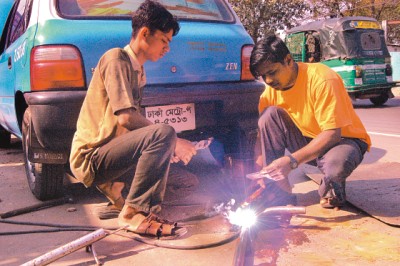
Law against welding on streets ignored
Novera Deepita
Welding has been a common practice in the roadside workshops and under-construction buildings in the city despite the fact that existing laws restrict such activities in the public places and residential areas.Selina Raihan, a student of North South University, said: "Welding is a common public nuisance in buildings under construction on Kemal Ataturk Avenue. The flames caused by welding can hurt us any time when we pass through the road." "It is unbelievable that the authorities concerned remain silent about such illegal practices on a busy road," she said. There is no data available about the number of accidents caused by welding, but according to Penal Code 1980, such activities are considered as public nuisance. Section 268 of the Penal Code 1980 says: 'A person is guilty of public nuisance who does any act of an illegal omission which causes any common injury, danger or annoyance to the public or to the people in general who dwell or occupy property in the vicinity, or which must necessarily cause injury, obstruction, danger or annoyance to persons who may have occasion to use any public right.' Bahreen Khan, a senior advocate of Bangladesh Environmental Lawyers Association (Bela) said: "The owners of the multi-storey buildings, shop owners and construction workers are well informed about the law. But they are still doing it because they usually get away with doing it by paying a little amount of fine that is not more than Tk 500." "There is hardly any strict enforcement of these provisions of the law that ensures punishment of such public nuisance. An amendment is a must for the Penal Code because the punishment of such crime is as little as Tk 50," she added. Health hazards from welding, cutting and brazing operations include exposures to metal fumes and ultraviolet radiation. Safety hazards from these operations include burns, eye damage, electrical shock, cuts, and crushed toes and fingers. Many of these can be controlled with proper work practices and personal protective equipment. But most of the people involved in these jobs are either unaware of these hazards or reluctant to follow the law. Momena Haque, the owner of an under-construction house, said: "It is very expensive and troublesome if we take our doors or windows to any other places for welding. It is convenient for us to do the welding in the building." Monir Hossain, the owner of an open welding shop in Dhanmondi, is involved in this business for the last 22 years. "I know welding in open places is against the law but I don't have any choice. I have to do it at my roadside shop like all other welding shops in the city. I cannot afford an enclosed place for welding." "The house owners or pedestrians never gave objection. I never paid any fine because no accident occurred in my shop. I gave my employees special glasses and helmets for protection but most of them are reluctant to use them," he added. A high official of Dhaka Metropolitan Police, on condition of anonymity, said: "To ensure the implementation and enforcement of these laws we need more manpower. We have many more serious offences to check. So, it is difficult to check all these trivial crimes or disorders with the insufficient number of manpower."
|