Short Story
Family Pride
Julie Reza
It was one of London's grey, dank, end-of-summer evenings. The rain had drizzled all day, and weary commuters crammed onto the underground, feeling tired and miserable. Minu, tall, slim, and clad in a simple top and designer jeans, squeezed on the train just as the doors were about to shut. She looked around the carriage for somewhere to sit--without luck. Groups of people leant against the doors and hung onto the rails, resigned to standing-up for the length of their journeys. Out of the corner of her eye, Minu noticed a man putting away his spectacles and fidgeting with his bag--a sure sign that he was getting off soon. Years of commuting had taught Minu to be alert if she wanted to sit. She nimbly manoeuvred past the lucky people with seats, carefully negotiating the bags and legs of those who were standing, so that she could hover near him. Sure enough, the man descended at Holborn. Minu sat down. Good, now she could get the few minutes shut-eye that she desperately needed. She'd been partying all week. Tonight, Friday, would be no different. Yesterday she'd met up with her old college mates, and had been persuaded to go clubbing until the early hours. "I'm getting far too old for that sort of behaviour," she ruefully thought. Those undergraduate days were long gone! She now had a 9-to-5 job at the BBC. Admittedly she didn't have a mortgage yet--and marriage still seemed a couple of years off. But she sensed she was getting ready to settle down. Anyway, first things first, she needed to close her eyes and mull over what she was going to wear tonight. It was her brother's 35th, and her family were throwing a bash at 'La Maroush' a trendy little Moroccan restaurant in Marble Arch. From there, she and her friends would head onto a bar in Mayfair. Minu's brother was seven years older than her, an age difference that Minu would like between her and any boyfriend. In fact, she had someone in mind--Nasir, her brother's accountant friend. She'd noticed him looking at her once, and reckoned there was something there. So, what to wear? A silky, red, sleeveless dress, with the black Versace shoes she had bought at Selfridges's sale? Maybe with the jet necklace that her jewellery designer friend had given her? Simple, chic and understated. Definitely no gold! That should make her stand out from all the other Asian babes that would be at the party. Idly, Minu thought of how proud she was of her parents and their achievements: they were educated, smart, well spoken. They knew how to behave with her English friends and their families. Although her mother had started to wear a shalwar-kameez she usually wore simple western suits, always with a bright coloured scarf, a token acknowledgement of her ethnic roots. Only when attending Bengali cultural events was sari preferred over suit. Minu's dad, Masood, was a solicitor who had made a very comfortable living in a city accountancy firm. Her mother, Anika rare for an Asian woman of her generationhad her own interior design shops, set up with her own family inheritance. Minu's dad had come to the UK in the 1950s with a prestigious scholarship to study law at King's. Her grandfather, a district commissioner in one of the larger cities of then East Pakistan, had also been generous with his allowances. Thus, 15 years later, when Minu's grandparents eventually found a pretty young graduate from a good family background for their son to marry, Minu's dad was set up very well--with a comfortable job and his own four-bedroomed house and car. Married 'back home', Minu's parents were settled back in England within a few months, and Minu's mum soon became pregnant with Minu's brother. English had always been spoken at Minu's home. The family bookshelf had held Wordsworth, Keats and Hardy, interspersed with a Tagore or contemporary Bengali writer. Classical western music was encouraged, although the Indian classics were not neglected. Both Minu and her brother had gone to private school--her brother had even been a boarder. University was taken for granted. Minu had graduated in Fine Art and History from Goldsmith's; her brother had studied law and then done an MBA at LSE. The train trundled along, getting quieter as passengers left. Minu was finding it hard to keep her eyes shut without falling asleep. The air was damp, and there was the strange smell of umbrellas that hadn't had a chance to dry-out fully. She opened her eyes and idly glanced around at her fellow travellers. Those opposite were asleep--some with their heads hung forward, others leaning against the back or side. Minu glanced sideways, at the people sitting on the same side of the train as her. A teenage couple, and next to them a blonde, young mum, with a small baby barely visible as more than a bundle of blankets. At the end, sat a couple of Asian men--no, a boy and elderly man. The man had an orange beard and hair. He wore an ill-fitting checked jacket and crumpled tie. The boy looked nervous and awkward. She immediately recognised them as Bengali like her--but dissimilar in every other way. Minu knew what type of family they were from! She even knew the origins of the bizarre, carrot-shaded beard and hair--henna! She looked at the young boy. There was faint fuzz above his lips. He must be fourteen or fifteen, she mused. The man was clearly his father. "From the type of family who have children when they're young," she thought (and grimaced)--so she reckoned the boy probably had lots of older siblings. She noted the boy fidgeting, constantly looking uncomfortable. Probably had a telling off from his dad, Minu supposed. Yes, the man looked like a strict, authoritarian father--"hmm, typical"--she almost spat to herself. The man looked grim, and every now and again murmured something to the boy. Yes, Minu knew the type of family. Uneducated, living in a council flat--probably getting all sorts of benefits (thanks to tax-payers like her, she thought). The mother would be at home, sari tucked in at her waist, cooking and clearing up after her squad of children. She could imagine the home: ghastly patterned carpets; plastic mats and protectors all over the place. The kitchen would be caked in sticky grease, some sort of curry constantly on the boil. The bathroom would be damp from the constant drying of towels. The children would be taken to school every day--but to no avail. Although encouraged to learn, they'd not be not given the 'proper environment'. That was especially true for the daughters--doubtless expected to cook and clean; probably discouraged from mixing with their western schoolmates, prevented from attending after-school classes. Minu looked as closely as she could at the man and boy. With pity? No, she had to admit to herself, with disdain. "These are the people that give Asians a bad name," she thought. "Why couldn't they try to improve themselves?," she wondered. After all, they were exactly like her parents--immigrants. Why couldn't they have adopted the new country and its ways, in the way that her parents had? And what galled her most of all--why did this man insist on having that ridiculous colour of beard? "Doesn't he know what people think of him?" she wondered. She exhaled deeply. Thankfully, she wasn't that type. They made her feel embarrassed to be Asian. She looked around the carriage again, at the teenage couple, at their pierced noses and ears, at the young mum, at the sleepers, now gradually waking one-by-one, and hoped that when those people looked at her they wouldn't think she was from a family like that. ***Meanwhile Abeer shifted in his seat. He wasn't happy. In fact he was feeling desperately sad. Having his father sitting stiff and prim next to him made him feel even worse. Every time Abeer moved, his dad looked at him, and murmured. They'd had a long day. His dad had been wearing that best jacket and tie of his all day--instead of his usual looser clothing. They'd set out at nine that morning. It had been drizzling even then. Getting caught in the rain was probably what had made Abeer shiver so badly at the hospital. Or at least that was what Abeer had told his dad. Abeer had been in and out of doctor's surgeries the last few months. He'd had fevers, and had been feeling weak and sick. He seemed to be losing weight, and his mum had insisted that his dad took him to see the doctor. Blood tests, biopsies and scans had been done. Today he'd had another appointment with the specialist. As Abeer was only fifteen they'd suggested his dad accompany him. Abeer didn't really understand why--his dad's grasp of English was extremely limited at the best of times, and he certainly wasn't familiar with medical language. Even Abeer, born and bought up in England, didn't understand everything the doctor mentioned when Abeer had asked about the test results. Hodgkin's disease--what was that? Lymph nodes--what were they? But, nevertheless, Abeer had understood enough. He knew what cancer was--well, not what it was, but its significance. And he knew what the doctor had meant when he'd pulled up a chair opposite Abeer, gently touched his forearm, looked him in the eyes and quietly sighed "Abeer, I'm sorry, it looks far, far more serious than we had hoped." Thankfully, his dad hadn't been paying attention just then. His dad had just nodded quietly throughout the consultation, even when the doctor had asked if he had understood everything, even when they'd had the meeting with the counsellor. Both professionals must have thought Abeer's dad was a reserved man. They were probably relieved that they didn't have to deal with any heavy emotions. They knew what Asian relatives could be like. After the consultations Abeer had taken his dad aside in the waiting room. Quietly but clearly, he explained in cockney-accented Bangla: "Baba, I have an......an allergy...... a very bad allergy to some". foods. This means that I will be sick a lot.....but the doctor will give me medicine and treatment. At first some of that might make me sick too. But they say I will back to normal health in just a few.....months. Do not worry Baba." Abeer's dad had nodded. He placed his hand on his son's thigh and said "I understand. Son, you must explain to us what the doctors said about your allergy. You are a smart, educated boy. You must tell us what you can eat. Your mother will cook whatever you need. Tell us whenever you feel unwell--your sisters will look after you. We pray for swift recovery. Any pain that you feel, your mother, sisters and I will feel too." They had got onto the underground for the journey home. Abeer, desperate to get back home to his mum and sisters, thought about death. His dad had been quiet, ruminating over Abeer's words, every now and again turning to his son and to say: "Tell me son, will you still be able to eat chicken?"......"Tell me son, can you tolerate spice?" Abeer turned away. Maybe he'd get closer to his elder siblings: the siblings whose death had devastated his parents; the siblings whose footsteps still trod through the life of his family; the two brothers and the baby sister that had died in the Bangladesh famine of '74. His parent's had been poor village people then, with no schooling or education. They'd lived off the land, not needing pencils and paper to tell them what, or when, to plant. Heartbroken over the deaths, the couple had left when a distant relative suggested they come to England, where Abeer's father could work in the kitchen of his restaurant. Abeer's mother could learn to sew, and stitch things from home. They could borrow the money for the trip from family and friends. That was what they did, their extended family accompanying them all the way to the airport in the capital, standing silently, as the plane with Abeer's mum and dad took off for a new land. Once in England, Abeer's parents had found themselves overwhelmed and homesick. But it was their chance for a second life. Fellow countrymen rallied round, and they found work. They toiled hard, saved money, learning from the many others that had settled before them. After a while Abeer's mother became pregnant, but miscarried. Many more years passed before, eventually, Abeer's parents had more children--Amrin, Abeer himself, then Anwara--and they had learnt to be happy again. Abeer, their boy, grew up to be polite, and, according to his teachers, clever too. The girls were also clever, although mischievous. "Maybe they will go to University and become doctors," Abeer's dad would always comment. Abeer could pave the way. They could find him an educated wife, and they would be looked after in their old age. Everything seemed so settled. They had a future of hope. This 'land of opportunity' certainly had been that to them--and they were grateful for that. They had become a complete family, with everything a family needed, or could ever need. Abeer shifted in his seat, and looked around the carriage, not really seeing anyone. The tears were in his eyes, but he had to hold them back. He thought about his family--how wonderful they were. And he thought of how proud he was of his parents and their achievements. Julie Reza is a doctor/writer who lives in the U.K.
|
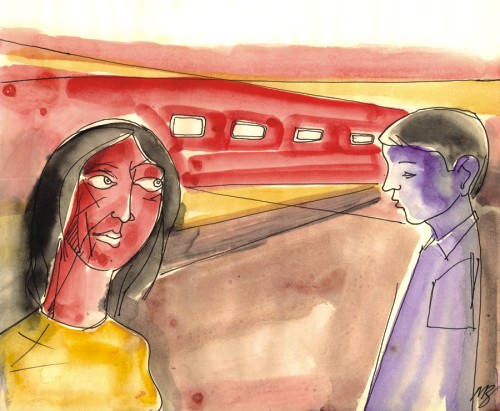
artwork by mustafa zaman |

