Dance recital
Shovana Narayan's Kathak spellbinds audience
Karim Waheed
The term Kathak means, "narrating a story". One of the oldest, yet thriving dance forms, Kathak originated in northern India. It was originally performed by communities of people called Kathakaras or story tellers.These bards, performing in village squares and temple courtyards, mostly specialised in recounting mythological tales from the scriptures, and embellished their recitals with hand gestures and facial expressions. When the patronage shifted from the temples to the royal court, there was a change in the overall emphasis. Since then, through the ages, Kathak has been evolved by several talented dancers. Padmashri Shovana Narayan belongs to this group of immensely talented artistes. Shovana Narayan and her group performed at the Osmani Memorial Hall, Dhaka on January 31. The dance recital was presented by High Commission of India, Dhaka and Indian Council for Cultural Relations. Prior to the event in Dhaka, Narayan and her group performed in Rajshahi and Chittagong. Narayan's career spanning several decades has seen her mesmerising audiences worldwide and she has been honoured with several awards. She received the Padmashri Award for excellence and her outstanding contribution to dance in 1992. Among others, the Sangeet Natak Akademi Award by the President of India (1999-2000) is noteworthy. She has written eight books on dance and is also a visiting lecturer to several universities in India and abroad. The auditorium was packed with ambassadors of different countries, noted cultural personalities, dance exponents and enthusiasts. Narayan's group that included Afsar Mullah, Dharmendra Gautam, Urmi Mishra and Sangeeta Srivastav, started the show with a composition titled Om -- ancient verses written by a scribe, Ravan. The composition narrating the cosmic creation and Shiva's Tandav (dance of destruction) was enjoyable. After a brief instrumental prelude, Narayan made her dramatic appearance. Besides dancing, the danseuse seemed to have another talent -- quick wit. As she was speaking to the audience in between dancing, she was having trouble with the microphone. The poised diva smilingly said to the sound engineer, “Even I don't have any clue when I'd like to speak; you best keep the mike on throughout the evening.” Greeting the audience in Bangla, Narayan said, “I'm here after 13 years and the warmth I've received is still invigorating.” A noticeable feature in Kathak is the complex and often fast rhythmic footwork. With the aid of ghungroos, a skilled Kathak dancer can express a lot through the footwork. And that was demonstrated by Narayan as she enacted different sounds of nature -- sounds of a horse running for instance. The audience was mesmerised. Narayan also acted out Kamadev with his bow and arrow, Shiva with his mridanga (rattle drum) and half moon with the help of seasoned musicians accompanying her. Her stances delineating rolling clouds, thunder and rain were awe-inspiring. The highlight of the evening was two dance compositions narrating mythical stories -- Draupadi's Vastraharan (disrobing) and Buddha's renunciation from Yashodhara's perspective. With intense and subtle facial expressions, eloquent gestures, intricate footwork and tahai (a spinning movement in one spot at great speed), Narayan became the Pandava queen and the wife of Gautam Buddha. She flawlessly embodied emotions of joy, fear, grief and divine blessing. Shovana Narayan's performance was a delight to dance exponents, dancers and enlightening to those who do not have a great understanding of Kathak. The art lovers would certainly appreciate more events like this.
|
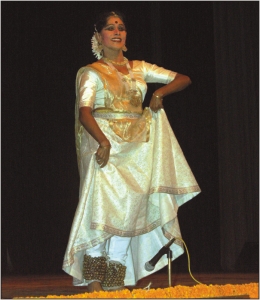
Shovana Narayan evokes sounds of nature with her ghungroo, Photo: K Waheed |

