Alluring show-tunes of by-gone days
Syed Abdul Hadi
It was an early October day and I was passing by a busy London supermarket area, when the mellow tune of a flute tantalised my ears. I could not but stand mesmerised, till the hypnotic melody came to an end. I can't express the feeling in words. A feeling of nostalgia overwhelmed me. I looked around and found two young South American musicians playing on their indigenous flutes. I approached them and asked if I could get a recording of the tune they had just played. They handed me a CD and told me the composition is called By-gone Days. I gave them ten pounds in return and was in a bliss that could only be expressed in the universal language of music. This is the power of music! Music triumphs where language fails, and this, in particular, is the role of music in films. It has to express the particular mood of a sequence where the dialogues fall short. Unfortunately, our filmmakers had never properly appreciated the basic role of music. They have always indulged in exploiting music to "fill up the void"; ignoring the fact that silence sometimes is the best music. Of course, there are exceptions, depending on the merit of the director of the film and the music composer as well. Directors like Fateh Lohani, Khan Ataur Rahman, Zahir Raihan, Amjad Hossain, and Sk Niamat Ali are some of those who could use music to create the desired expression and also to add to the aesthetic quality of their films. In 1956 our first feature film Mukh O Mukhosh was released. Despite its shortcomings, it was hailed and heartily welcomed, as it could overcome so many hurdles, including lack of technical facilities and artists, etc. Samar Das, one of our pioneering music composers, scored the music. Even a music director of his stature was criticised at that time for not being able to be selective in using proper musical instruments in particular sequences -- he used electric guitar in a scene highlighting a village with paddy fields all around. Maybe there was no other alternative available to him at that time as there were very few musicians to choose from, let alone an orchestra group. Nevertheless, the songs of the film were melodious and attained immense popularity and appreciation. We all know that songs play a vital part in our films and seem to be inseparable from the filmmaking formula of the subcontinent. This is perhaps due to the influence of opera to which our filmmaking owes its ignition. This is not unusual, but the problem is, we have not been able to salvage our filmmaking from that tradition as a distinct media. With the exceptions of a very few, our films are more opera than movie even to this date. Indiscriminate use of songs, continuous and irritating music from the very beginning till the end has been the dominant trend in our films. It is not unusual to get a headache if one ventures to enjoy a film till its end. Nevertheless, there are sparks of excellence yet in this dismaying situation. We may remember some memorable songs like O amar chokkhu nai in Fateh Lohani's Asiya, Achhen amar mokhtar and Hayre kopal mondo in Amjad Hossain's Golapi Ekhon Train-e or Shoachan pakhi in Humayun Ahmed's Srabon Megher Din -- which are a few examples of what emotional and aesthetic effect can be achieved by proper use of songs in films. Some of the best examples of situational songs in films are perhaps Satyatjit Ray's Pather Panchali where he aptly used a traditional song Haire din to gelo shondya holo, paar koro amarey to create an atmosphere of the ultimate tragedy of human life. Similarly, we may remember The last post played on trumpet by a fellow soldier at the tragic death of his friend in a combat in the famous film From Here to Eternity. Many such examples can be cited from memorable international films. Apart from our heritage of folk songs we also have a rich tradition of lyrical or poetic music (kabbya sangeet). Our composers, lyricists and singers, all have put their best to add to this genre. Lyricists who have made a mark during the 50s to 70s were Professor Abu Hena Mustafa Kamal, Professor Md Muniruzzaman and poet Shamsur Rahman. Songs such as Amar prothom dekha shey khon tirey written by Abu Hena Mustafa Kamal and sung by this author, gained popularity; Mir Kasem Khan composed the song. Ami shagorer o neel penned by Abu Hena Mustafa Kamal, composed by Abdul Ahad and sung by Ferdousi Rahman is a classic. During the late 60s Md Rafiquzzaman, Gazi Mazharul Anwar and Nazrul Islam Babu attained popularity as lyricists; they continue to enthrall the music aficionados to this date with their creations. Composers like Abdul Ahad, Samar Das, Dheer Ali Monsur, Abdul Latif, Khandakar Nurul Alam, Subal Das, Sattya Shaha, Altaf Mahmood, Ali Hossain are the pioneers in creating an original style of lyrical music in Bangladesh. After the Liberation War, Alauddin Ali, Alam Khan, Sheikh Sadi Khan, Ahmed Imtiaz Bulbul and others introduced a new trend in music composition. Songs or lyrical music have always been more popular than classical or absolute music in this part of the subcontinent, which Tagore had also observed in his writings on the mass taste in music in Bengal or Bangla speaking people. In fact, Bangladesh could be proud of reigning over the musical arena of both Bangladesh and West Bengal as a whole during late 60s and 70s in respect of quality, quantity and creativity. The author is a renowned singer.
|
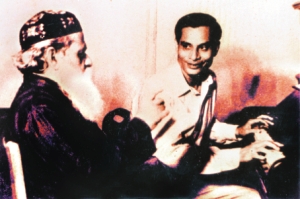
Abdul Ahad (R) with eminent litterateur Dr. Muhammad Shahidullah |

