Profile
Chandra Shekhar: self-effacing but self-assured
Fayza Haq
Self-effacing but determined, Chandra Shekhar, who has amazed gallery viewers and connoisseurs over the decades, revels in making excellent pen-sketches and oils. He has not known easy accolades like some of his Bangladeshi contemporaries, who prefer to paint overseas. He continues to toil and struggle in his own country and goes in to do a stint of commercial work every now and then, to bring home the bread and butter. He has been a "friend, guide and philosopher" to many successful artists at the Institute of Fine Arts (IFA), Dhaka University, and yet gives credit to his mastery in paintings and sketches to his teachers at IFA. He has gone on to do bold experimentation, believing that art must progress, and meet the demands of the time. He has been in quest of a soul pitch in his creative art for ages now. Before entering the Department of Fine Arts in 1976, he used to copy images from calendars and billboards as a child. He was also motivated by the fascinating rickshaw art, which he viewed around his house in a nearby garage for vehicles. Again, when he found reproductions of artists like Pablo Picasso and other world-renowned masters, he reproduced them ad lib. However, Chandra Shekhar says he has no particular favourites in masters -- either in the west or east. He says that he is motivated by any good artwork that stirs him, irrespective of its acknowledgement by critiques or viewers. Today, when he has seen the Louvers, Tate, Pompadour and other European and Asian galleries, he still feels that when he mused over the reproductions as a child, the impact was more breathtaking and bewildering. "My reaction was that artists in our country, were and still are equally powerful," he says, "For good art a necessary environment is requisite. This can exist anywhere in the world. The factor that shapes art is the socio-political situation, I believe. The Liberation War, e.g., ushered in some of the finest work, such as that of Shahabuddin. Religion too guides art, as we know that non-figurative art tends to prevail in the Muslim world. Zainul Abedin, for instance, went into abstract art, as he dwelt during the Pakistan days. Murtaja Baseer received rave reviews for his figurative art." Meanwhile, the rickshaw painting of his time (when only brush and oils are used) also aroused his penchant for daring choice of colours and lines. Chandra Shekhar says that he was not into sophisticated art orientation "as are some of the artists who have their origins in the bourgeois or upper echelons of society," as he puts it. He was, however encouraged and egged on by his elder sister, Maya Dey, who had creative and intellectual contacts in the capital city, when he was a child in Chittagong. As for his assessment of the state of art, today, in the 21st century, he believes that there is not much individual beauty in it. He says that one artist tends to copy another. "We do not necessarily have much genuine feelings, philosophy or drive," he comments.
|
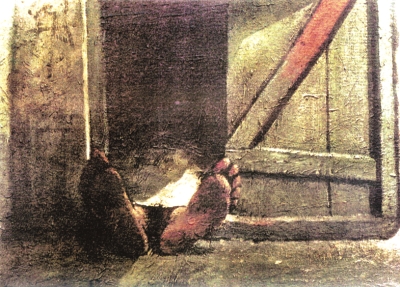
Bangladesh 1971 |

