Short Story
Culture
By Syed Waliullah, (translated by Asrar Chowdhury)
Seeing that it was pouring rain outside Kamrul Hassan folds his legs under him, sits down, lights a cigarette and says : So you have to understand, this culture thing seems to have a smell that hits you in the nose. And that smell isn't the fragrance of rajanigandha or hasnahena , but rather like that of limes. And the colour? The colour isn't as lustrous or eye-dazzling like, say, a Basra Rose, sunflower, or the Red China Rose, et cetera, or even of that genre; it is rather very much like the brilliant azure sky on a moonlit night.Saying this, Kamrul closes his eyes and puffs hard on the cigarette. Today the gathering has failed to pick up steam; due to the sudden rain hardly anybody has shown up. Still, Kamrul is lucky that Russell (Rasul) has turned up. Rasul's name is now Russell because of his frightful crush for the church. And this love doesn't stem from affection for the magnanimity of religion, or from an appreciation of the church's beautiful hand-engravings it stems from the attraction he feels towards female churchgoers. When all the dark and plump female native Christians head for church on Sunday, then Russell--his hair cut short, wearing a clean suit--also hurries to join them like a devotee choked with emotion, and there is never be any exception to this rule. Till now, it hasn't been possible to figure out which one of these large, dark women has tamed him, and he also keeps this issue concealed. According to some, he's still casting an eye around, but hasn't been successful till now, the reason being that in his eyes all of them are pretty; none is less so than the other. Russell listens to this explanation of culture and remains silent. He always has a terrible yen to listen to big matters, but after listening his heart would tremble in fear. But even though he fears it, he still listens, listens with a studied patience. In fact, he is a veritable mountain of patience. Kamrul opens his mouth again after a little while, and says: Pascal, the humanist intellectual, said that the history of the world would have been written differently had Cleopatra's nose been a little smaller or a bit larger--Oh! Russell?
-Yes, Russell responds in a low voice
- Do you notice the affinity between culture and Cleopatra's nose?
- No. Russell pauses, then replies in an even lower voice
- This culture thing is so astonishing that if there's even a hair's breadth deviation, it turns into something totally different. Understand?
- My God! Yes. It really is terribly delicate. There is amazement in Russell's eyes and his heart fills up because he has been able to pronounce on something. Kamrul smiles on hearing this, and closes his eyes again. He has finished what he had wanted to say. The next day is Sunday. Russell is present at the church on time. It would be better to call it a warehouse rather than a church. At its top, a piece of iron looking like a plus sign bore the only sign of Christianity (and even that was a bit crooked). Yesterday's 'culture' word is still spinning in Russell's head, and making his whole being shiver, and he keeps thinking: My God! How delicate it really is. But that was all--he cannot go beyond that thought. It is as if his mind can't proceed any further, and would suddenly lose itself in thin air. In the meantime, many women are coming in, none of whom looks at him; but today he is too absorbed with culture to even notice whether they are looking at him or not. And yet, repeatedly, through a hundred such cultures, a single thought pokes at a corner of his mind, and which is that he's been coming to this church for such a long time, and what precisely has he gained from all these trips? His only gain has been the display of the fat padre's teeth stained brown from the smoke of innumetable cigars. But the women, astonishing how many women, but whose teeth have never been on display for him. Not even for a single day. Ah, but let it pass. In other words, although his heart sometimes weeps at the thought, would weep because it can't bear it any more, still, how delicate a things is culture, and suddenly he can't stand that too and is on the verge of something very much like crying. Now Kamrul is a pundit. If Cleopatra's nose... and if the nose of the girl sitting beside the pillar--? And whatever else it might be, Christianity is not delicate. In fact, it is as hard as iron. Kamrul has said that Bernard Shaw once pronounced that Christianity had become barbaric in the process of converting barbarians into Christians. Shaw was a pundit, which is why he had gotten it right. Not only is the religion itself not delicate, but in fact is a fundamentally hard pyramid of barbarism. If it wasn't so, astonishing, if it wasn't so then how could the hearts of so many women been rendered so hard, so unyielding (as well as so impregnable)? But let's also let that pass, and listen to the padre's sermon. Ah, what Jesus was, there's no arguing. You can't find the likes of him anymore. Doesn't one's eyes well up with tears listening to the stories? Yes, they do, they do, how can they not? And so that evening sitting among the group gathered around Kamrul, Russell can't control himself and bursts into tears. Kamrul, about to launch into a tall tale, suddenly stops, and asks in amazement: What's the matter, Russell? Hey, Russell? Russell doesn't reply to the question; just wags his finger in the air and while crying seems to be murmuring something to somebody: Today I'll tell, today I'll definitely talk about it.
- Yes, of course you will. You must.
- Yes, I'll definitely talk about it.
- Say it. At first, Russell is a bit confused. He has to tell, true, but to whom? But then as he looks at Kamrul's fixed eyes his mind recovers. He pauses for a moment and asks in an unusually thin and meek voice: Shall I say it?
- Say it.
Again he pauses for a while and then in a strange voice makes an admission: I am in love. But Kamrul explodes in rage when he hears about love. Love? What is love? Love is a poison made of Endrin and Genesin: love awakes in the minds of Man from their admixture; and therefore, love is lethal. And besides, love for whom, for those rodents? They are rats, absolutely vile! Can't you see how their dark skins glitter? Russell can' go on anymore. He collapses into tears, and the evening gathering seems to become muddied with his weeping. When it comes time to leave, Kamrul talks with him, says something in a low voice. Russell replies:
- The one with the curly hair.
- Come on, what's the name? Kamrul seethes.
But everything has its limits. Without limits, everything else is unbearable. This is why this time Russell rebels, and screams with explosive eyes--(Kamrul is worried about what he is going to say): I don't know.
Kamrul lets go of his shoulders and says softly: Fine. The next day Kamrul explodes again:
- The one with the curly hair on her head! That?
Russell is unmoved.
- Russell, I'm telling you, this is not good. Either you have to take leave of us, or you have to put a stop to your affection for that pumpkin-faced rat. Again, Russell is silent. But Miah Hesabuddin takes his side. In a melting, liquid voice he starts to give Kamrul advice on love's actual form. He talks about the transformation wrought on the suitor and the beloved. He goes on to say that the bridge over which the suitor and the beloved cross, i.e., love, Russell is now standing on that very bridge of love, and that in such a crisis moment there's the possibility of a devastating consequence if Russell is further hounded. Therefore that woman with the curly hair--
- That pumpkin-faced muskrat? Russell!
Russell bursts into tears again.
- Rascal! Kamrul hisses between his teeth. But Russell is a human being and Kamrul is also a human being, and humans do feel affection for each other. Which is why, before he leaves, Kamrul puts a hand on Russell's shoulder and says in a low voice:
- All right, let me see what I can do. The next day Kamrul rages again. He will see to the matter, but how to go about it? There is no way to get introduced with that female muskrat, not directly at least. Miah Hesabuddin attempt to console him, Russell keeps on weeping, and in the end Kamrul presses Russell's shoulder gently before he leaves. And the next morning, Kamrul rages again, utters imprecations a few times while sipping his tea, but in the end he, clamping his hat on his head and attired in white shirt and trousers, starts for the padre's house. The face beneath the hat was frightening, though. All the women are orphans (the very thought tears at Kamrul's inside). They work in a missionary driving school and live in the adjacent boarding house. The priest's residence is also very near. However, he is not at all unaware about the fact that between these two lies Matron's house. His mind begins to soften. If this didn't work, what else could be done? The poor wretch, weeping and sobbling and carrying on every day! That is such an innocent fellow! And though he may have something cracked in his head, one has to feel sorry for the man. A field. At the edge of the field there's a small jungle. The space is full of various types of bushes and trees, and over on the other side is their boarding house and the priest's residence. One can see the red tiles between the trees. There the road curves by the side of the jungle in a crescent shape. Kamrul first gazes at the red tiles, then at the road ahead, slowing down his pace, and does a final rehearsal on how he would put the matter to the padre, while muttering to himself, ah, but what a poor fellow, really what a poor fellow! But he cannot go further, cannot think. Suddenly he comes to a stop by a bush by the side of the road, thunder struck. He stands still and looks at it. A pair of eyes can be seen inside the bush and that pair of eyes were none other than those of Russell's. It is possible that Russell is also startled at the thought of being caught, and thus is frozen in place, unable to move an inch. Slowly, gradually Kamrul's two eyes start to become explosive. Who knows whether the Kamrul's eyes turn red or blue but he silently looks at the eyes floating eyes in the bushes very well--he gazes at those eyes for long moments, then turns around and marches away with his two feet, not looking anywhere, the face beneath the hat even more frightful. In his heart, he also feels somewhat fearful. God only knows what Russell is going to do. In the end, he shocks Kamrul by not coming to the evening's gathering, doesn't not come at all. He doesn't come that day, he does not make an appearance the following day; in fact, he doesn't come at all. Kamrul opines, ah, the poor fellow, the poor fellow is been terribly embarrassed. Then he shuts up. In the end, Kamrul begins to have some respect for him. One evening amidst a spectacular gathering he lights a cigarette and keeps his eyes closed for a while. It could be that in the distance Amjad has started to play Indian classical music, and so he is listening intently. But at that very moment when Amjad, his face contorted, is about to loose off a note, Kamrul opens his eyes, he opens his eyes and says, the boy had a little bit of culture.
- Who?
- That rascal. Russell. It seems the boy had some culture. None of them knew anything, nor had they been provided with any explanation, about his culture, and so nobody said anything, and Karmul too refused to elaborate on it. Amjad contorts his face again and lets out a loud wail. Syed Waliullah (1922-1971) is considered one of the foremost of Bengali writers. Asrar Chowdhury teaches Economics at Jahangirnagar University
|
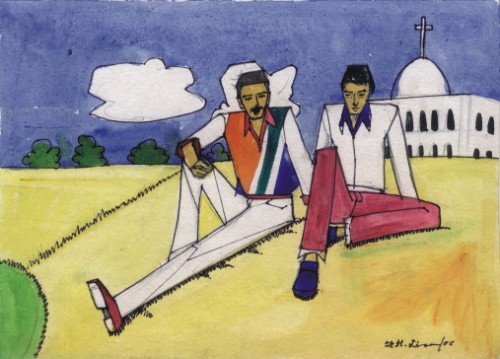
artwork by t h lisa |

