Travel Writing
In the Land of No Worries
Part - 1
Fakrul Alam
Australian Salute
My attention was attracted by it almost as soon as I stepped out of Sydney airport and pretty soon I was doing it too--the Australian salute! The gesture consists of the fingers of your hand raised half voluntarily as if to swat away something occupying facial space and upsetting one's mental equilibrium, but in the end the movement is obviously nothing more threatening than a half-hearted attempt to brush away the pesky, ubiquitous Australian fly. Indeed, I now realize I had seen it often in cricket broadcasts: Big Tony Greig, it is obvious, was doing it in the sidelines, while commentating, as was modestly built Rickie Ponting while taking guard, or brawny Bret Lee when darting in to bowl his lightning-quick balls. And my wife and I were going to do it again and again the three weeks we spent in Down Under Land whether in and around the cities of Sydney, Canberra, Melbourne, or Brisbane, where we were to spend 21 pleasure-filled "high" Australian summer (late December to early January ) days!The Australian salute! I was to see it in beaches, on mountains, outside houses as well as shopping malls, everywhere! It is almost an instinctive gesture, but also a conscious one, telling you that no Australian will attempt to hurt even so horrid, persistent, and irritating a thing such as the common fly. As a young boy growing up not so far away from the drains of old Dhaka, I had been trained to repel it by violent means, as an undergraduate at the University of Dhaka I had pondered the profound realization of the cruelty of nature reflected in Shakespeare's unforgettable lines ("As flies to wanton boys are we to the Gods, they kill us for their sport "), but here in Australia I was to find out that the aggressive fly always has its way; Australians will not hurt it or "apply desperate physic" as some other Shakespearean somebody had said somewhere. And that is why in Australia I saw wild birds stroll listlessly or indifferently by or swans swim languidly or daintily past Man, not bothered and secure in the knowledge that He had never used a boomerang or a gun to destroy him for quite some time now. Brisbane River
From the air, as our plane descended on its flight path to Australia's third largest and economically vibrant city, I could see clearly that at least aerially the most attractive thing about it was the meandering Brisbane River, around whose banks it had obviously grown, and which wound its way at a leisurely pace into Brisbane Bay. First impressions are often not wrong. The best thing about Brisbane, it seems to me, is its river and the City Cat service from which one can view it perfectly, the service being part of TRANSLink, the efficient, sensible, user-friendly public transport system of the city. City Cat, in fact, is a ferry service, that will take you all the way from the University of Queensland campus at one end of the city, through downtown Brisbane and South Bank, the eye-catching cultural complex, to Bretts Wharf, where one can begin to see the ships in the Bay. It is cheap too (a daily ticket that also allows you to use the buses and city trains cost only five Australian dollars and let's note in passing that approximately 50 taka will buy you the country's dollar). One memorable evening we took the one hour ride from one end, the University of Queensland landing station, to another, where the harbor is on view. When we started the sun was beginning to set splendidly and by the time we had reached the harbor it had disappeared smoothly; as we went back, downtown skyscraper lights glowed and wowed the eyes. One function of travel, at least for a Bangladeshi, is to remind him how drab and dismal things have been made to be at home. Every time I took the City Cat thus, I thought bitterly of our Government and City fathers, for not too long ago, BTV featured with great fanfare the opening of a city ferry service from Ashulia to Sadarghat, which was eventually to encircle Dhaka city and provide commuters comfort and an easy way of crisscrossing the city. Alas, the promised service never outlived inaugural day and the ferry disappeared as no doubt did the lacs of taka sanctioned for the scheme. Civic responsibility over the decades has made Brisbane the very livable city it appears to be; uncivil perspectives, the politician's hypocrisy, and irresponsible governance has made Dhaka the dysfunctional city it now is, and the more is the pity! Canberra
We drove into Canberra on a hot, still, sky-blue day. The streets were absolutely empty because these were the New Year holidays, and since we were lost we desperately needed to stop and take directions from somebody to reach our destination. That, in the end, involved driving for miles, for in this purpose-built federal capital of sparsely populated Australia, on such days you will see almost as many people on the streets as you will wild kangaroos and birds! Canberra, of course, is the capital city of Australia, built in a valley, and surrounded by modest-sized mountains. As befitting the capital of a proud and prosperous country, it has an impressively designed and relatively newly built Parliament, a must-see old Parliamentary building now converted into a museum and a portrait gallery, and the delightful Australian National Museum. The Parliament complex is made distinctive by its exquisite granite Aboriginal mosaic and ceremonial pool, the spacious marble Great Verandah that functions as the main public entrance, the eucalyptus tree-like pillars of the foyer, the delicately crafted panels, the ceremonial Great Hall which our guide told us can be rented out by private groups (imagine Kahn's centerpiece in Sher-E-Bangla Nagar being rented out!), the elaborately woven tapestry imitating an eucalyptus forest dominating it, and the two Chambers where Westminster-style debates take place (unlike the farce carried out year after year in the place that we have learned to ignore!). The old Parliamentary Building preserves Australia's political history in loving detail (no distortion, occlusion, and repression here!). The library of the Old Parliament has been converted into the National Portrait Gallery, modeled after the one in London, but more eclectic in its collections. But the best thing I saw in Canberra was the National Museum, especially the part of it displaying in great and fascinating detail the rich and fascinating culture of Australia's first people, the Aboriginals. I consider myself especially fortunate in visiting it at a time when it had on show some brilliant and unique works by contemporary Australian aboriginal artists, eloquent testaments of the colorful, rhythmic and vibrant ways in which they viewed their reality. Didgeridoo
We first heard it as we walked on the sidewalks close to the Sydney Harbour on the second day of our trip: two big, sprawling-bellied aboriginal artists playing this unusually long instrument sounding like no other musical instrument that you have heard: insistent, solemn, loud, mesmerizing, alive ! It is as if the street musicians were proclaiming through their fascinating instrument that the first people of the country were not to be denied and must be heard. I was able to examine and see elaborate collections of didgeridoos later not only in the Australian National Museum and the Queensland National Museum but also in a shop selling Australian gift items in downtown Brisbane. There are many such shops in the cities we visited and I found them to be just right for gift shopping: containing all sorts of likeable items, including some fairly inexpensive one, coasters done in aboriginal art motifs, boomerangs, T-shirts, etc. What would budget-conscious tourists like us do without such shops! Emerald Lake
The last stop in the ride we took on Puffin' Billy, the name of the nineteenth-century steam train that huffs and puffs its way in what I think is the suburb of Belgrave just outside Melbourne, emitting coal dust in the face of the excited tourists who are now its only passengers, moving through stations that have been rebuilt to look like the ones of yore, past hand-waving car-drivers, at least one of whom we kept meeting because he was bent on delighting his grandchildren who were on the train with us. With us on board in our car was the excited attendant: like everyone else running Puffin' Billy, he was a volunteer and in it because of the thrill of preserving a Melbourne tradition. As for the lake itself, it was small but just as its name announced: emerald green and beautiful. There were innumerable grey swans on it, and for a moment I fancied I was on Swan Lake, and the swans were floating gracefully into the distance to the invisible but tranquil tune of a Tchaikovsky! Footie
As I traveled across Australia, it became obvious to me that it was not cricket that obsessed this sport-loving nation as one would have thought, especially if one is from a cricket-obsessed country oneself, but footie (Australian football, also called footy). It is not like soccer or the football that we love, nor like rugby or American football, though it seems like a cross between these last two games. I kept glimpsing the game in my travels: in the field next to the house where I stayed in Brisbane, on the tube, on billboards and in newspaper sports sections, it fascinated me: it's more free-flowing and less intimidating than American football (none of those man-mountains or tank-like gear on view!), less public-schoolish but more combative than rugby. The games nation play reveal a lot about a nation's psyche; Australian football confirms to me that the nation's mindset can be located between England and Wales (where rugby originated) and the USA (American football also uses a similar-looking ball and field): Australians have managed to carve out their own unique space between their pommie ancestors and their domineering cousins in North America. Gabba
There were three public spaces in American that I had dreamed about going to before I entered the country: the Sydney Opera House, the Melbourne Cricket Stadium or MCG, and the Australian Open tennis stadium. In the end I managed only to do a guided tour of the Opera House, but I also saw a cricket match in the Gabba, or the Brisbane Cricket Stadium. And although the match I saw was not part of a test match (the only form of cricket worth watching for the purist) or a one-day one (the Aussie invention which the philistines have embraced) but the gimmicky twenty-twenty version, I was thrilled that I had got the opportunity to view the match.. The match we saw was between the Aussies and South Africa. The game was not very interesting; the Australian team was without Bret Lee, Glen McGrath, and Shane Warne and yet it managed to beat the South Africans easily. The stars of the game were Damien Martyn and Andrew Symonds, who between them manage to pommel the South African attack. The interesting aspect of the evening for me, however, was the Gabba atmosphere. I can say, in fact, that it literally rained empty beer paper glasses and left-over beer at one point. I was also part of Mexican waves and witness to the high-spirited and nonstop sledging of the South Africans from the galleries. It was good to be part of the event where everyone was excited and yet the excitement was wonderfully contained by the elaborate security arrangements made by the stadium management and the Brisbane police. Equally impressive is the transport arrangements made by TRANSLink so that you can go the game and return from it without any hassles or waste of time. Fakrul Alam is professor of English at Dhaka University.
|
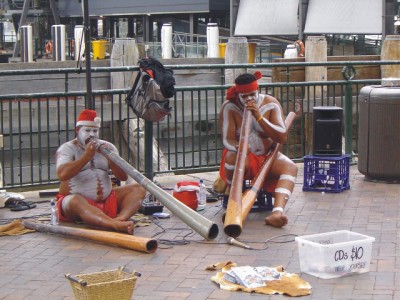
Photo by author |

