The struggle within
Hameeda Hossain
Women's struggles cannot be compressed into a monolithic, homogenous movement, because our lives are caught within a complex mosaic of religious, ethnic, caste hierarchies and class interests. While our first experience of subordination is in the family, gender relations of power are mirrored in communities, labour markets, political and legal systems. As in the rest of South Asia, women in Bangladesh have engaged with populist movements for independence and democracy with some expectation that the promise of freedom and equality would extend to gender relations. But the reformist agenda of the newly independent state, despite its commitment to constitutional rights, failed to challenge entrenched relations of power within the family and the community. By the mid-seventies women's lives were conditioned by contradictory pressures of an official Islamisation, compulsions of a market economy and the international women's movement. Some glimpses down memory lane reveal the course of women's struggle for freedom and justice and their modes of resistance against the obstacles they faced. Seeds of a progressive, non-communal movement
Within the larger struggle women began to script an alternative world view. Since early days when Roqaiya Sultana made women's seclusion an issue of public debate, progressive women have challenged the controls imposed by communal politics and religious fundamentalism. Secular democracy was viewed as promising more space for women's voices. In the communal divide that convulsed India in 1947 urban, middle class women such as Lila Nag, Ashalata Sen and other members of neighbourhood samitis formed in Dhaka during the civil disobedience movement crossed the religious divide and worked together with Sufia Kamal and others who had migrated from Calcutta. Together in Dhaka they sheltered Hindu victims of communal violence, set up a secular school and campaigned for communal harmony. In the sixties, as the language movement was reinforced by a growing consciousness of economic exploitation and political disenfranchisement in East Bengal, women activists challenged the government ban on broadcasting Tagore songs on TV and radio and women newscasters from wearing a traditional teep on the forehead. Government suppression of the right to a national language, to their culture, to their land was reason enough to engage with the growing political resistance but women also saw the bans as a denial of their personal autonomy. Women came into secular, progressive movements from separate streams. Cultural activists, older members of urban, neighbourhood samitis from politically conscious, educated bhadrolok families and women students mainly from the left, Marxist groups came together to form the Mohila Porishod, which was backed by the Communist Party. The kinship links of its members contributed to its ideological moorings, which were anchored within secular, progressive politics. Women were also active in peasant movements. Ila Mitra and Hena Das led the Tebhagha movement in North West Bengal and tea garden workers in Sylhet. They worked at the grass roots and had to face prison sentences along with their male colleagues. If the "woman question" surfaced in their internal discourse, a conscious reference to gender oppression and gendered politics did not enter the public debate until later. So that in public accounts or in public statements by women leaders the subjective remained invisible. Justice for war crimes
The issue of rape as a war crime and victimhood has recurred in feminist debates, with early concerns for women's welfare, family honour and state protection giving way later to concerns with sexual violence, women's autonomy. In 1971, rape as a weapon of war was justified by Pakistani soldiers as a victory for Islam. The survivors found little freedom in the aftermath, as economic insecurity, social stigma and family rejection served to emphasize their dependency and exclusion. State prescribed abortions and state patronized marriages were offered as compensation to women survivors, while their victim hood served the cause of national martyrdom The Parliament needed to be nudged by two of its members Nurjehan Murshed and Badrunnessa Ahmed to acknowledge women who had fought in the war, or become victims because of the war. At the time, women activists, such as Nilima Ibrahim, Bashanti Guhathakurta and Naushaba Sharafi scoured the countryside offering comfort and hope to rape victims and widows. While many informal groups offered welfare, the war-torn economy gave little hope of cultural and institutional change. It is only recently that women survivors have found the courage to recall their experiences in the war, their personal pain and loss, their economic dislocation and sense of isolation. The issue of justice remained suspended until Jahanara Imam took a leading role in demanding a trial of war criminals in the nineties. Her leadership was particularly critical as political parties that had collaborated with the Pakistan army in war crimes, had surreptitiously made a come back through official patronage. Contending with sectarian controls
Sectarian and communal politics were super scripted over secular and democratic constitutional principles, following a military coup in the mid seventies. Between 1977 and 1987 when fundamental constitutional amendments were imposed by two military dictators (General Ziaur Rahman and General Ershad) religion became a weapon of political control. Official patronage paved the way for mosque led political propaganda, resurrection of a communal leadership and a proliferation of madrassahs, whose students became ready foot soldiers in political and communal conflicts. The threat of Islamisation prompted many women's groups, along with religious minorities and liberal groups into street protests and to seek justice in the court. While women joined the protests in large numbers, Nari Pokkhyo, a small women's group, filed a class action in the High Court against the Eight Constitutional Amendment because it denied constitutional guarantees of equality. The question has been evaded as hearings were never held. An attempt to introduce Arabic in educational curriculums met with strong resistance from students who were supported by progressive women's groups. Market driven development
While religion became an arbiter of social and gender controls, women's labour became critical to Bangladesh's entry into global markets in the eighties. Strategies for micro-credit and contraceptive technologies were eagerly taken on by governments and disseminated through a mushrooming of internationally funded NGOs to poor women. At the same time their role as drivers of an export led economy created a scope for proletarianization of women workers. Bangladesh interpreted the international discourse on women's integration into development through a hierarchical, male dominated government bureaucracy. The first UN Conference on Women in 1975 had identified under-development with the invisibility of women's economic contribution, while at the second UN Conference in Nairobi in 1985 third world women critiqued the effects of structural adjustments and the market economy on their lives. In Bangladesh, women's labour made a major contribution to two major foreign exchange earners-garments ad shrimp exports. But there entry into the market offered no improvement in the quality of their life nor in the security of their livelihood. On the contrary, salination of the South West due to shrimp enclosures endangered traditional livelihoods threatened the appropriation of farm lands. A strong resistance of village women who had carried out subsistence agriculture on Polder 22 of Herinkhola in Paikgachha led to a direct conflict with the shrimp lord. Korunomoyee, a woman farmer, was brutally killed on November 7, 1989 by armed gangs, employed by the shrimp lord as she led the procession. She became the symbol of resistance to the ravaging of the environment by an export economy and her death anniversary is commemorated by villagers in front of a mural dedicated to her courage. Politics of violence against women
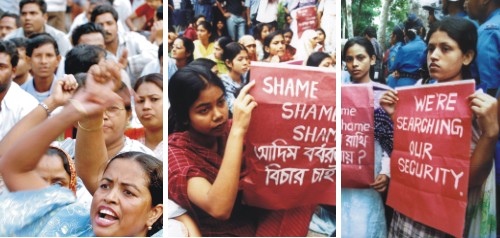
Media reportage of violence against women within the household and outside, around the mid-eighties, politicized the issue, women activists were able to articulate a human rights perspective. Women friendly legal aid and human rights organizations mobilized around legal reform, law enforcement to make women conscious of their rights. They then protected women's interests in marital disputes by intervening in traditional mediation councils. Their efforts were directed to persuading traditional village leadership to accept gender equality in relations of marriage, property and inheritance rather than turn to unfair customary or religious practices of hilla marriage or dowry. Since the early seventies Mahila Parishad had proposed reform of personal laws and political participation, demands that have now become near universal amongst women's groups. The courts became the site for redressing gender injustice. Sensational cases of domestic violence such as Rima's murder by her husband (in a well known middle class family) forced feminists to evaluate the deep rooted causes of violence in the politics of gender imbalance. Growing evidence of violence in the public sphere and in the work place, or violence against political rivals provoked us to question the role of the state in perpetuating gender hierarchies. Women's protests became more focused on issues of security and rights and led to the formation of the Oikkyo Boddho Nari Samaj. Campaigns for a uniform family code and laws to criminalize dowry, polygamy gained ground. The government responded with cosmetic changes in an anti-dowry law that failed to address the economic and social basis of inequality. Inability to understand the reality of women's lives allowed for the persistence of archaic, discriminatory inheritance laws. A similar short sighted approach has led governments to criminalizing the symptoms rather than addressing it as a consequence of social, legal and economic injustice. Negotiating the democratic space
With the end of Ershad's military rule women began to see in the impending transition to civilian rule an opportunity to conceptualize a gendering of citizen state relations. A small group of women after opinion surveys and intensive discussions in 1989 and 1990 drafted a charter for establishing women's rights within the family and the community and for their participation as citizens in a democratic framework. But in the rough and tumble of electoral politics, the "woman question" was side lined, and even staunch women party activists were pushed out of the running for electoral nominations. The confrontational culture of polarized politics in the nineties has encouraged the proliferation of regressive dogmas. In 1993-94 the media reported on incidents of fatwa instigated violence, which led to torture and deaths of women in different villages of Bangladesh, their humiliation or social ostracisation. Fatwas ordered women not to work outside their homes, to close down NGO run rural schools. Law agencies did little to curb these anarchic tendencies as progressive writers and poets were declared murtads, leading to social censorship and fear. Investigations showed that small groups formed under different appellations but allegedly backed by leading extremist political parties were responsible as the government looked away. Women's defence lay in constitutional guarantees of equality and international commitments to human rights made by the state. In the first case of a fatwa that led to the death of Nurjehan in Moulvi Bazar, a Maulana and his seven accomplices were convicted. Women organizations played mobilized wide support for their public campaign against fundamentalist attacks throughout the country and in international networks. Several years later two High Court judges issued a suo motu rule against fatwas that prescribed hilla marriage. Although an appeal was filed by an extremist political organization against the rule, women have relied upon it to resist maulanas' decrees in some places. Women are now on the frontline in resisting the state's complicity in gendered oppression. Our legal battles have led to the conviction of four policemen for the rape and killing of Yasmin, a minor domestic worker in 1995. The Sammilito Nari Samaj inspired a country wide movement that challenged the (a) impunity of state agencies, (b) patriarchal tolerance of violence (c) insecurity of women workers and oppression of child labour. University women students came together to form a platform against sexual violence in Jahangirnagar and Dhaka Universities to break the silence on sexual violence in academic institutions. But we need to recognize that we need to move beyond technical legal remedies, towards a transformative struggle for peace and tolerance of differences. We need to transcend the limits set by political allegiances and recognize in the kidnapping and disappearance of Kalpana Chakmas in 1996, allegedly by military officers, a commonality with the violence against women in 1971. We need to recognize that when the rights of women workers are violated or when minority women are threatened, it is equivalent to an attack on our collective struggle for autonomy. Our resistance to gendered power and violence would make for a meaningful change if we were to transcend the limitations of our class, ethnicity and particularly our political affiliation. Hameeda Hossain is a women's rights activist.
|
|

