Eye Treatment Campaign
Children get professional care free of cost
Durdana Ghias
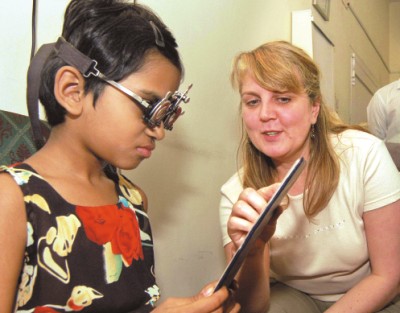
Three-year-old Rony was sitting in the waiting room with his parents. He is almost blind and can reacts to only a crash or thud. "He was a premature baby. It took us six months to realise that he could not see", said his mother. "I took him to many doctors, only to be told that he was too young to identify the damage," she added. The waiting room was crowded with children and anxious parents while Dr Munirul Huq along with his two British colleagues, was busy consulting and treating patients in his chamber. The children had eye defects and many were congenital which is difficult to treat if neglected for too long. Some parents were relieved to hear that their children have enough time to recover. Some were worried as treatment came too late children approaching twelve. Dr Huq escorted his patients to and from the chamber as a gesture of patient-doctor courtesy. All this took place at the three-day charity campaign fro January 28-30 arranged by Dr. Huq, in his chamber -- The Eye Pavilion Limited in Banani. Along with him, this year he had Dr. Jean Clark and Dr. Karen Miller treating children and giving advice. Dr. Huq is an eye specialist/surgeon and ex-registrar of Royal Alexandra Hospital, Paisley, Scotland, UK. Dr Clark, an orthoptist and Dr Miller, an optometrist, are from the Royal Alexandra Hospital of UK. Their special mission to provide specialised eye treatment free of cost to children has spread out of Dhaka. Parents expressed their satisfaction about the service they received. The father of 12-year-old Molly said: "I came here as my daughter has an eye allergy. I am glad of the quick and accurate diagnosis made, and will come back for treatment later." "I read about the service in the newspaper and wasted no time in coming here with my son, who suffering from hazy eye sight," said another parent. "The doctors of public hospitals are busy in their private practices. Furthermore I cannot afford to pay the high fees demanded by these eye specialists," he added. Dr Huq organises this campaign twice a year one for children and the other for cataract in adults. He started this campaign in 1992 and each year he engages one or two of his British or American colleagues who volunteer to take part in this endeavour. Dr. Miller and Dr. Clark were earlier in Dhaka in 2004 but this would be the first time they are moving out of the city. "We wish to be here every year to treat children, but our personal commitments and the cost of travel does not permit an annual involvement," said Dr. Miller. "Many friends donated money to make my presence to take part in this charitable event possible," Dr. Clark said. "Doctors in UK get only a 10-day vacation and they spend this precious time working in Bangladesh. This is not for a hospital or an organisation, but just for personal endeavour," said Dr. Huq. He said that most patients were from lower and lower-middle income families. "They come to this chamber decked in their best attire, but most of them are unable to afford the normal consultation fee of Tk 500 to top eye specialists," said Dr. Huq. The team was in Tangail for a day, in Gopalganj for three days and was expected to return to Dhaka yesterday. They will treat the spill over patients in Dhaka on their return. Children are treated for three main eye ailments -- amblyopia (idle eyes), squint and congenital cataract. "The right age to treat patients with such ailments, mainly amblyopia, is from seven to ten. Cure for those above 12 is very unlikely and the problem may remain for the rest of the child's life," said Dr. Huq. Dr Huq added that health care in Bangladesh is divided between public and private sectors, with the private sector in leading the race. With the majority unable to afford private treatment, doctors should do some charity when ever possible, he said.
|