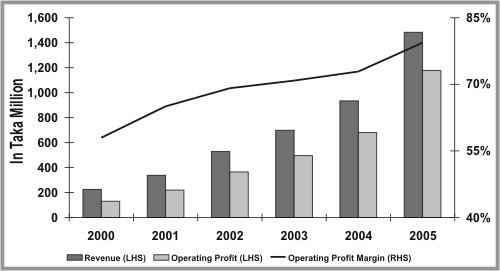
Treasury, transaction services help Citibank post 73pc growth in operating profit
Sarwar A Chowdhury
When majority of the private commercial banks primarily focus on loan disbursement for making profits, a leading foreign commercial bank, Citibank NA, has been successful in significantly increasing its profits from non-loan based revenue sources.Last year, three-fourth of the total estimated operating profit of Citibank Bangladesh, the local branch of US banking giant Citigroup, came from treasury and especially transaction services while the rest one-third profit was made from lending business, officials said. For the year 2005, the bank's estimated operating profit before tax stood at Tk 1.173 billion, registering a 73 percent growth over the previous year's profit before tax of Tk 700.87 million. With only three branches, two in Dhaka and one in Chittagong, the bank has managed to achieve this significant revenue growth mainly based on its innovative treasury and customer-friendly transaction services and by introducing newer products to the market under highly competitive and challenging conditions. "In our client base, we have many of the top global clienteles who are extremely savvy. They are highly demanding new ideas and products. That is why our emphasis is on continuous innovation with qualified and committed resources," said Citigroup Country Treasurer Bashar M Tareq. "The top tier local corporates are also moving faster to catch up," he added. Khondoker Rashed Maqsood, head of Citigroup Global Transaction Services, mentioned, "Our clients continuously require customised solutions at competitive prices. When these are combined, banks need continuous innovation to survive. And Citigroup is at the forefront of these activities that no other banking institution can match." Citibank Chief Executive Officer Mamun Rashid said, "An efficient bank does not need many branches to make profit, it only needs a good business plan, superior products and skilful people to offer those services and products to the right kinds of clients." Starting with a representative office in 1987, Citibank established a full-fledged commercial banking business in Bangladesh in late 1995. Since then the bank has been offering various services including e-business or electronic banking, corporate banking, treasury, cash management, and correspondent banking solutions to the leading business and corporate houses both local and foreign. Citibank initiated the first project finance, derivative transaction, largest ever deal (including merger and acquisition) made in telecom sector, pioneering cash management and internet banking in Bangladesh. Rashid, also the Citigroup country officer-Bangladesh, said, "Given that our country has huge potential, Citibank considers itself as a conduit for transfer of world-class banking services to our homeland. We are already exploring the possibility of expanding our distribution capabilities and working for providing our customers with a more integrated set of products and services, yet a more simplified experience." Only business and profit generation cannot be a yard-stick of an organisation's success, especially in the context of a nation like Bangladesh, he said adding that Citibank has been continuously playing its role in that. Citibank has engaged in a plethora of social activities to emancipate women, increase interest in book reading, stand by the victims of the atrocious acid attacks and contribute to preservation of culture through the Liberation War Museum. The bank along with Grameen Trust has also launched a programme titled 'Project Dignity' to reach the fruits of micro-credit to the beggars and also supported the creation of the first-ever Asian University for Women in Chittagong. Last year Citigroup introduced the Global Microentrepreneurship Awards (GMA) programme in Bangladesh, recognising the several unsung heroes of the country. Shamima Khatun, one of the GMA winners, had attended the closing ceremony of the International Year of Microcredit at the UN Headquarters in the USA. In future, the bank plans to explore opportunities in the areas of small and medium enterprises and capital market, Rashid said.
|