Treats from Land of the Rising Sun
Japan Festival begins
Fayza Haq
The contemporary Japanese clay work exhibition at the National Museum, which opened on February 7, was remarkable for its fresh and pristine presentation. It included both abstract and figurative representational forms. The exhibition is part of the 12-day Japan Festival, which runs from February 7 to February 18 at the National Museum premises.Matsuda worked on parts of human bodies which were like symbols and stood for contemporary society. Kumakura brought in jazz singing of the time of African-American liberation in America with the carved lip forms. These were again reflections of freedom. Nakamura depicts trees, branches, rocks and other conventional elements of Japanese beauty. Suzuki combined specific forms like horses, birds that he wrapped with affection as he worked with his clay. In Takako's Degenerative Bible we saw pages eaten up by worms and covered with dust. In bronze and black, the realism in it was indeed remarkable. His Bible on the sand was another piece in black and gold. The pages appeared torn and separated while the sand below had cracked badly. Yuriko's Carry on, Carry on! had twisted feet, an apple and a tray in vermilion and decorated with strands of chrysanthemums in gold. The tray included minute geometrical decorations in red and green. Package by Kimiyo was also startling for its modern presentation, in which scraps of newspaper stuffing and a large parcel in clay was the subject. Kinpei's Introduction to Japanese taste brought in a combination of three images, one sitting atop the other . There was a black form at the base and on top juggled a spotted red piece. Against these was an abstract form of an embracing lion. His other work was a jug with layers of lines in black, brown and gray going through the vessel. Kaneko Jun's work was a piece in gray and black. Jun's Double plate introduced a set of two large dishes, one sitting on another: The one on top being cut away, revealed a whole one at the bottom. Circles of blue, beige and black decorated the pieces. Mutsuo's Inversion-2 was a massive urn, painted over with gold, silver, pink and white swirls. His Crossing wind had two rectangular blocks, one resting on another. Fleecy black and gray conventional shapes of clouds decorated the forms. Junki Chi's entry was like an open box that had been decorated with gold spots, and larger forms of encircling and entwining shapes. Ryosaku's piece introduced two delicate feet of ladies decorated with flowers and leaves. In the same artist's Solar eclipse we came across a tormented man, overcome by the dramatic occurrence of nature. The mouth of the figure was open while a hand covered the eye. Usamo's Child with a red face and Horse were simplified, modern creations in cubes and semi-circles. In many forms of clay we saw the powerful moulding of the artists' hands combined with their fancy-free imagination. Apart from the clay work display, the components of the Japan Festival are a photography exhibition, a Discover Japan exhibition and a Japanese film festival. The Discover Japan exhibition, organised in cooperation with Dhaka Japanese Language Institute Alumni Association and Bangladesh Japan Youth Friendship Association, will illustrate traditions and lifestyles of modern Japan through different kinds of items including videos, posters, toys, dolls, books, ikebana and bonsai. This display will be held at the National Museum from February 13 to February 14.
|
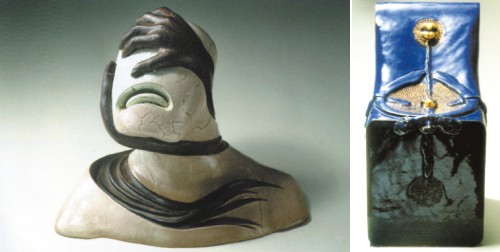
(left) Solar Eclipse by Miwa Ryosaku, (right) Melody by Kumakura Junkichi |

