Of mists and mires in opalescent grays
An exhibition of Kazi Ghiyas' paintings
Fayza Haq
On February 10, the Japan-based Kazi Ghiyasuddin begins his solo exhibition of 42 paintings at Chitrak. Kazi Ghiyas went to Tokyo Japan 30 years ago, through a Japanese government scholarship in 1975. There he had to learn Japanese for six months at Osaka before he commenced his course on fine arts. Next he went to the Tokyo National University of Fine Arts and Music, where he got his PhD on his paintings, after having mastered a course in art teaching and art appreciation. "I have more than a dozen dealers to represent my works around the world," says Ghiyas, who is not keen on entering competitions, as he has sales aplenty the world over. In Tokyo alone he has four representatives, and others in Koushu, Okinawa (a US base in Japan) and Khanajawa. He has participated in many art fairs in Japan, Korea and Argentina, and has taken part in group shows in Europe, as in Italy, and New York, USA. His present exhibition is a continuation of his earlier old style of modern abstract work. In this he has combined his nostalgia for the Japanese natural environment, and what he found around his studio in Savar, where he worked for his present exhibit. He took his inspiration from the fields, rivers, lakes, the sun and the moon, the trees with their branches and foliage, as well as fish and fowl around him. He has used a lot of opalescent gray-green, turquoise blue, jet-black strokes, lines, dots and curling doodles. These are impressions of the wind, rain, fog, water and land masses of Bangladesh and Japan, which he has simplified, and put together in mind-whirling paintings. He has used oil on hand-made paper -- most of his materials being brought from Japan. "I stay in Tokyo and come here twice a year to work at my studio-cum-residence in Savar. People regard my work as abstract but I'd differ with them. In my mind the representation of my environment is to please myself first and not necessarily the viewer in Bangladesh, although here too the viewer, has for many decades, been exposed to abstraction. I express what I understand. I did a lot of realistic academic work as a student, and continued in the same genre, putting in a lot of labour into my landscapes. My experimentation is a progress from my youthful days. I believe in being forward looking, and progressing with the times." Today he works in both watercolour and oil. He includes his feelings and emotions, along with what he sees around him. He says that his reactions to images naturally differ from that of others. He combines these feelings about the images in his environment in a manner that is not only abstract, but also that which has its inspiration in our folk craft, nakshikantha (stitched quilts of Bangladesh). Dwelling on the state of the arts in Bangladesh, Kazi Ghiyas says that he feels that the leaning towards experimentation in our artists -- both young and senior ones -- is something that is recommendable.
|
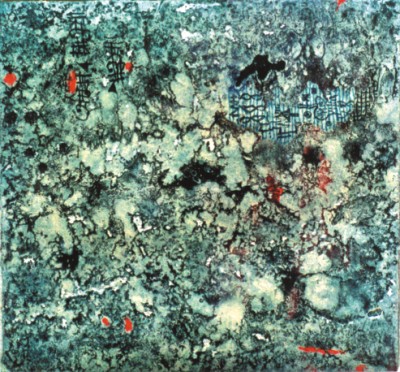
An art work by Kazi Ghiyasuddin |

