Delhi agrees to address Dhaka's concern for trade gap
Both sides sign trade, anti-smuggling deals; consent to start Sealdah-Joydevpur train link
Pallab Bhattacharya and Rezaul Karim, New Delhi
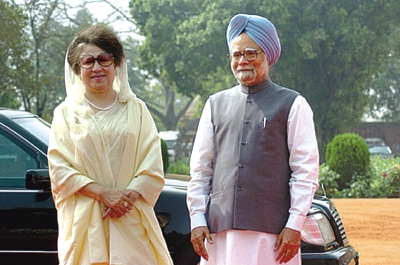
India yesterday sought Bangla-desh's cooperation in fighting terrorism and agreed to address Dhaka's concern over yawning bilateral trade gap as the two countries signed two agreements, including one on joint efforts to check illicit trafficking of narcotic drugs and psychotropic substances.At the two-hour meeting between Indian Prime Minister Manmohan Singh and his Bangladesh counterpart Khaleda Zia, the two sides also agreed to operationalise the Sealdah-Joydevpur train link and decided to hold high-level meetings over disputes on security and water more regularly. India and Bangladesh last night inked a revised bilateral trade accord and an agreement to combat cross-border smuggling of narcotics. The agreements were signed capping a two-hour talks between Khaleda Zia and Manmohan Singh, followed by delegation-level meetings between the two sides. The agreement for mutual cooperation for preventing illicit trafficking in narcotics and psychotropic substances and related matters was signed by Bangladesh Foreign Minister M Morshed Khan and Indian Commerce Minister Kamal Nath. The revised trade accord was inked by Bangladesh Finance Minister M Saifur Rahman and Kamal Nath. Bangladesh Foreign Secretary Hemayetuddin told reporters that the Joint Economic Commission will meet soon to take up the issue of trade imbalance. He said the Bangladeshi side raised the issue of river interlinking to which India assured that there was no proposal to bring in rivers originating in the Himalayas under it and that nothing will be done to hurt Bangladesh's interests. On the construction of Tipaimukh dam, Hemayetuddin quoted the Indian side as saying it was a project for storing water and not diverting it. Bangladesh also wanted early conclusion of an agreement on sharing of water of the Teesta, he added. Dhaka raised the issue of some alleged anti-Bangladeshi groups operating from Indian territory and India assured to crack down against them, he said, adding that home secretaries of the two countries will soon meet to discuss the issues. Hemayetuddin said India has welcomed the recent arrests of Jama'atul Mujahideen Bangladesh (JMB) chief Abdur Rahman and Siddiqul Islam alias Bangla Bhai. With regard to Tata's plans to set up a project in Bangladesh, Dhaka said it had sought "clarifications on certain matters" after New Delhi said it wanted increase in Indian investments in Bangladesh as part of efforts to address the issue of trade imbalance through "flexibility and pragmatism". "Both sides agreed that India and Bangladesh are victims of terrorism and need to join hands in fighting this scourge," Indian External Affairs Ministry spokesman Navtej Sarna told reporters. During the meeting, the Indian side is believed to have raised the issue of existence of northeast insurgent camps in Bangladesh and sought Dhaka's cooperation to dismantle these. Asked if India had sought crackdown by Bangladesh on the northeast insurgents there, Sarna said Bangladesh is "aware of our concerns...Terrorism, by its very nature, is a kind of phenomenon which can best be tackled by joint cooperation." New Delhi has been furnishing lists of all insurgent camps to Dhaka, seeking action against them. The latest list contained 170 camps. The signing of the investment protection treaty between the two countries could not be signed as it is understood to have run into rough weathers following reservations voiced by Indian finance ministry, which pointed out that the agreement would be violating certain norms of India's stringent Foreign Exchange Management Act (FEMA). The investment protection treaty would be studied in the light of the objections and redrafted, sources said. The two sides signed the Revised Trade Agreement on expiry, which aims at expanding bilateral trade and economic relations on the basis of equality and mutual benefits by facilitation, expansion and diversification of trade. Under the agreement, the two sides will make mutually-beneficial arrangements for the use of their waterways, roads and railways for commerce between the two countries and for passage of goods between places in one country through the territory of the other. Although Bangladeshi exports to India have been rising steadily, there is an imbalance of trade, Sarna said, adding India "recognises" this and is "sensitive to Bangladesh's concerns". He said one way to address it is promotion of Indian investment in Bangladesh. Referring to the Tata's $2.5 billion investment proposal, Sarna said Bangladesh is looking at various proposals and seeking "clarifications" on certain issues. With regard to security and water issues, the two sides decided that the institutional mechanisms already in place should be strengthened. The two countries decided that the home secretary-level meetings should be held more regularly to address the security issues as should the meetings of the Joint River Commission to address the water-sharing issues, Sarna said. Khaleda Zia, who is also the Saarc chairperson, discussed some issues relating to the regional economic grouping. She also met UPA Chairperson and Congress chief Sonia Gandhi and exchanged views on bilateral, regional and international matters. Minister of State for External Affairs E Ahamed and chairman of AICC's foreign affairs department Karan Singh were also present during the 45-minute meeting between Sonia and Khaleda at the official residence of the UPA chairperson.
Related Stories
 PM for common water sharing approach
India last night said it wants to see Bangladesh "strong" and "stable" even as Dhaka opposed New Delhi's ambitious river interlinking project saying it would cause "unmanageable economic and ecological
|
Ceremonial reception to Khaleda
Prime Minister Khaleda Zia yesterday began the official leg of her three-day visit to India with a warm ceremonial reception at the Rashtrapati Bhavan, the presidential palace.
|
|