World Water Day
Water and culture in Bangladesh
Kazi Shamsul Amin
We plan our cities near water; we bathe in water; we play in water; we work with water. Our economies are built on the strength of water transportation -- and the products we buy and sell are all partly water, in one way or another. Our daily lives are built on water, and shaped by it. Without the water that surrounds us -- the humidity of the air, the roughness of the river's current, the flow from the kitchen tap -- our lives would be impossible. In recent decades, water has fallen in our esteem. No longer an element to be revered and protected, it is a consumer product that we have shamefully neglected. Eighty percent of our bodies are formed of water, and two thirds of the planet's surface is covered by water: water is our culture, our life. Each year, March 22 -- World Water Day -- marks a permanent effort to promote access to safe drinking-water and sanitation. It is a springboard for raising awareness about water, stimulating debate and focusing on the dangers that derive from inadequate access to safe water and basic sanitation. The theme "Water and Culture" of World Water Day 2006 draws attention to the fact that there are as many ways of viewing, using, and celebrating water as there are cultural traditions across the world. Sacred, water is at the heart of many religions and is used in different rites and ceremonies. Fascinating and ephemeral, water has been represented in art for centuries -- in music, painting, writing, cinema -- and it is an essential factor in many scientific endeavours as well. Each region of the world has a different way of holding water sacred, but each recognizes its value, and its central place in human lives. Cultural traditions, indigenous practices, and societal values determine how people perceive and manage water in the world's different regions. In many parts of the developed world, people take it for granted to turn on a tap for safe and clean water to drink, to cook, to wash -- yet, more than one billion of our fellow human beings have little choice but to use potentially harmful sources of water. In 40 of the 50 diseases prevalent in Bangladesh, including diarrhoea, dysentery, typhoid, parasitic worm infestation and polio, unsafe water is one of the main elements of transmission. Urban poor paying price
A recent study conducted by the Centre for Urban Studies (CUS) estimated that the slum population of Dhaka is 13,17,000 living in 2,328 slums and 679 squatter settlements. As of 2001, the total number of slum dwellers is 31.5 million. To accomplish the demand of 13 million people in Dhaka, DWASA alone is extracting about 1500 million litres of water from the ground every day against its actual demand 2000 million litres. The rest of the demand is being fulfilled through the private initiatives which is also ground water based. Among the six divisional headquarters, only Dhaka and Chittagong have water supply authorities (DWASA and CWASA). Water is being supplied by the City Corporations in all the four remaining divisional headquarters. Although a significant percentage of urban people live in slums, they do not have the right of piped water connection as they do not own their lands. As a result, local mastans (muscle man) take the control of water supply to the slums through illegal connections. They charge much higher than the regular rate and the poor people become bound to pay the same. Against this backdrop, many of the poor slum dwellers have to collect unsafe water far from their residence. WaterAid interventions
WaterAid is a UK based international charity dedicated to the provision of safe domestic water, sanitation and hygiene education to the poorest, has been working in Bangladesh since 1996. It has been working in urban slum areas partnering with eight local NGOs, and become successful in convincing DWASA, CWASA and other municipalities to provide water supply connections to urban slums. Water supply authorities became convinced to permit connections to slums in different urban locations after giving guarantee of payment from the NGOs. Such implementation of water and sanitation project in urban slums has been a major breakthrough. After few years of experience DWASA became confident about such modalities and procedures and became flexible on providing such connections to other slum areas. In that way an institutional change has taken place. This experience was reflected in "National Drinking Water and Sanitation Policy 1998." In addition, these water supply projects have also influenced reduction of cost for water services for the target slum dwellers and demonstrated a high willingness to pay almost hundred per cent to DWASA / CWASA for the services. Another important achievement in this project was participation of women. Despite the socio-cultural religious context it was possible for women from marginalized groups living in slums to become active participants in this project and an ownership feeling has gradually developed among the group. WaterAid partnership with local NGOs has to date constructed 263 community water points and 175 community sanitation options (cluster latrine, sanitation block) in Dhaka and Chittagong. Rural perspective
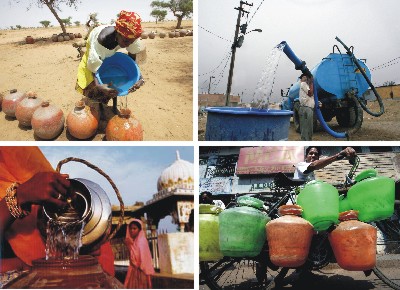
From the poetry of Sojon Badiar Ghat by Jasim Uddin to the paintings of Zainul Abedin, we see a clear picture of water culture: a woman carrying an earthen pitcher to bring water from pond or river. Water is related to Bangladeshi women for decades. The weight of water that women in Asia carry on their heads is commonly 20kg, the same as the average airport luggage allowance. Currently 80 percent of the poor live in rural areas where the rate of extreme poverty is twice as high as in urban areas. Over 95 per cent of the population relies on groundwater as the principal source of drinking water with shallow tube-wells and suction hand pumps being the technologies most commonly used. Arsenic menace
Bangladesh once claimed of earning a good progress in safe water provision to i97 per cent of the total population. However, after identification of excessive arsenic (more than 0.5 mg/l), safe water coverage has fallen to 70 per cent. Arsenic in groundwater is a major concern with over 13,000 cases of arsenicosis confirmed (August 2002, DGHS) and an estimated 30 million people currently at risk. It has rolled back the last 20 years of gains in providing safe drinking water. This fall of water coverage has created ache in the heads of government, donors and NGOs. High concentrations of naturally occurring arsenic have already been found in water from thousands of tube-wells, the main source of potable water, in 61 out of Bangladesh's 64 districts (British Geological Survey). The government, along with local and international NGOs, including Unicef, Danida and WaterAid, have started working to save the people from arsenic threat. Challenges in char, haor and beels
Chars areas are inhabited by the very poor and disadvantaged. Char areas like Fulsori and Shaghata of Gaibandha, Kalihathi of Naria, Domshar and Jazira Tangail are lacking access to basic water and sanitation services. One of the most challenges of the char areas is that the areas submerge in flood waters very often. Consequently most of the water and sanitation options wash away and submerge in every flood. Fresh water options get contaminated by bacteriologicaly unsafe water during the flood. River erosion, lack of road networks and standing water bodies are major challenges for livelihood. Salinity in coastal belt
People in the coastal areas, mostly south-western including Satkhira, Khulna, Bagerhat and Pirojpur, have been facing the hard reality of drinking saline water for decades. The situation has become worse when the people of these areas started shrimp farming intruding brackish water far inside the coast. As a result, it added salt to the wound -- more salinity added to the ground water. Finding no alternative most of the people in the area have been using bacteriolo-gicaly unsafe surface water. A number of NGOs have been working there and successfully initiated pond sand filter method to provide alternative option. Water culture of CHT wiping out
Names of the many localities in three hill districts under Chittagong Hill Tracts (CHT) generally end with the suffixes like Chhara, Chhari, Long, and Khyang (for example, Satchhara, Bet-chhara, Bagaichhari, Bilaichhari, Shubalong, Kaslong, Rigrri-khhyang), etc. In tribal language, these suffixes stand for spring and stream. Many of the localities under Banderban, Rangamati and Khagrachhari named after these springs and these names provide an indication of the important role these springs play in the lives of the twelve ethnic groups of indigenous people living in the CHT for hundreds of years. The indigenous people are not habituated to use modern water technologies, as they have not been introduced to them like the people in plain districts. So the indigenous people have to depend solely on the natural sources of water, particularly on the springs, for drinking, cooking, washing, bathing, irrigation and cultivation. All villages, therefore, have been built adjacent to the springs. Even people have to shift their age old villages in case of the death of a spring near which the village was located. All of the rivers and tributaries in CHT are simply the confluence of hundreds of springs of this region. The river Karnaphuli, that keeps the Chittagong port functional, is getting water from these springs. And same thing happen in case of the Sangu, Naf, Matamu-huri, etc. The hard reality for the indigenous people of the CHT is that the springs of this region are drying out. It is assumed that a hundred years back, there were as many as 200,000 springs flowing over the CHT area. Presently, there are no statistics of how many springs are still flowing. But the local people observed that many springs across the CHT are dying each year. The vital spring located at Ghagra, on the way to Chittagong and Rangamati is now simply a remnant of the forceful spring of 7-8 years back which had a good depth of water flowing all year round. The Ghumni Ghat Chhara, Satari Chhara, Pengjamrong Chhara, Kolabong Chhara (Mura Chhari Union), Karia Frya Chhara, Manchhari Chhara under Miasachari Union are going to face the same fate causing severe water crisis for the indigenous people living there for many years. The severity of water crisis has not been properly noticed by the governments and donor agencies. Due to the lack of knowledge to the CHT, and inaccessibility for hills and forests, the press media even could not focus the problems and consequently the under privileged hill people are passing their life through a severe water crisis. Rural interventions
WaterAid's strategy in Bangladesh is to work through local partners to improve hygiene behaviour and access to water and sanitation services for poor communities, with emphasis on: the demonstration of innovative approaches; participatory methods; gender and vulnerable groups; hygiene promotion; monitoring and evaluation and sustainability. To highlight the poverty focus and demonstration affects, project work will concentrate on "difficult" areas where access to safe water and sanitation is poor, building on previous project experience. WaterAid targeted the high-need areas where access to safe water and sanitation is limited and where the humanitarian costs of their continued lack are excessively high (examples include squatter settlements in urban areas, arsenic affected areas, and settlements on river islands (chars) that are vulnerable to severe annual flooding and erosion). It has also targeted areas inhabited by ethnic minorities who have traditionally been neglected in the provision of basic services, particularly in the Chittagong Hill Tracts region. WaterAid is also working in areas where pumping for irrigation has lowered water tables beyond the suction limit, rendering previously installed suction hand-pumps dry for significant periods each year (mainly the Barind area in the north-west); and incoastal areas where saline intrusion has rendered shallow tube-well water non-potable and where alternative technologies such as deep tube-wells, spring protection, and rainwater catchment systems are needed. WaterAid partnership with local NGOs has to date constructed 1,848 community water points and motivated community people to build 94,336 sanitation options on their own. The author is Documentation and Communication Specialist of WaterAid Bangladesh.
|