Joint Communiqué
Dhaka, Delhi to maintain high-level political talks
Rezaul Karim, from New Delhi
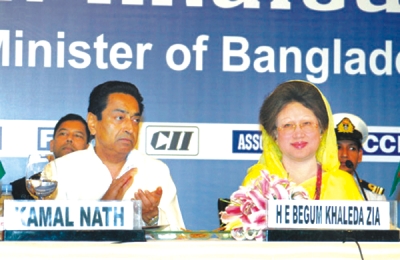
Both Bangladesh Prime Minister Khaleda Zia and Indian Prime Minister Dr Manmohan Singh have agreed on the need to maintain high-level political dialogue between their two countries.They also underpinned the common desire "to strengthen and consolidate" the existing friendly ties between Bangladesh and India based on their shared history and culture and wide-ranging people-to-people relations. The current visit of the Bangladesh PM has provided both countries with "the opportunity to continue and sustain their high-level political dialogue", said an eight-point joint press release issued yesterday in New Delhi on conclusion of Khaleda's three-day visit to India from March 20. The joint release said Khaleda's visit is also "testimony to the highest priority attached by the two countries to the promotion of their bilateral relations in all aspects". It said during her visit, the Bangladesh PM held comprehensive discussions with the Indian PM on "the entire gamut of bilateral relations". They also discussed regional and international issues of mutual interest. The joint release said two agreements were signed during the visit of the Bangladesh PM: the Revised Trade Agreement and the Agreement for Mutual Cooperation for Preventing Illicit Trafficking in Narcotic Drugs and Psychotropic Substances and Related Matters. "While the revised trade agreement is expected to provide a framework for expansion of bilateral trade, the other agreement signals the joint determination of the two Governments to combat drug trafficking," it said. Discussions between the sides led by the two prime ministers were held in a cordial atmosphere and there was a constructive and forward-looking exchange of views, said the statement. The discussions resulted in greater understanding and appreciation of each other's point of view. It was agreed that meetings of the bilateral institutional mechanisms such as the Joint Economic Commission, the Joint Boundary Working Groups, the Joint Rivers Commission and the home secretary-level talks would be held more frequently to ensure movement in a positive direction and their outcome monitored by the political leadership on a continuous basis. "Whether it is security, trade or sharing of water, the two leaders reaffirmed their commitment to work closely together to find mutually satisfactory solutions," the statement said. Both sides agreed that the visit of Khaleda Zia to India has contributed to "further consolidation and progress in the already close and friendly relations between the two neighbouring countries". The two prime ministers also expressed their satisfaction over the successful conclusion of the 13th Saarc Summit in Dhaka in November 2005. They agreed that the positive outcome of the summit would enable the Saarc member countries to achieve specific economic and social objectives. They also emphasised that implementation of the Safta must be pursued with vigour to advance the Saarc economic agenda. During the visit, Khaleda called on Indian President Dr APJ Abdul Kalam, Vice-President Bhairon Singh Shekhawat and United Progressive Alliance Chairperson Sonia Gandhi. Indian Minister of Commerce and Industry Kamal Nath, Minister of State for External Affairs E Ahamed, Leader of the Opposition LK Advani, and Mizoram Chief Minister Zoramthanga also called on the Bangladesh PM. The Bangladesh PM conveyed her thanks to the Indian PM as well as the government and the people of India for the warm hospitality extended to her and the members of her delegation during her visit to India. Khaleda extended an invitation to Indian PM Manmohan Singh to visit Bangladesh, which the latter accepted with pleasure. Precise dates would be worked out through diplomatic channels, the statement said.
|