Irrigation strained as water table drops
Reaz Ahmad
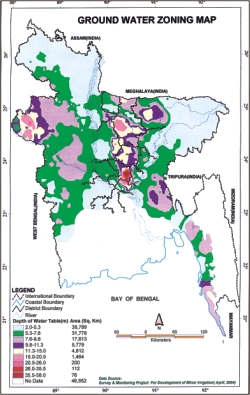
The predominantly groundwater-based irrigation system in the country has reached a critical phase with croplands in many areas going out of the reach of shallow-level aquifer due to fast depleting groundwater table.The country's first-ever groundwater zoning map prepared recently comes up with a daunting picture of the water table falling to such an extent that about 3 lakh shallow tube-wells (STWs) out of a total of 11 lakh are unable to lift irrigation water. Latest official statistics show that 8.9 lakh hectares out of 31.5 lakh hectares of irrigated lands in the last Rabi season in the country went almost beyond irrigation, making over 3 lakh STWs virtually redundant. The STWs can draw groundwater for irrigation purposes provided the water table is within a depth of 2 to 7.6 metres. But the groundwater zoning map shows that the groundwater level in nearly 9 lakh hectares of cropland in northeastern, northwestern and central regions of the country fell to a depth of 7.6 to 11.3 metres. "Farmers can no longer draw irrigation water from these regions using STWs at ground-level, rather, they have to further dig the earth and set their STWs in a certain depth for reaching the falling water table. That is what we call deep-set shallow tube-wells," said engineer Md Eftekharul Alam, one of the architects of the groundwater zoning map. The map has been prepared over the last 15 months using the last 35 years' aquifer data. Bangladesh Agriculture Development Corporation (BADC) kept uninterrupted records of as many as 3,700 STWs across the country at an interval of every 15 days for this period. The groundwater zoning map is now ready for official launching sometime this month, BADC sources said. A team led by BADC assistant chief engineer Eftekharul Alam, under the guidance its immediate past member director (minor irrigation) AS Nazim Ahmed, prepared the map. "Groundwater table in 23,392,00 hectares command area has gone down to a critical level where over 3 lakh STWs are becoming inoperative posing a looming danger for thousands of farmers in irrigating almost 9 lakh hectares of croplands," said Eftekharul. The country incurred a loss of Tk 3,000 crore in lost productivity as the areas' potential rice output of 44 lakh tonnes dropped to 11 lakh tonnes last year because of the acute irrigation problem due to fast depleting water table, he said. According to 2005 irrigation survey report of the government, over 10 million farmers have an overwhelming dependence on STWs in irrigating almost 70 percent of the 47.8 lakh hectares of irrigated croplands in the last Rabi season while the public-sector schemes provided irrigation for the rest 30 percent. The groundwater zoning map shows that a record high of 78 percent irrigated croplands in Pabna have become critical for STW operation, followed by 75 percent in Comilla, 60 percent in Kushtia and Naogaon, 55 percent in Mymensingh and Cox's Bazar, 50 percent in Joypurhat, 49 percent in Chittagong, 45 percent in Bogra and Rajbari and 30 percent in Jhenidah, Netrakona, Gazipur and Narayanganj. Besides, farmers are being unable to draw water by STWs in 28 percent of the lands in Sherpur, 20 percent in Jamalpur and Tangail, 18 percent in Natore, 16 percent in Manikganj, 15 percent in Dhaka, Narsingdi and Sirajganj and 10 percent in Rajshahi, Chapainawabganj, Kishoreganj and Munshiganj. "As an immediate bailout measure, policy directives are required for halving the number of STWs in operation in critical zones, as identified by the groundwater zoning map, and the farmers there need to be advised for switching over from rice farming to less-irrigation intensive crops like wheat, potato and maize," noted Eftekharul. A recently published official document said, "Regulation of water flow in the Ganges at Farakka point by India has caused a reduction of dry season flow. Decreased flow in the Padma and its distributaries has affected the pump irrigation." The Minor Irrigation Survey Report of 2005, published jointly by the BADC, Department of Agriculture Extension (DAE) and Barind Multipurpose Development Authority (BMDA), said, "Similar problem exists in case of the Teesta, Surma, Kushiyara rivers, where the upstream authorities in India control the flow. Withdrawal of water in dry season makes the river water availability very much insecure for irrigation. On the other hand, the reduction of river water during dry season in the branches of Ganges/Padma allows the salinity line to move upstream. All these problems of major surface water sources have resulted in a growing dependence on underground aquifers as the source of water for irrigation in dry season." Experts pointed out that agriculture, being the mainstay of the country's economy, is still being able to cater to the growing need for food production at par with population growth rate, largely because of phenomenal growth in irrigated rice -- Boro -- during dry season. Boro accounts for 55 percent of the country's rice output while the rest comes from Aus and Aman. Expansion of low-cost STWs at private level (owned by farmers themselves in most cases) has virtually revolutionised the growth of food output. And now that STWs-based minor irrigation is at stake due to fall water table, the prospect of further rise in rice production appears bleak, they warned.
|