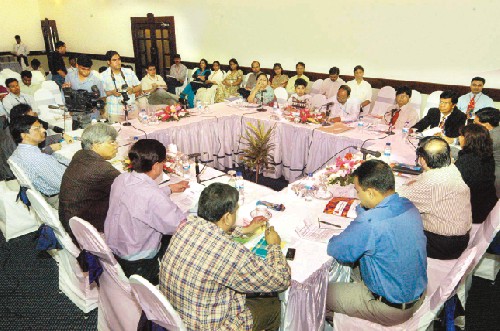
The Daily Star and Save the Children-USA Roundtable
Improving children's health a must for better future
Staff Correspondent
Expressing deep concern over the poor health status of primary schoolchildren, medical experts and educationists at a roundtable yesterday recommended a comprehensive programme to improve children's health and termed it the key to building the future generation of leaders.The roundtable agreed to form a committee to develop concrete recommendations specifying the responsibilities of different segments such as government sectors, NGOs, local government, teachers and community, and make it a national agenda for improving the health of children. The Daily Star and Save the Children-USA (SC-USA) jointly organised the roundtable on 'School health and nutrition' with the theme 'Achieving health is essential for completing education' at Spectra Convention Centre in the city. The Daily Star Editor Mahfuz Anam moderated the session. The speakers said political will and cooperation among NGOs, UN agencies and government departments is the key to improving health status of schoolchildren. They also called for ensuring access to safe water and sanitation both in schools and communities and raising social awareness among schoolteachers, management and parents. They also suggested incorporating basic health issues into the curriculum of primary schools and teachers' training module. Anuradha Harinarayan, deputy country director of SC-USA, said Bangladesh has achieved success in primary school enrolment and in reducing the child mortality rate, but now the challenge is to check dropouts and reduce morbidity rate. According to a baseline survey of the SC-USA, 97 percent of children now enrol in primary schools, but only 67 percent of them completes primary education. "The total environment of schools and community should be improved for a healthy and equitable education system to take full advantage of schooling," Anuradha noted. Presenting a keynote paper, Dr Nizam Uddin Ahmed, director of Health, Population and Nutrition (HPN), SC-USA, said 56 percent of about two crore primary schoolchildren suffer from some degree of anaemia, while only 10 percent of the sick children seek medical care from qualified healthcare providers. Quoting the SC-USA survey conducted in Nasirnagar of Brahmanbaria, he said 87 percent of students in primary schools are found infested with intestinal worms while 63 percent of them defecate in the open field and only 8 percent had access to a sanitary latrine at home. Dr Nizam Uddin suggested classroom-based health education, de-worming at least twice a year, micronutrient supplementation including iron and iodine, vision screening, first aid facilities at schools and provision of safe water and sanitation to help improve children's health. Stressing the need for water and sanitation facilities, Dr Mahbubur Rahman, director of Primary Health Care, said the authorities should also focus on awareness at the community level. "If you need complete education, you need good health. Today's one taka will save ten take in future." Qumrun Nahar, project officer of United Nations Children's Fund (Unicef), called for considering the special health needs of the adolescent girls, small kids and disabled to ensure their education. Md Habibur Rahman, director of Education Sector, SC-USA, suggested inclusion of health and nutrition as a separate subject in the primary and secondary school curriculum and creation of health-related data bank to facilitate the health workers and the policymakers. Referring to the ratio of teacher to student in primary school, which stands at 1: 63, Mahe Jabin Masud, head of School Feeding Programme of the World Food Program (WFP), said it is difficult for the teachers to create awareness among the students. Stressing the need for social mobilisation, Dr Faruk Ahmed, director of HPN of BRAC, said lack of teachers' training on healthcare of the children is a major obstacle to improving the health status. MA Rahsid, executive director of NGO Forum for Water Supply and Sanitation, said school management committees should ensure that the students are careful about personal hygiene. Dr ABM Jahangir Alam of World Health Organisation, Dr Sukumar Sarkar of Health and Nutrition Section of USAID, Zillur Rahman of Channel-i, MA Sabur, country director of Water Aid, Dr Ashok Kumar Roy of GlaxoSmith Kline and Zahirul Islam of WFP, also spoke.
|