Pottery Trade Fair
Fayza Haq
The National Pottery Trade Fair 2006 began at Bashundhara City yesterday. There were 15 stalls and all presented clay items that are in everyday use.The leading stall in the mela was 'Kadamati' and it belonged to Monira Sultana. She had brought in many types of mugs, cups, bowls and plates with swirls, curls, dots, zigzags and variations of geometrical designs in rectangles, triangles and circles on burnt sienna. She said that they were extensions of the 'alpana' motifs. There were also candle stands, vases and different forms of simple curios for the average home's use. Sometimes the items had three dimensional floral motifs stuck to them. "Everything is local -- the designs, colours and the motifs. I'm having this display here to create awareness of the value of clay and all the things that you can get out of this element. Even dinner-sets have been made from clay. As an artist from the Fine Arts Department, Dhaka University, if I don't make the public aware of this they will remain ignorant.” The Bilblash stall from Patuakhali had vases with floral motifs, wall hangers with flower and leaf designs along with 'kula' designs and candlesticks. Other stalls had similar items along with statues of deities, tea sets, flower vases in the shape of turtles. Swapan Kumar Paul, a trainer with an NGO, commenting on the mela said, "This is to encourage the terracotta workers in the villages. Coming to the fair they are encouraged to work harder and find more motifs for their items. Sometimes oxide colours, such as red, green and blue have been combined with the clay colour. There are items with transparent glaze but these are not popular with modern buyers. When working with clay, there are items like iron nails and pebbles mixed in the clay and these have to be removed before working." Pottery appeared in Bengal around 1500 BC and was well-known in Mainamati and Paharpur. The pottery artisans in Bangladesh inherited the production skills from their forefathers. Potters belong to the Pal caste and most of them belong to the Hindu community. The export value of our pottery is about a few crore taka. The market for pottery has been gradually squeezed. The livelihood of the potter's existence is in threat. The livelihood is below Tk 3000 a month. Local financial institutions have yet to come forward and lend the terracotta artisans a hand. Veena Khaleque, Country-Director, Practical Action-Bangladesh, said, "The age-old skill, traditional production technology and practices and declining product life cycle have excluded the rural potters of the market. Understanding marketing demand, technological modernisation, development of product quality and product diversification, and redefining the pottery groups all these have not been very easy for the pottery groups." The Daily Star is the Media Partner of the event.
|
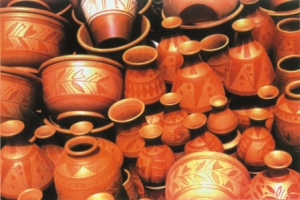
A display of exquisite pottery at the fair |

