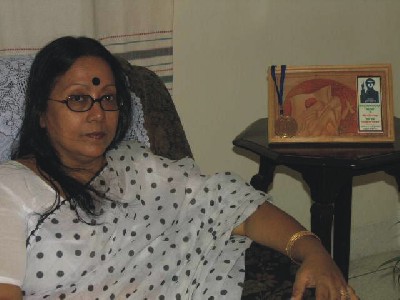
Mini Quadir
Leaving footprints on the sand of time
Karim Waheed
Mini Quadir is known as an accomplished Tagore artiste. Mini is also adept in the genre of gono sangeet (songs of the masses). She has been an active member of the cultural organisation Kranti since 1967. According to Mini, "Kamal Lohani, Altaf Mahmood and Sheikh Luthfur Rahman were some of the prominent members of Kranti. We had the opportunity to learn songs from these noted composers."However, singing is not the only trait that makes Mini stand apart. Mini has several feats to be proud of. The first flag of Bangladesh to be hoisted was made by Mini and she is one of the very few women who worked as 'transporters' for the freedom fighters in Dhaka during the Liberation War. She used to move ammo from Dhaka to a camp of freedom fighters in Savar. In a cabin in Sikdar Medical College, where she is being treated for gall bladder stones, Mini reminisces on incidents and experiences during 1971: "My cousin Manirul Haq, who was the president of 'Dhaka Chhatra League' then, asked me to make a flag. I was good in needlework. I was told that the flag should be bottle-green with a red sphere in it. I started working on it; I can still recall how excited I was. However, I had to make modifications twice. I was almost done with the flag when I was told that a white map of our country has to be in the centre of the red sphere. Later I was told, that map has to be golden, not white. I borrowed some absaan (glitter) from my cousins and made the map golden. That was the first flag of our country, as far as I know. "On the eve of March 25, I performed two songs -- a gono sangeet for a programme of Kranti and a Tagore song for a another show, both aired live from DIT building (the then TV Station). A colleague showed me huge objects covered in trepol (tarpaulin). I was told these were tanks. While performing, we apprehensively watched paratroopers marching into the building. However, they left after a while. I contemplated what was going on. That all became clear a few hours later. The co-worker who dropped me off in his car was stopped on his way home by the Pakistani military and the car was burnt. "We all moved to our village home in Darikandi, Comilla. On our way we came across stacks of dead bodies; vultures had started feasting. I was just a teenager. I can still see images of the scavengers pecking on eyes of the deceased. "My uncle had a launch and we figured it'd be safer to live on the boat. I still remember the launch getting stuck at times in piles of bodies thrown in water; their hands tied at the back. How would you feel if you see your parents, brothers, sisters, friends, namely your fellow countrymen slaughtered like that? I wanted to kill the butchers who were committing these massacres in the same method applied by them. "We returned to our home in Rokonpur, Old Dhaka in June, 1971. People were crossing the border but my family didn't want to leave the country. One day, my brothers asked me if I'd like to assist them in moving some ammo (guns, grenades, bullets and other explosives) to a camp in Savar. There were several check posts, where the military would thoroughly inspect men for arms. Apparently, they didn't check women. The plan was: I'd be in a car packed with arms, which will go through all the check posts. After crossing all the points, I'd get off the car and return home. "Of course there was the possibility of getting blown up to pieces or getting caught. I knew if the latter was about to happen, my brothers would kill me first and then kill themselves. We were aware of the 'ingenious' ways Pakistani military tortured women. "I remember accompanying my brothers and their friends in a procession celebrating victory on December 17. We were in a rural area just outside Dhaka. Villagers offered us water and muri (rice flakes) though we were not parched or starving. Some greeted us with leis that had one or two flowers in them. That was all those poor villagers could pull together. How many kings or queens received a heartfelt ovation like that? "However, I do feel dejected sometimes when I see undeserving people labeling themselves as Muktijoddha (freedom fighters). I know quite a few, who were in a rush to flee to India during the War. I'm not trying to deride whatever contribution they had made to the Liberation War, living in the safety of another country but it makes me livid when people comment, 'What have you done living in Dhaka during the war?' "In 2004, 33 years after the war, I was honoured by the Council of Urban Guerrilla Dhaka '71 with a crest and medal for my contributions. Apparently, I couldn't be located when I was previously considered by other organisations for the honour. I remember once at a family gathering, my young nephews and nieces asked me about the war. I was narrating what I'd seen during the war and was interrupted by a relative who pulled her children away saying, 'my naive kids believe everything people cook up.' "Whom do I blame? Whom can I blame?"
|