In Conversation
Hashem Khan's River of Blood
Fayza Haq
In 1971 Hashem Khan was a 28-year old teacher at the Institute of Fine Arts. In the non-cooperation movement, students, teachers artists and the intelligentsia as a whole were involved. Khan recounts those momentous days: "People realised that they would have to fight for their freedom. The inspiration for the guerilla war came from Bangobondhu Sheikh Mujibur Rahman's speech on March 7. The artists took out a procession and the preparation for this took us 10 days. "There were many posters and festoons and 500 artistes took part in the procession under the leadership of Zainul Abedin. This was called Shadheenatar Michhil. The four words of the alphabets of freedom were hung around the necks of four young women. The war began on March 26. I had a brother who was a doctor and the two of us went to the village. There we were attacked and while my elder brother was killed, I was wounded. Along with my mother and niece, I was at the hospital for two weeks. When I came back I found that all my friends had left for the war including my close friend Shahadat Chowdhury." Since he was wounded, Hashem Khan decided to stay back in Dhaka, and help those who were going to the war, by distributing food, clothes and medicines. Thus for nine months he had, in his own way, joined the freedom struggle. During that time he did a few drawings and sketching. Later on relying on these sketches he made many paintings and had an exhibition in 2000 in the National Museum where he had dwelt on the subject of the River of '71. He went to Meghna, Sitalakhya and Buriganga and felt that the colour had changed over the last 35 years. He felt that the blood and bodies of lakhs of people were immersed in the river waters. This stirred him so much that he did six large paintings on that subject. He says that he is still strongly influenced by the Liberation War and goes back to that theme again and again in his paintings. Sometimes these works were figurative and at times abstract. Every March he is reminded of the subject and does sketches and paintings on that theme. The Liberation War, according to Hashem Khan, has given a lot of courage and strength to the people. "We had fought against the well trained Pak army but because we were motivated we won," he says. In his paintings of the period he drew attention to the fact that in '71 the colour of our rivers had changed, mixing with the blood of the sacrificed people. "It was as if the river was crying". In the painting dedicated to the war there is the inclusion of the mother handing over the rifle to the son to go to war and in the backdrop are the ploughs of the ordinary people who have gone to the war. The sky is awash with red and black. Rokto jokhon diyechhi aro dibo and Joy Bangla are the lettering on the canvas. Hashem Khan says that he was aware of the struggle for freedom since 1952 when he was a schoolboy. He was linked with the famous poster Shonar Bangla shoshan keno? He had also done the logo, monogram and poster on the 'Six Points'.
|
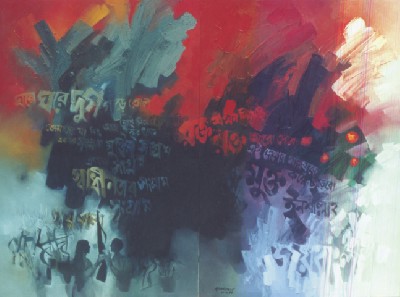
Fascinating artwork by Hashem Khan on Liberation War |

