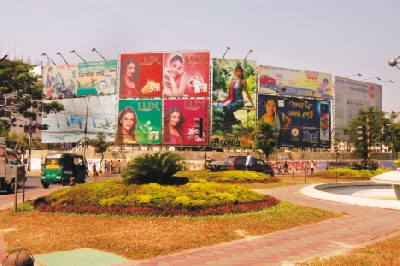
Unauthorised billboards to come under new scrutiny
Tawfique Ali
The good governance committee of Prime Minister's Office (PMO) has recently entrusted a non-government organisation (NGO) to carry out a situation survey on the increase of unauthorised billboards in the city."We expect to submit the report after survey and evaluation of situation on billboards and recommendations on how to streamline the sector in next two months," said Prof Nazrul Islam, president of Centre for Urban Studies (CUS). "Dhaka has been reduced to a city of signboards," said Prof Islam, who is also a geography and Environment Science teacher at Dhaka University (DU) and member of the committee. Dhaka City Corporation (DCC) approves installation of various billboards flouting its own set of rules in many cases, he added. Gigantic billboards installed at every nook and corner of DU campus has spoilt its sanctity as an educational institution, Prof Islam further said. Billboards atop tall buildings, along major overhead thoroughfares are dangerous, as they could harm the public and utility service system if they fall, he said. Signboards should be installed at appropriate spots so that they do not mar beauty and greenery of cityscape and obstruct motorists' vision, but over 10,000 billboards, hoarding and other advertising signs in the city have become a menace over the recent years, sources said. Absence of an effective law and clandestine deals with the DCC, have given advertising agencies to go ahead with rampant installation of unapproved commercial billboards in recent years, sources said. "When those close to the ruling party are involved in the advertising business, how can one expect the sector to run according to rules," said noted economist and environmentalist Prof Muzaffar Ahmed. "A comprehensive legislation is required to address the present context with the latest trend, technology, content and style of advertisements," he said. In approving a particular board or sign, authorities must consider the content and manner of advertisement, common people's tolerance, and its impact on the masses, he said. The DCC guidelines on outdoor advertisements allows no overhead billboards or hoardings in front of hospitals, government offices, educational institutions, mosques, temples, churches, museums, and historical sites. Shahbagh, Bangla Motor, Karwan Bazar, Farmgate, Mirpur Road, Mohakhali, Gulshan, Kuril, Biswa Road, DU campus and other major roads and intersections are spots plagued with wild advertising boards and signs. "Such advertisements simply destroy the cityscape and its natural beauty, pose dangers to motorists and commuters also," said Khorshed Mahmud at Mohakhali intersection as he waited to board a bus to his office in Motijheel. According to DCC rules, height of a mega sign cannot exceed the height of a foot-over bridge and have a gap of at least two kilometres between two such overhead signs. These mega signboards cannot be installed on major roads. A DCC zonal executive officer and some members of DCC's advertisement site allotment committee said requesting anonymity: "the DCC lacks in equipment to pull down huge billboards safely and has only cranes and pay-loaders." A top official of DCC's conservancy department said: "Billboards here and there are an onslaught to our city beautification work. But the task of checking the menace lies in the hands of allotment committee and estate department." Chief Estate Officer Abu Taleb said that DCC has not approved the billboards installed in front of Hotel Sonargaon and nearby Panthakunja. Authorised billboards at present are a little over 100, he said, and approximately 250 applications are under consideration. Though the DCC estimated around 700 unauthorised billboards he agreed that the actual number would exceed several thousands. About the electric display installed on tall buildings Taleb said that the DCC has served removal notice to the one near Asad Gate. "It is not possible to suddenly demolish such a display when we come to know it has been installed spending crores of money," he said. "It is difficult to regulate billboards atop private buildings," said Alamgir Hossain Khan, convenor of DCC's advertisement site allotment committee. "We just collect tax from the board owners," he said. When his attention was drawn to risk factors posed by many huge billboards placed on tall buildings, he said: "I do not know whether they have approval or not." All authorised billboards lost legality on July 19, 2003, as the DCC stopped renewing contracts with the advertising agencies following a court case. Outdoor Advertising Owners Association (OAOA), an organisation of 19 advertising agencies, filed the case with the High Court over DCC move to raise rent of billboard from Tk 30 to Tk 150 per square foot. DCC resumed receiving applications for contract renewal in May 2005, according to the chief estate officer. The Appellate Division of the Supreme Court issued a stay order on November 17, 2003 preventing the DCC from demolishing billboards for three months. The Supreme Court extended the injunction for six months on January 12, 2004. The stay was extended once again until December 24, 2004. As the case could not stand any longer, the DCC went on demolition drive once again from January to March 2005.
|