Becoming one with Romena
"We had shot the scenes at real concentration camps in Comilla. The walls and floors still had blood stains" --- Babita
Sadya Afreen Mallick
EVEN after 34 years, it still unnerves me when I think of the role I played in the movie on our Liberation War in 1972. The nation had still not fully recovered from the bloodied period, when I accepted the role of Romena in Orunodoyer Agnishakkhi," said internationally acclaimed actress Babita. The film was directed by none other than the celebrated Subhash Dutta. "Subhash Da's movie was a reflection of the many factual incidents that had happened during the war. Romena, was a village belle, who was madly in love with the local village boy played by Ujjal. One day she goes to see the cinema shoot in her village where she meets popular actor Anwar Hossain. This chance encounter was to change her life forever in months to come. "Shortly after the cinema crew leaves the village, the war engulfs the peaceful village. Man, women, child are slaughtered indiscriminately. Romena is dragged from her home, beaten mercilessly, raped and left for the dead in the prison camp. Ujjal, who had left the village makes a desperate attempt to rescue her, is shot dead during a fierce encounter with the army. "Romena discovers that she is pregnant and loses her will to live. But through some sheer determination she clings on till the war ends, living in a perpetual nightmare. Returning to the village, Anwar Hossain, finds her abandoned, more dead than alive. "Anwar, moved to tears at the unrecognisable sight all around him, decides to shed his identity as an actor, and like his roles in so many films, dive headlong into helping the victims. In a poignant scene, he approaches Romena, and accepts her unwanted child as his own. "To date, I don't know what horrified me more. The fact that this was too close to reality or that during the shoot, I could sometimes sense the presence of the faceless Romena," said Babita. "We had shot the scenes at real concentration camps in Comilla. The walls and floors still had blood stains where the young girls had been chained and tortured. The crew had to clear away human bones and crushed skulls from the set. And there were still plenty of live land-mines left by the army as a signature of death. To us, the war was very much still real, the blood never dry in our eyes, and the soundless screams of the prisoners deafening. "In this backdrop, I lost my orientation of when I was Babita and when Romena. At one time I noticed the walls had small scribbles, a desperate message for help that had never come. Working in this environment became an endless emotional labyrinth. I am sure even the crew was caught up in this, and every so often would look away to wipe their eyes. For me there were several shots, when I just could not take it anymore, and would collapse unconscious. Only colleagues, who knew me well, knew what was going on in my mind, while others thought it was just realistic acting. "It was the same time that I was scheduled to shoot for Satyajit Ray's Ashoni Shanket. Subhash Dutta discussed with Ray and worked out a schedule so I could work on both films. Later, when Ray saw the film he was full of rare praise for the director. I had also worked on other projects that were equally moving." In the film Alor Michhil directed by Narayan Ghosh Mita, Babita dons the role of a college girl whose life comes to a tragic end because of the unscrupulous people in society. In the film Abar Tora Manush ho, directed by Khan Ataur Rahman, Babita plays the lead role alongside Raisul Islam Asad, Al Mansur, Babu, Rowshan Jamil, Khan Ataur Rahman and Sarkar Feroze. "Such movies were not only a product of a talented crew, director and actors. The glue that held us all together was the emotional bondage we felt every time we walked into the set. During shots we came to recognise some gestures from the crew - a glazed look, a forlorn nod, a sharp intake of breath they all spoke of some personal tragedy, some unmentionable memory that they could relate with during the scene," said Babita. The films, though not shown regularly anymore, won recognition both at home and overseas. Babita received the National Award for her role of Romena. "I was content that the wider audience had a chance to see the horrors and that this would remain a testament of the bravery for many generations to come. But, I am sure anyone who has worked in these films desperately wished that if only they could trade all the awards in the world for the life of even one nameless Birongana." As the spirit of Muktijuddho lives on in the hearts of a hundred-million strong Bangladeshis the world over, it's a wish that will probably never die.
|
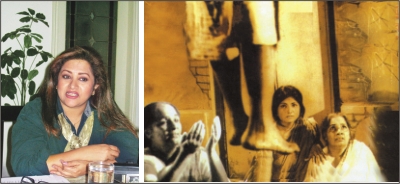
Babita speaks on her roles in Liberation War movies (left), a scene from Orunodoyer Agnishakkhi |

