Pahela Baishakh
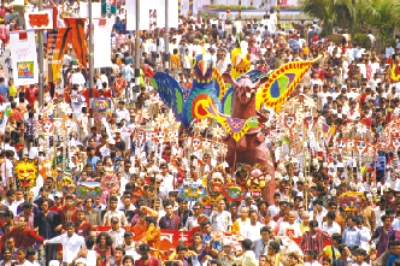
Celebration turns into human sea
Staff Correspondent
Resolved to uphold Bengali cultural heritage, thousands of people on Friday poured into the streets, parks and open spaces across the capital and elsewhere to celebrate Pahela Baishakh, the first day of Bangla New Year.Irrespective of religion and age, they welcomed the first day of the Bangla year 1413 with fanfare and festivity, shrugging off the threat of militant attacks. The biggest cultural festival of the Bangalees began with Tagore's song "Esho hey Baishakh Esho Esho" sung by the artistes of Chhayanaut at the city's Ramna Batamul. Alongside Ramna Park, the Dhaka University campus, Central Shahid Minar, Dhanmondi, and Jatiya Sangsad Bhaban area too were swarming with people throughout the day. Great many varieties of handicrafts and artefacts were displayed and sold at Baishakhi Melas in different parts of the capital. Women in dazzling white saris with red borders and men clad in punjabis roamed the city streets, exulting at the arrival of the new year. Different organisations brought out processions and organised musical programmes, fairs and cake festivals to mark the day. Students of the Institute of Fine Arts of Dhaka University took out traditional Mangal Shobhajatra in the morning with thousands of revellers wearing chequered masks. At Ramna Botomul, artistes of Chhayanaut sang songs, and recited poems and essays eulogising thousand years old traditional way of Bangalee life. The much-awaited function concluded peacefully with the singing of the national anthem. To accommodate vast numbers of people, vehicles were not allowed on the roads stretching from Karwan Bazar to Shahbagh, Matshya Bhaban to Shahbagh to Doyel Chattar. Still, the traffic systems around Dhaka University, Ramna and Dhanmondi Lake came to a standstill. Pahela Baishakh has its origin in the Mughal period when Emperor Akbar introduced the Bangla calendar to ease tax collection. In course of time, it evolved into a day of celebrations and an integral part of Bangalee culture and tradition. The traders and shopkeepers open Halkhata (fresh accounts book) on this day and entertain their customers with sweets. Concern for security could not contain the wave of enthusiastic visitors as they rushed to the heart of celebration -- Ramna and Dhaka University campus. Around 10,000 members of law enforcement agencies in uniform and plain clothes kept a close eye on the movement of people towards Ramna Park and other places. Rapid Action Battalion (Rab) conducted a sweep of the festival venues with the dog squad. A number of closed-circuit television cameras and metal detectors were installed as part of stepped up security. Thousands queued up at the entrance points of Ramna to get inside while artists spread across the area were busy painting motifs on the cheeks of visitors. Different social, political and cultural organisations took up elaborate programmes to welcome the Bangla New Year. The organisations included Chhayanaut, Alliance Française de Dhaka, Proshika, Oitijhya, Nagar Samajik O Sangskritik Kendra. The main opposition Awami League (AL) brought out a colourful procession in the city marking the day. Starting from Bahadur Shah Park in Old Dhaka, the procession ended at Ramna Park after parading through Gulistan, Bangabandhu Avenue and National Press Club areas. Thousands of party activists and common people participated in the vibrantly coloured procession, carrying banners and festoons. Elegantly decorated elephants, horse carts, and the party's election symbol 'boat' on trucks and rickshaw vans caught the attention of the pedestrians. AL Presidium Member Tofail Ahmed and Acting General Secretary Obaidul Quader led the procession. Earlier in the morning, AL President Sheikh Hasina exchanged New Year greetings with party leaders and workers at her Sudha Sadan residence in Dhanmondi. President Prof Iajuddin Ahmed, Prime Minister Khaleda Zia, Leader of the Opposition Sheikh Hasina and other political leaders gave separate messages on the occasion. The national dailies brought out special supplements while Bangladesh Betar, Bangladesh Television and different private channels aired special programmes.
|