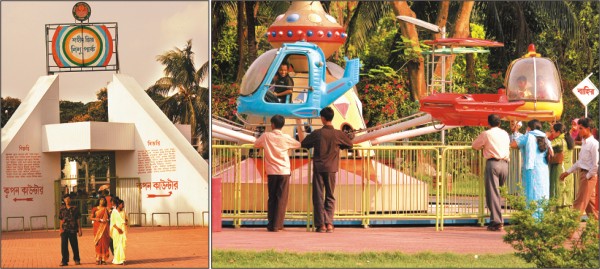
Rides sans safety measures at Shishu park
Sharmin Mehriban
Inadequate facilities, lax regulations, ignorance of visitors combined with indifference from the authorities pose a threat to the personal safety and health of the visitors to Shishu Park, majority of whom are young children.Originating in 1979 and owned by the Dhaka City Corporation (DCC), the park has a number of amusement machines of Japanese origin, each having two operators cum technicians. The technicians do weekly checks on the machines. During load shedding, in the absence of generators, these machines have to be manually operated to get riders off them. In the case of the Bismoy chokro (Ferris Wheel), an operator has to climb right to the top to bring the riders down, putting his own life at risk. Most rides are not protected from rains; leaving riders drenched or even be struck by lightning during sudden thunderstorms. The Jhulonto chair (set of revolving swings attached by thin straps) has no seat belts. Water is not available and toilets are left dirty. Authorities said that 19 sweepers are employed in the park, but there no bins were found. A hollow ground at a distant corner of the park is used as an incinerator, emitting smoke and causing inconvenience to visitors. Park regulations state that adults must accompany children below 12 on rides, but there is no minimum age limit. This correspondent saw a woman carrying an infant out of the Romancho chokro (a revolving and tilting wheel). Another visitor who observed this said that it was not safe for a woman to ride with a baby. But the visitor himself stood watching his little son adjusting the balance on a ride all by himself, while an operator watched from a distance. "Places like Shishumela are worse," he said. Two little children sat in a ride without seatbelts; the older one holding the younger very tight, while the mother watched. She had no answer when she was asked why she put the children's life at risk. "There are no 'fasten seat belts' notices anywhere," said a bystander. But operators said that no accidents have taken place so far. A likely reason for this is that the machines are operated at a slow pace, yet the danger persists. One food outlet on the premises served this correspondent stale fuchkas and tamarind water. One shop owner said that the restaurants served non-sterilised water direct from the tap. "One kilogramme of kerosene cost Tk 36 and we cannot afford it," he said. "Most customers bring their own water," he added. Entrance tickets at the park cost Tk eight only, and most visitors are oblivious to safety and hygiene. When contacted, the deputy assistant engineer of the park, Md. Zakir Hossain, said that the DCC had been informed about the generators, but refused to elaborate. He asked this correspondent to contact the DCC. Khondoker Shujat Ali, the DCC's superintendent engineer said they were aware of the non-availability of generators and the broken toilet amenities. "We will have the toilets repaired and look into the matter of providing generators," he said. When asked about the restaurants serving stale food and tap water, he said that there has been no improvement despite the ongoing anti-adulteration drive and that it is up to the individual to choose what is hygienic. "We will do our best but it is also the responsibility of the park authorities to look into such matters." he said.
|