Down The World Cup Lane
Mexico 1970: The height of brilliance
Agencies, undated
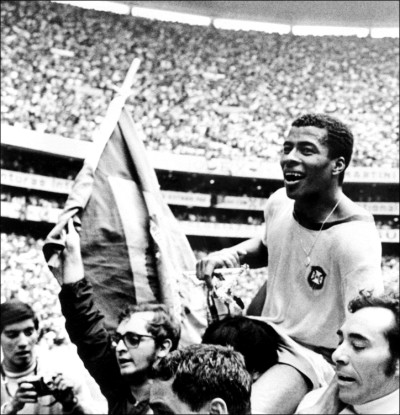
Despite their vic-tory in the preceding World Cup and an ensuing record that had seen them lose just four out of thirty-five games in four years, England were not the favourites when the World Cup came around in 1970. Their only four losses had come against good opposition and none had been by more than a single goal. But there had also been ten draws during that time and England were very dreary to watch. The squad though was as good as the one in 1966. Banks, Moore and Hurst were all there. Stiles had been replaced by Mullery and there was a dynamic winger in Lee coupled with a good crop of attacking full backs- very necessary in a wingless team. So who were the favourites? Brazil, ofcourse. They had scored 23 goals in their qualifying campaign in six matches. Tosato had got ten of them and had struck up a rich partnership with Pele, who himself bagged six. Carlos Alberto, Gerson and Jairzinho were coming into their prime and Clodoaldo provided the base at midfield while Rivelino was another exciting talent. Prior to the tournament they had as coach, Joao Saldanha, a journalist who was a huge critic of the national team. Such was his vehement criticism that the powers that be finally decided to make him national coach to relive his constant nagging. What sounds like the recipe for disaster turned into an instant success. They cut a swathe through the qualifying campaign but Saldanha was sacked in ignominy as he was found brandishing a revolver in the face of a critic of his methods. He was promptly sacked and Zagallo, infinitely calmer took the Brazilians to Mexico. Elsewhere, West Germany had Gerd Muller in their books but scraped through 3-2 against Scotland. Italy, the European Champions looked strong in qualifying with Luigi Riva scoring seven goals. Argentina though, were eliminated by Peru. The other teams that made it were USSR and El Salvador whose door was opened as Mexico qualified as hosts. El Salvador qualified after three matches with Honduras, which sparked off a war that had presumably more to do with immigration than football. Three thousand people died. Mexico's record as hosts were none to encouraging as peaceful demonstrators were shot dead by armed police before the Olympics held in Mexico City. FIFA turned a blind eye to that and the enormous problem of heat and altitude, which had left European competitor needing oxygen in the Olympics. Games were also set at noon to accommodate TV schedules in Europe as the World Cup was being broadcast in colour all over the world. Players lost up to ten pounds and needed fluids during games. Many were sent home with heatstroke. The tournament produced some exhilarating football and one of the great forward lines but the price in human terms was a rip-off. The first great clash of the tournament came when Brazil and England met at the group stage, with Brazil narrowly getting the better of Bobby Moore's team by a goal to nil. The quarter-finals threw up four European teams and four Latin American teams, with one of the most intriguing matches being England versus West Germany, a repeat of the 1966 final. With only half an hour to play, England had a two-goal lead and looked to be coasting into the semi-finals, but West Germany are never beaten until the final whistle and sure enough they fought back from the dead to sneak a 3-2 win in extra-time. Beckenbauer started the comeback with a goal and Seeler and then Mueller scored in extra time to break English hearts and exact revenge for 1966. Meanwhile, in the South American "local tie", Brazil finally overcame Peru's spirited challenge. In the semi-finals, Italy and Germany spent the first 90 minutes of their game standing off each other like wary tigers, with Karl-Heinz Schnellinger equalising in injury time after Boninsegna had opened for the Italians in the 8th minute. Tired legs and high emotion combined to provide a goal feast in extra-time as the ball went into the net five times, with Italy getting the last word to win an epic encounter 4-3. Brazil, meanwhile, wiped clean memories of their defeat to Uruguay at the 1950 World Cup final by putting three goals past their South American rivals after shipping a goal early on. The Brazilians arrived in the final at the summit of their art, and their match against Italy turned into a carnival of all the best that the game has to offer. The poor Italians were simply overwhelmed as Tostao, Gerson, Pele, Jairzinho, Rivelino and the rest gave the sporting world a lesson in football. It was 1-1 at one point as Italy's Boninsegna equalised Pele's early strike. Jarzinho had been kept at bay by the brilliant Fachetti for most of the game but this time his probing paid off albeit with more than a little slice of luck. Fachetti took the ball off Jarzinho but it rolled to Gerson who stepped away from a challenge and scored with a crisp cross-shot. Within minutes Gerson's deep cross was headed across goal by Pele and Jarzinho miskicked in from close range after nipping in ahead of Fachetti. The game was over at that point and the last celebratory goal showed all the Brazilian skills. Clodoaldo held off several challenges to feed Jarzinho on the left. He rushed inside but again Fachetti did not let him pass. He transferred the ball to Pele who passed to Carlos Alberto. The ball bobbled at the last moment but Carlos Alberto still crashed his shot past Albertosi's right hand post. They called it the "PRESIDENTS GOAL" as the President had predicted they would score four. This was Brazil's third World Cup triumph, and as a recognition of their achievements they were allowed to take the famous Jules Rimet trophy home for good.
|