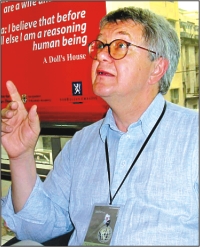
Terje Mærli
Winner of the Ibsen Award '06
Ershad Kamol
Norwegian director-playwright Terje Mærli is one of the two winners of the Ibsen Award provided in the Ibsen Commemoration Festival '06, Bangladesh. He has received the honour for his outstanding career in theatre in Norway and abroad. The other winner of Ibsen Award is seasoned Indian theatre personality Ebrahim Alkazi. Mærli is particular renowned as a director of Henrik Ibsen's plays. He has so far directed around 100 theatre performances including 32 productions of 16 plays by Ibsen.Mærli has participated in the seminars and international conference in the Ibsen Commemoration '06 Bangladesh, besides observing the plays. What is his impression of the festival? "Productions are very interesting, which has enriched my views. I've got new ideas to develop. And Ibsen Commemoration '06, Bangladesh is a well-organised theatre festival," says Mærli. To compare and contrast the presentation of Ibsen's plays in the orient and the west, Mærli says, "Directors in Asia basically emphasise on the political issues in the presentation of Ibsen's plays, where as the directors from Northern Europe have different interpretation of the same plays. As we find huge gap between the socio-political scenario of Ibsen's days and contemporary Europe, the Northern European directors emphasise on the psychological and mythological aspects of the characters in Ibsen's plays. "In the Scandinavian countries there is less political turmoil, social injustice and environmental pollution: the major aspects of Ibsen's plays, compared to the rest part of the world. So, Ibsen's plays need different interpretations in these days in the region. That is why we try to unveil the conflict between the inner and outer self of a person, crises of existence and mental pollution (pollution within) of human beings through Ibsen's plays." To analyse his own style, director Terje Mærli says, "I don't believe in 'realism' in my directorial compositions. First of all I take away all the 'living room' sequences of Ibsen's plays, in which most of the actions of the text take place. Through the actions and body language of the actors I create required compositions on an empty stage. In case of sets, simple but quality light is used to create the ambience. Instead of the realistic costumes, I prefer 'masks', to portray duality in Ibsen's characters, as these characters can be interpreted in different ways. In case of characterisation, I like to avoid doing any overview of the multidimensional characters of the plays. And I dictate my actors at the initial stage to 'get in the frame' of the play, and then allow little freedom during choreography." Besides Norway, he has directed Ibsen's plays in Denmark, Germany, Japan and Sweden. And he asserts that the people from the Scandinavian countries get advantage during the staging of Ibsen's play more than the people from rest part of the world. Terje Mærli is also a playwright. In his plays he basically deals with 'existentialism philosophy' or crises of existence. And he thinks as a playwright he is influenced by French philosopher-playwright Camus and Sartre. He has also directed TV drama based on Ibsen's plays. On the current theatre scenario of Norway Terje Mærli says, "All the theatre groups in Norway are professional. At least 20 troupes are government subsidised. And there are many troupes, which do not get subsidy, but are doing quality theatre. And rich theatre curriculum is included in all the public universities. Prior to receiving the Ibsen Award in Dhaka, Terje Mærli has been honoured with prestigious awards including the Amanda Award, Theatre Critics' Award and Scandinavian National Theatre Award.
|