TechNews
UV LED to bring in next-gen optical tech
Afp, Paris
A trio of Japanese scientists say they have invented an ultraviolet (UV) light-emitting diode (LED) that could open the way to a new generation of optical discs with very high data-storage capacity.The LED operates deep in the ultra-violet range of the energy spectrum, with a wavelength of only 210 nanometres (210 billionths of a metre), the shortest of any device of this kind, they report in Thursday's issue of the British journal Nature. LEDs are semiconductors that emit light when they are electrically stimulated. They are widely used in consumer gadgets, providing the light source in many of today's up-market flat-screen televisions. LEDs that emit ultraviolet light, which is not visible to the human eye, could have biological and public-health applications, such as killing germs in contaminated water. They could also eventually replace lasers, which gobble up more energy and use toxic gases, as the tool for reading disc-stored data. Engineers are cramming more and more information on disks, which thus throws down the challenge of finding a source of coherent light that is fine enough to read between ever-tighter tracks of data. To do this, they have been working progressively farther down the light spectrum, from the wider wavelengths of red towards the narrower wavelengths of blue and violet. For instance, the latest industry standard in commercial lasers is Blu-Ray, whose 405-nanometre wavelength enables 27 gigabytes of storage on a single-layer DVD. This compares with ruby lasers, whose wavelength of 4.5 gigabytes enables storage of 4.5 gigabytes. The new LED devised by Yoshitaka Taniyasu of NTT Basic Research Laboratories and colleagues is based on "doping" aluminium nitride, a substance not previously used in LEDs, with silicon or magnesium.
|
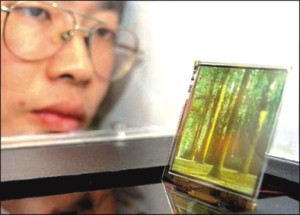
A man looks at a four-inch active matrix organic light-emitting diode (AMOLED) display. A trio of Japanese scientists say they have invented an ultraviolet light-emitting diode (LED) that could open the way to a new generation of optical discs with very high data-storage capacity. PHOTO: AFP |

