Cycle of strikes
Alastair Lawson, BBC News
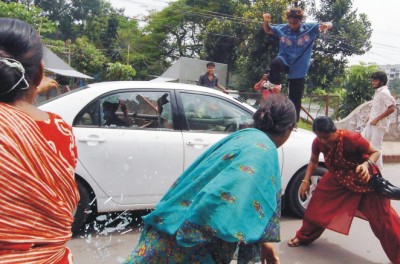
Bangladesh is once again in the grip of a nationwide strike marked by violent confrontations with the police. An insight into why there is so much violence and instability in the country came earlier this week in the country's parliament. For much of the last 15 years, parliament as an institution has failed to function, plagued by a series of opposition boycotts. Even when it does operate, it is only a matter of time before it closes down again. Take this week's incident, for example. A senior Bangladesh Nationalist Party (BNP) MP, Moshiur Rahman, took to the floor on a point of order and accused the main opposition Awami League leader of having links with a militant group responsible for a string of bomb blasts across the country. "Sheikh Hasina sought blessings from Golam Azam and kissed his feet," he said. It was a taunt not out of place in a school playground. Golam Azam is not only a former leader of the hard-line Jamaat-e-Islami group but is also accused of being a war criminal who collaborated with the Pakistan army during the 1971 war that led to the creation of Bangladesh. While the nature of Mr Rahman's comments is unlikely to be taken seriously by political commentators, the reaction of the opposition to his jibe was criticised as being equally childish. After protesting against his comments for 15 minutes, they reverted to the tactic they know best - yet another walkout of parliament. In the eyes of many observers, both the Awami League and the BNP are equally guilty - and equally hypocritical - when it comes to parliamentary boycotts and general strikes (hartals). When they are in government, they denounce them as damaging to the country's economy and sending all the wrong signals to the international community. But when they are in opposition, they say such tactics are the only ways to draw attention to the failings of heavy-handed, incompetent and dictatorial governments. The two sides do not talk to each other and that failure to communicate is reflected in their respective sets of supporters. The high level of antagonism between Sheikh Hasina and Prime Minister Khaleda Zia who can barely bring themselves to talk face to face makes antipathy between the two worse. Recent demonstrations in Bangladesh may have been among the most violent in recent months, but in truth they are the latest manifestation of the same old problem: the intense distrust between supporters of the Awami League and the BNP which makes Bangladesh one of the most politically polarised countries in the world. While few people in Bangladesh can truly escape the party political label, not everyone is interested in taking to the streets in support of the latest political cause. The business community for example dislikes hartals called by either side. For the most part, their main concern is making money and providing a decent income for their families. The same can be said of most garment factory workers, who have recently staged a series of determined demonstrations in support of better wages. So far, there does not seem to have been much of a political dimension to those protests. Their demonstrations and those staged by opposition supporters have been quite distinct. The worry for the government is that at some point there may be common ground between the two, with the opposition capitalising on the frustrations of the factory workers. All this comes at a tense time in Bangladesh. The stakes are high with an election scheduled for January. A row between the two main parties over the composition of election lists ahead of the election is unresolved, as is a dispute over the make-up of a caretaker government that will oversee the election process. In most countries, such disagreements are normally debated in parliament. In Bangladesh, parliament has effectively neutered itself, which means the various protagonists take to the streets. Already the government has threatened to mobilise its supporters to counter the opposition challenge. In Bangladesh, the failure to talk could exact a heavy price.
|