Allow zero tariff facility to all exports from LDCs
ICC-B urges G8 leaders
Star Business Report
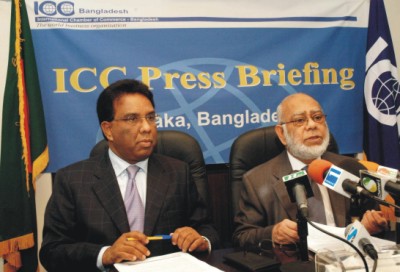
International Chamber of Commerce-Bangladesh (ICC-B) yesterday urged the rich and affluent countries, including those in the G8 club, to come forward and take the lead role in freeing the world from poverty.In a globalised economy, ICC-B President Mahbubur Rahman said, there should be a free movement of factors of production in order to accelerate growth and development. He was speaking at a press conference organised by the ICC-B marking the release of the ICC policy statement titled 'Business and the Global Economy' in Dhaka for the heads of state and government who are attending the three-day G8 Summit that began at St Petersburg in Russia yesterday. He gave a clarion call to the leaders of G8 nations to help facilitate unhindered movement of less skilled workforce under Mode 4 of WTO so that the least developed countries (LDCs) are integrated in the global economy. He said Bangladesh also did not lay emphasis on Mode 4 earlier. "But, we should have done it. Had Mode 4 been allowed, it would have helped our remittance to reach US$15 to $20 billion from existing the amount of $4.8 billion." The ICC-B chief appealed to the world leaders to grant zero-tariff facility to all exports from LDCs as well as to remove all hindrances, including non-tariff and para-tariff barriers. The statement focused three issues of crucial importance to the world business at the present time, namely Doha Trade Negotiations, Global Energy Security and Intellectual Property Protection and Economic Progress. Mentioning WTO as a centre pillar of international economic co-operation, the ICC in its statement expressed profound concern at missing further deadlines in Doha trade talks and woeful inadequate progress. Describing that multilateral trading system is at a stake, the ICC cautioned the G8 leaders that any failure in the Doha Round talks would cost badly and the repercussions would be far-reaching. Moreover, WTO system would be weakened and already potent forces of protectionism would be encouraged, it added. The ICC also warned that the trends of bilateral trade agreements, which are not a substitute for non-discriminatory global rules, would be accelerated. The International chamber believes that time is running out fast for the Doha Development Round and its failure would carry risk of a longer-term impact on the world economy. On this point, the chamber's Bangladesh chapter chief said more concentration on bilateral free trade agreement hinders the multilateral trade. "Sometimes, interests on multilateral trade has also been reduced due to more focus on bilateral trade," he observed. Expressing that the challenges of fulfilling the long-standing promise of Doha Round is mostly political rather than technical, the ICC statement said despite numerous setbacks, ambitious outcome is still desirable and achievable by end-2006 if the leadership takes hard decisions. ICC strongly recommended for placing this at the top of the St Petersburg agenda. The ICC urged the leadership from the highest political level to devote their personal attention to breaking logjams that have bedeviled the talks to date in some prominent and politically very sensitive areas. As energy and business are mutually interdependent, the ICC welcomed the inclusion of global security as an important agenda at the summit. Given the predicted growth in energy demand, the ICC stressed all energy options should remain open, including nuclear. The ICC also urged the G8 leaders to work closely on energy diversification, encourage increased private-public investment in energy production, promote energy related technological innovation and foster energy efficiency and conversation. The ICC also emphasised the global epidemic of product counterfeiting and said copyright piracy poses an ever-widening threat to economic and social welfare. It is an illegal and often dangerous activity, which touches virtually all sectors and costs the global economy approximately $650 billion annually, it said. The ICC, therefore, strongly believed that protection of intellectual property is vital for encouraging research and innovation, international trade and investment and sound economic growth and development. ICC-B Executive Board Member and former president of American Chamber of Commerce in Bangladesh Aftab-ul Islam also spoke at the press conference.
|