55 killed in Lebanon blitz, foreigners flee
7 Palestinians die as Israel pushes back into Gaza
Afp, Ap, Beirut
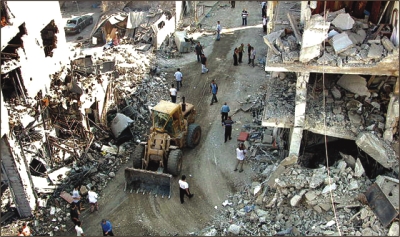
At least 55 civilians were killed yesterday as Israeli jets and gunboats pummelled towns and villages across Lebanon and tens of thousands fled an increasingly bloody conflict both sides defiantly warned would have no limit. Israeli ground troops headed back across the border to strike Hezbollah outposts as another volley of rockets fell on northern Israel on the eighth day of an offensive that the international community has so far done little to end. Streams of Lebanese were fleeing their homes to find safe havens and thousands of foreigners, mainly Westerners, were being evacuated by sea to the neighbouring Mediterranean island of Cyprus. Meanwhile, seven Palestinians were killed yesterday as Israeli troops moved into a Gaza refugee camp, pushing a campaign to rescue a teenage soldier and stop rocket fire into a fourth week. Hezbollah rockets yesterday slammed into this Arab-Israeli town revered as the place where Jesus grew up, killing two young brothers as they played outside and wounding 18 other people, Israeli authorities said. The attack on Nazareth --the first by the Lebanese guerrillas to reach near important holy sites --came hours after Israeli troops engaged in a fierce firefight with Hezbollah inside Lebanon, a clash that killed two soldiers and one militant. Israeli helicopters fired rockets on a residential Christian district in Beirut, the first direct strikes in the centre of the capital, raising concerns about the evacuation operation underway at the nearby port. "The security cabinet met this morning and decided on the continuation of the offensives in Lebanon and Gaza with no time limit," an Israeli official said, describing the military's action as an "intensive war against Hezbollah." The Shiite Muslim militia retorted that its guerrillas can continue to strike Israel with "an arsenal of rockets for long months, and not just days or weeks." More than 300 people have been killed in Lebanon since Israel unleashed a massive military assault it says is aimed at destroying Hezbollah after the capture of two soldiers eight days ago in attacks that left another eight dead. The United Nations is drawing up plans for an international force to try to restore calm in Lebanon but US President George W. Bush -- who says Israel has the right to defend itself -- insisted that Hezbollah and Syria had to be reined in before there could be peace in the region. And Israel pressed on with a deadly new wave of attacks against southern and eastern Lebanon on Wednesday, with 21 of the 54 killed in a single village where residents said 10 houses were destroyed. Israel also continued its deadly offensive in the Gaza Strip which is aimed at retrieving another soldier held captive by Palestinian militants, killing seven people in raids on Wednesday, bringing to 93 the number killed since it launched an operation to retrieve a captive soldier and halt rocket attacks. Lebanese Prime Minister Fuad Siniora, who took office about a year ago after the first elections since former powerbroker Syria ended its three-decade military presence, accused Israel of "committing massacres" against his people. "The intensifying aggression in this barbaric way proves that Israel has decided to push Lebanon back 50 years." But Israeli Prime Minister Ehud Olmert defended the relentless bombardment, saying it was aimed at obtaining the release of the two Israeli soldiers and the disarmament of Hezbollah in line with an existing UN resolution. Across the border in northern Israel, a civilian was killed Tuesday when a rocket hit a park in the resort of Nahariya in the latest of hundreds of rocket attacks by Hezbollah. Over the past week 25 Israelis have been killed, most in a barrage of Hezbollah rocket fire across the border, including 12 soldiers. Another eight rockets exploded in Israel's northern metropolis of Haifa Wednesday, although there were no reports of casualties. And with no ceasefire in sight, foreigners continued to flee the worst violence in Lebanon since Israel sent in its forces in 1982 against Yasser Arafat's Palestine Liberation Organisation. In Beirut, hundreds of people were waiting to be evacuated by sea while three ships arrived on the Mediterranean island of Cyprus, which lies just 100 miles (160 kilometres) west and is being used as the hub of evacuation operations by Western states. More Americans are also due to be evacuated on a chartered cruise liner, with warships ordered to waters off the coast to bring out thousands of citizens and provide security amid fears the ships could become a target. Britain, hoping to evacuate about 5,000 of its nationals by the end of the week, pulled out about 170 Britons on a destroyer. "It's hell on earth, it's escalating day by day," said Joe Noujeim from England as he arrived in Cyprus, expressing relief at finally getting out with their three young children. For many ordinary Lebanese there is little chance of such a rescue and many were fleeing their homes in the main target areas such as southern Lebanon to try to find safe havens. "The situation is both alarming and catastrophic. There are about 500,000 people displaced already. The situation is extreme," the representative of the United Nations Children's Fund (UNICEF) in Beirut, Roberto Laurenti, told AFP. The United Nations said it was evacuating all non-essential staff from the country. As the European Union and the United States prepared to send envoys to the region, UN Secretary General Kofi Annan outlined plans for an international force for Lebanon that he said should be "considerably larger" than the current 2,000-strong UN peacekeeping force. But Israel -- which has always rejected the deployment of foreign forces in its conflict with the Palestinians -- said it was "too early" to discuss such a possibility. US Secretary of State Condoleezza Rice is expected to travel to the region although she was unwilling to be drawn on a specific date, saying she would only come when it is "helpful". Bush again lashed out at Syria, amid fears the conflict in Lebanon and Gaza could spread across the region, no stranger to war. "In order to be able to deal with this crisis, the world must deal with Hezbollah, with Syria, and to continue to work to isolate Iran." Israel, which has sent ground troops back into Lebanon for the first time since it ended its occupation in May 2000, has been emboldened by strong public support at home and the lack of a ceasefire call from its ally Washington. The international airport has been knocked out, ports bombed, bridges destroyed, power stations set ablaze and houses turned to rubble in scenes reminiscent of the country's devastating 1975-1990 civil war. Israeli Deputy Prime Minister Shimon Peres said the Jewish state is not planning to attack Iran or Syria, noting that it already has its "hands full" with Lebanon and the Gaza Strip. SEVEN KILLED IN GAZA
Seven Palestinians were killed yesterday as Israeli troops moved into a Gaza refugee camp, pushing a campaign to rescue a teenage soldier and stop rocket fire into a fourth week, reports AFP. Around 70 Palestinians were wounded in Wednesday's incursion and three militants shot dead by Israeli forces operating in the West Bank town of Nablus, where a soldier was killed by a roadside bomb on Tuesday. In conjunction with Israel's major offensive in Lebanon, where close to 300 people have been killed in eight days of bombardment, Prime Minister Ehud Olmert has vowed to fight the Palestinians until "terrorism stops". The army said troops moved into the central Gaza Strip from Israel under the cover of darkness late Tuesday, saying the incursion was aimed at targeting "terror infrastructure" around the impoverished Maghazi camp. "It is a focused operation to target terror infrastructure there, as part of the ongoing effort in which one of its main targets is getting back Gilad Shalit and stopping the launching of Qassam rockets," a spokeswoman said. Ground troops have been operating inside the Gaza Strip since June 28, when troops rolled back into the territory in a bid to retrieve Shalit, a corporal whose capture sparked the worst Israeli-Palestinian crisis in months. At least 93 Palestinians and one Israeli soldier have been killed since Israel's assault in Gaza intensified on July 5, with forces currently on the ground both in the central Gaza Strip and in the south. Amid the hostilities, EU foreign policy chief Javier Solana, paying his second visit to the region in days, was scheduled to hold talks with Palestinian president Mahmud Abbas in Gaza City. International appeals for restraint have fallen on deaf ears and a UN resolution urging Israel to stop the offensive was vetoed by the United States at the Security Council last week. On Wednesday, seven Palestinians, including three from the armed wing of the governing Hamas that claimed joint responsibility for Shalit's capture, were killed in the central Gaza inursion in which around 70 people were wounded. Four civilians died when an Israeli tank shell exploded in a built-up area, damaging nearby houses as ground troops entered the northern and eastern edges of Maghazi, medical sources said.
|