Children still deprived of legal rights
Speakers tell roundtable
Staff Correspondent
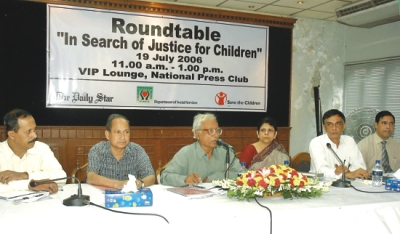
Speakers at a roundtable yesterday called for establishing a child-friendly society through a change in attitude towards them, proper implementation of the Children Act, 1974, establishment of juvenile courts on an urgent basis and development of necessary infrastructure.Although there is a proper legal procedure for children accused of crimes, many cases involving them are tried in criminal courts and even they are not sent to children development centres, they said. They suggested that the judges, probation officers and law enforcers should be given proper training on juvenile justice system and the media should play a pro-active role in raising mass awareness about the issue. The roundtable on 'In search of justice for children' was jointly organised by The Daily Star, Department of Social Services and Save the Children, UK at the National Press Club in the city. The programme is supported by Manusher Jonno Foundation (MJF). Prof Serajul Islam Chowdhury of Dhaka University said the children do not commit crimes, they make mistakes, but they still have to undergo punishment, which is a sad thing for society. "It is society that is responsible for the repression of children, leading the children to make mistakes," he said, adding that the rule of law cannot ensure justice for children -- sensitiveness of conscience is needed to this end. UM Habibun Nessa, head of programme (protection) of Save the Children, UK, said though the Children Act was formulated a long time ago, it drew attention of the legal experts very recently, but by the time many children were tried in criminal courts and sent to jails, instead of correction centres. She said children who commit crimes or are subject to exploitation should receive justice, but the present legal system and infrastructure is not sufficient for it. "Thousands of children are subject to exploitation, as they are employed in hazardous child labour," Habibun Nessa said, adding that 95 percent of children who were removed from the garments industry have again ended up in the invisible exploitative child labour. Advocate Alena Khan, executive director of Bangladesh Society for Enforcement of Human Rights, said the law enforcers, in many cases, send the children directly to jails bypassing the court. The police also do not mention the ages of accused children in the First Information Report (FIR), she said, suggesting that the district or police administration should conduct investigations to determine the age of accused children. According to a report of Save the Children, UK, a total of 582 children have been languishing in different jails in the country as of last month. Alena Khan also alleged that the officials of Social Services Department do not visit the children in the detention centres. Fahima Nasrin, deputy attorney general, said the age of the accused children mentioned in the FIR is not verified, which often lead to legal complications. Wahida Banu, director (Programme) of Aparajeyo Bangladesh, said the people, even those who are educated, are not aware of the laws and treaties protecting the children. So, justice for the children cannot be ensured, she added. She suggested strong intervention in the correction centres where abuse and drug addiction are commonplace. "The authorities seriously look into how drugs are supplied there." Criticising the non-implementation of laws, Shaheen Anam, executive director of Manusher Jonno Foundation, said there is a monitoring tool in the home ministry, but it is not functioning properly. On the role of police dealing with children's cases, she said a child-friendly society is needed to create child-friendly police. Mehtab Khanam, a professor of psychology at Dhaka University, said, "There are many problems facing children in the conflicting social system, but we do not care about them." "We should change our attitude toward the children to correct their personality disorders," she noted. On the age of accused children, Deputy Inspector General of Police Phony Bhushon Chowdhury said it is not possible to verify their ages instantly. There should be some kind of mechanism for it, he added. Stressing the training of the police and probation officers to sensitise them to child issues, he said there should be at least one cell in every police station so that accused children can be kept there before they are sent to court. Acknowledging that the Children Act is not being implemented properly, Chief Metropolitan Magistrate of Dhaka Jalal Ahmed said the number of children in jails, however, has fallen now and more probation officers have been appointed. "We do not want to send children to jail, but some are still sent to jail, as a large number of accused are produced before the court everyday." He observed that at least two police officers should be employed in each police station, who will be given special training to deal with children's cases. Advocates Shahdeen Malik and Nizamul Huq Nasim of Bangladesh Supreme Court, Salahuddin Ahmed, president of Bangladesh Retired Police Officers' Welfare Association, Sanwar Ali, deputy secretary of Social Welfare Ministry, AM Abdul Jabbar, former secretary of Social Welfare Ministry, Rehana Sultana of Bangladesh National Women Lawyers' Association, Farida Yasmin of Bangladesh Legal Aid & Services Trust, Sarder Asaduzzaman of Danida, also spoke at the roundtable. The Daily Star Editor and Publisher Mahfuz Anam moderated it.
|