Qayyum Chowdhury
Mingling designs with forms
Fayza Haq
Qayyum Chowdhury says, "The artist who influenced me most is undoubtedly Zainul Abedin, my teacher. Before coming to the Dhaka Art College, I met him in Mymensingh where my father was posted. Apart from him the artists who moved me greatly are Vincent Van Gogh, Paul Gauguin and Picasso. More recently I met the Australian painter Egon Schiller, who had powerful drawings of human figures and landscapes. I found his style irresistible. From India I admire Poritor Sen and SH Raja. I did not have formal education overseas but I went overseas for study tours, such as to UK, USA, Russia and China. Wherever I went, I visited the art institutes and the galleries. I tried to learn as much as I could by studying the paintings and talking to the artists that I came across."Before attempting large paintings, he makes small sketches and drawings and only then does he move on to the canvas and paper. His paints and canvas are often brought from overseas, specially the water-colour paper, by his friends and well-wishers. "I believe with our weather, water-colour is most suitable for us," Qayyum Chowdhury says. "In Japan, China and India, most artists work on paper. My guru, Zainul Abedin, also liked water-colour sketches. Recently, I've tried acrylic but I don't find it as comfortable as oil. While working I like to listen to Indian classical music, Rabindra Sangeet, Mozart and Beethoven." He reads a lot too, whether it is poetry, fiction or essay. He works a lot on nature. He says that nature is the main source of his inspiration. He is not realistic. His paintings are full of designs based on nature. According to him man is an integral part of nature and he looks at nature in his own individual way. His favourite subjects are elements taken from the valleys and rivers of rural Bangladesh, with its trees, flowers, birds, animals, people and boats. He has combined abstraction with folk form presenting an eloquent synthesis of design and form, with the figurative melting into the nonfigurative. Over the decades, since 1952 when he started out as a professional, he has made alterations in his style. An artist's work should always have a change, he feels. He also did paintings on the Liberation Movement, the village being the focal point. The impact of the struggle on rural Bengal was important for him. In his series Childhood memories, he treated space, as a quality by itself and this was his way of reacting to the harsh realities of life. Another important series that Qayyum Chowdhury did was Village under water in which he depicted the great flood of the 80s. In this he found a new kind of harmony of forms and figures. In it he also created a harmony of abstraction and realism through a style that is now distinctly his own.
|
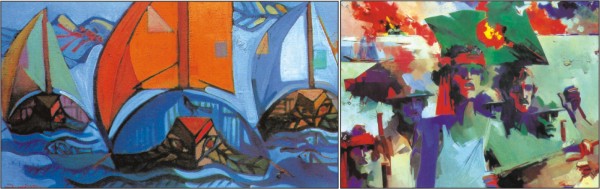
High Tide (Left) and Freedom Fighter |

