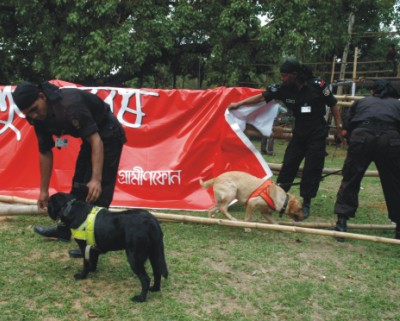
Man's best friend with sense of law-abiding duty
City Correspondent
Canine potential is largely underestimated in local society, but the canines of the Rapid Action Battalion (Rab) dog squad would prove the extent of canine efficiency that goes beyond humans.Originating in 2004 from a section of the police dog squad for security and detecting explosives, arms and narcotics, the Rab dog squad comprise of Labradors and German shepherds of both genders. The Labradors are of British origin while the German shepherds are German. "These species have a detecting by smell capacity from a distance of 10 to15 metres and a depth of two feet unlike local species," said Captain Md. Mizanur Rahman, assistant director of the squad, adding that the dogs could jump up three to four feet high. An average adult German shepherd is 62-65 cm tall and weigh between 35-40 kg whereas an average adult Labrador is 55 cm tall and weigh between 28-30 kg. The life span of a dog is 12-15 years. The breeding season is between March-April and September-October. A female can give birth to 6-8 puppies at a time. Males and females are segregated after breeding as excessive breeding could lead to a lower efficiency level. Cross breeding is restricted for the same reason. Dogs on the verge of retirement or suffering from incurable diseases are disposed through euthanasia and the deceased dogs are buried in a graveyard within the premises. There are 46 dogs, 40 kennels, 12 trainers and two veterinarians at present. Each kennel has a fan and an attached balcony to ensure air, sunlight and walking space. The fans ensure a certain level of temperature, as the dogs are accustomed to living in cold climates. They are subjected to regular medical check ups and bathed after 15 days and kennels cleaned regularly. Local nutritionists devise the canine diet comprise of bread, eggs, cod liver oil, boiled meat and vegetables. Every dog is fed according to age, weight and height. Puppies that do not have access to the mother's milk are fed with formulated canine milk. The dogs also have individual names engraved on their collars. A Rab oficer was seen chasing Boxy, a German shepherd of five-months, who was out of a leash. Poppet, an eight-year old Labrador, barked at this correspondent but quietened after an officer cautioned her and said 'no' in an assuring tone. "They do not bite unless we ask them to," said a Rab officer and explained it as gesturing at a targeted individual and uttering 'attack'. Jess, another an eight-year old Labrador, was being treated for skin disease at the vet clinic. Training begin when the dogs are six months. Initially they are familiarised to the smell of food and gradually to explosives, arms and narcotics. Individual dogs specialise in a single type of smell. Scratching at a specific location indicates that something has been detected. A dog's day begins at 5:30 am when they are served breakfast. They are exercised between 6:00 and 6:40 and then groomed and rested. By 8:00 am, the adult dogs go out on duty at various locations while the pups stay behind. The harness on their backs gives the dogs a hint that they are on active duty. "Sometimes they have to be woken up in the middle of the night for the sake of duty," said Rahman. Sterilization is not yet being implemented as the authorities intend to increase the number of dogs. "We imported 10 German shepherds and we intend to bring more Labradors to produce pure breeds," Rahman added.
|