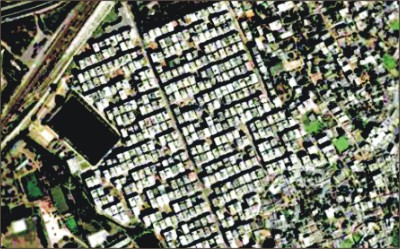
90pc DOHS buildings deviate from plans
Homeowners' body terms it concrete slum, laments lack of breathing space
Morshed Ali Khan
With over 567 residential buildings -- each six-storey high and crammed -- over an area of 82.99 acres Defence Officers' Housing Society (DOHS) in Baridhara represents one of the most densely built modern housing projects, devoid of any consideration for the environment. Approved by the Cantonment Board, over 90 percent of these six-story buildings have been built deviating from the original plans but later legalised and certified through a 'fine' paid by the builders to the board, sources said. According to Estate Officer of the Military Lands Wadudul Bari, the board approves construction of 2,540 square feet of floor space each for the five-Katha plots. But in over 90 percent of cases the plot owners end up deviating and extending the floor space beyond 2,700 square feet. The President of Baridhara DOHS Council, an association of homeowners, Brigadier (retd) Mustafizur Rahman termed the DOHS 'nothing but a concrete slum' and said it was a 'planning blunder'. He said the width of all the roads was negotiated to make more plots and the authorities did not consider aspects of green and open spaces for such a big project. "But we are trying to plant trees and create spaces for healthy movement of the residents," Rahman added. The housing blocks are so crammed most of them do not get proper sunlight or air exposing the inmates to a constant unhealthy atmosphere. Architects, town planners and engineers interviewed on the matter said the Building Construction Rules 1996 and lack of monitoring are responsible for creating such concrete jungles in the city. Since DOHS is already a built up area, the consequences can be physically seen. Dhanmondi, Gulshan, Baridhara, Uttara, Banani, Lalmatia and other so-called planned housing projects in the city are set to resemble DOHS once all the plots are built upon. They said the 1996 construction rules were grossly inadequate. Experts from different professional institutions worked for three years to formulate a new Building Construction Rules 2006, which was approved and gazetted by the government in June. But mysteriously the government deferred implementation of the new rules until December 31, prompting a rush among plot owners to get their building plans approved under the old rules at Rajdhani Unnayan Kartripakkha (Rajuk) office. Mahbub-uz-Zaman, professor at the Department of Architecture, Brac University, said during building constructions, every developer is only concerned with how best they can fill up every inch of the land with floor space. The space between two buildings, as required by the old rules, does not serve any purpose to protect the environment. It is a waste of space as all buildings are being built like boxes. The new rules, which require the landowner to leave open space as per floor ratio and build higher buildings, might ensure a sounder environment. "Concrete places like DOHS creates an urban heat island, which all inmates inside start feeling after sunset when heat radiates through walls and penetrates inside," Mahbub-uz-Zaman said. Architect Ishtiaque Zahir of Institute of Architects, Bangladesh (IAB) said due to such crammed living conditions in parts of Old DOHS in Mohakhali and Baridhara DOHS rents are much lower for large flats. "Cheaper rents and congested living attract undesirable section of tenants as we have witnessed in Mohakhali DOHS in the last few years," Zahir added. According to planning manuals used throughout the world, two thirds of the project land must be kept aside for roads, playgrounds, greens, worship place, schools and other amenities. "The unplanned areas of the city now look much better than these planned housing projects because the old construction rules, which most of the developers follow, leave room for irregularities," Zahir said. Engineer Saiful Islam of the Cantonment Board said the board took up a number of beautification programmes in Baridhara DOHS but the homeowners' council rejected it.
|