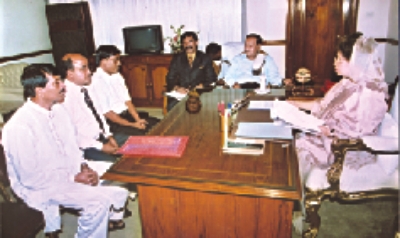
State offices used for BNP activities
Shakhawat Liton
In addition to using the Prime Minister's Office (PMO) and Prodhanmontri Bhaban, BNP Chairperson Khaleda Zia is now using the prime minister's evening office Jamuna at 30 Hare Road for her party activities ahead of the parliamentary election. Keeping BNP's central office unused, the BNP chairperson has been holding a series of meetings with the party's grassroots level leaders at Jamuna since last month using government facilities. Legal experts termed the practice as 'political corruption', but BNP leaders see nothing wrong with it. The high profile offices --- PMO and Prodhanmontri Bhaban --- have been used frequently over the last four years to hold different types of meetings of BNP, like resolving conflicts within the four-party alliance and nominating party candidates to contest in by-elections to parliamentary seats. In addition to using the high profile government offices, the prime minister has also been using government facilities in different areas of the country for holding public rallies seeking votes for her party-led alliance, all in the name of inaugurating different development works in the areas. "The prime minister is using helicopters to visit different areas in the country. She goes there and holds party rallies. The existing law does not allow such practices. But it is going on proving that there is no accountability," former adviser to a caretaker government M Hafizuddin Khan told The Daily Star. To prevent such misuse of government offices and facilities for the purpose of a political party, the Election Commission (EC) apparently has nothing to do at this stage due to legal limitations. The election law bans use of any type of government offices and public transportation for the purpose of a party in its election campaign after the election schedule is declared. Experts who held constitutional posts however said government offices cannot be used for purposes of political parties. "In broad terms, political corruption is the misuse of a public office for private gain. Now the ruling BNP is using public offices for the party's gain. It's of course a corruption," Hafizuddin, also former comptroller and auditor general, said. "It is also wastage of public money if the government carries out a party's activities using public offices. A case should be filed against such misuse of public money'" he added. Agriculture Minister MK Anwar however defended the use of government offices by ruling BNP's chairperson for carrying out her party activities. "There is nothing wrong with it and it is not an issue to discuss. It has been going on for a long time, the last Awami League government also used government offices to hold party meetings," Anwar, also vice president of the ruling BNP, told The Daily Star adding, "It's not possible to accurately separate the activities of the government and the ruling party. There is a lot of overlapping between the functions of the two." Talking to The Daily Star former chief election commissioner (CEC) Abu Hena also came out against using government offices for purposes of political parties. "Government offices should not be used for purposes of political parties. Many people think that the government and the ruling party are the same, which is wrong," he said. Anwar also a former cabinet secretary, however, said security measures are necessary if the BNP chairperson, who is also the prime minister, goes to the BNP office to carry out party activities. "There will be some unnecessary expenditure to ensure security for the prime minister," he added. USAGE OF THE PMO
On December 6, 2003, BNP Chairperson Khaleda Zia held a meeting at the PMO with her party's senior leaders and discussed the latest political situation. The meeting decided to organise public rallies in major cities like Dhaka, Chittagong, Sylhet and Comilla in a bid to increase the party's activities to face probable anti-government movement. On January 14, 2004, a meeting of the four-party alliance was held that unveiled a plan to raise the number of seats in Jatiya Sangsad to 450 including the 50 reserved for women. Top leaders of the alliance were present at the meeting held at the PMO. On December 8, 2003, Islami Oikya Jote leaders held a meeting with the BNP chairperson at the PMO and decided not to resign from the parliament following the prime minister's assurance that she would ensure their representation in the government. On January 23, 2004, a 12 member delegation of the four-party alliance from Sylhet city and the district unit called on BNP Chairperson also Prime Minister Khaleda Zia and apprised her of political and organisational activities of the alliance in Sylhet. At the meeting held at the PMO, Khaleda urged the leaders and workers of the alliance to work unitedly to strengthen the alliance by extending support to mayoral candidate MA Huq, also district president of Sylhet BNP. On October 27, 2004, the BNP chairperson addressed a meeting of grassroots level party leaders at the International Conference Centre (ICC) of the PMO and urged the party leaders to hold more meetings in districts, upazilas and unions to face the opposition's 'negative activities' politically. The meeting was addressed by more than 20 field level leaders of district, upazila and municipality units of BNP under Chittagong division. On January 8, 2005, the BNP chairperson held a meeting at the PMO with presidents and general secretaries of upazila and municipality units of Brahmanbaria and parts of Comilla. On April 4, 2005, a function was arranged at the ICC of the PMO to hand over the recommendations from the BNP's union representatives' meetings held between January 4 and March 29 of that year. BNP's Senior Joint Secretary General also Chief Co-ordinator of the Central Committee for Union Representatives' Meetings Tarique Rahman handed over to the BNP chairperson a set of recommendations. The meeting was attended by a number of BNP senior leaders. Besides, BNP's Parliamentary Board has on several occasions used the PMO to hold its meetings to pick candidates to contest in by-elections to the parliament's vacant seats. PRODHANMONTRI BHABAN
The ruling BNP last year held a two-day meeting with the party's grassroots level leaders at Prodhanmontri Bhaban, which is an official residence of the prime minister, where she does not live. BNP Senior Joint Secretary General Tarique Rahman organised the meeting in a bid to gear up the party's grassroots level leaders ahead of the next parliamentary election. About 3000 grassroots level leaders from across the country attended the meeting held on October 15 and 16. A number of BNP senior leaders including Finance and Planning Minister M Saifur Rahman, LGRD and Cooperatives Minister Abdul Mannan Bhuiyan, and Health Minister Khandaker Mosharraf Hossain also attended the meeting. Last year, BNP also used Prodhanmontri Bhaban to hold a meeting to pick party candidates for the election to reserved seats for women in the parliament. BNP Parliamentary Board headed by BNP Chairperson Khaleda Zia sat two days there to interview the party's nomination aspirants. Interestingly, BNP sold application forms for the nominations at its central office in Nayapaltan, but used Prodhanmontri Bhaban to interview the aspirant candidates. PRIME MINISTER'S TOURS
Prime Minister also BNP Chairperson Khaleda Zia has started extensive tours across the country and has launched an unofficial election campaign. She is using helicopters to visit different places and inaugurating some development works at the same time, making the visits official. But in each visit, the BNP chairperson addresses public rallies organised by the party's local units and seeks votes for the BNP-led alliance in the upcoming election. When the prime minister visits any area, she uses all government facilities and protocols. Even during visits to different districts, the prime minister has on several occasions held meetings with local BNP leaders at circuit houses. BNP OFFICE REMAINS UNUSED
As the party's activities like holding meetings with grassroots level leaders and nominating party candidates for parliamentary by-elections are usually carried out at the prime minister's offices, the BNP central office at Nayapaltan remains mostly unused for purposes of the organisaton. BNP's senior leaders who are also ministers do not visit the party central office as they meet with party high ups at their official residences. After BNP had come to power in 2001, the BNP chairperson asked party senior leaders to sit in the party central office regularly in rotations to keep communications with the party's field level leaders smooth. Some senior leaders who are also holding ministers' portfolios started visiting the party's central office. But after some months, they stopped.
|