Documentary
'Dr Zohra': A woman ahead of her times
Kavita Charanji
History is replete with portraits of brave and dedicated women who have risked their all in support of a cause. Here is one more -- Dr Zohra Begum Kazi, described as 'The Florence Nightingale of Dhaka.' The 96-year-old doctor (though she claims to be 100) is recognised as the first Bengali Muslim lady doctor of the then undivided Bengal. Her life and work are the subject of a soon-to-be-released film, titled Dr Zohra. The filmmaker is Mahbubul Alam Taru of production house Jharna bioscope who has done the photography, script, direction and editing of this documentary.Taru's tribute to womanhood through Dr Zohra, zeroes in on the eventful life and medical career of this brave medical professional. In a sense she had a head start of her women contemporaries. Her father, late Dr Kazi Abdus Sattar was a renowned physician and a political personality of the subcontinent, who hailed from the illustrious Kazi family of Gopalpur village under Kalkini upazila of Madaripur district. He was a close associate of Mahatma Gandhi, Jawaharlal Nehru and Vallabhai Patel, among other eminent personalities. Zohra matriculated with distinction from Aligarh Muslim Ladies School. Subsequently she passed intermediate from Lady Hardinge Medical College, Delhi. From this college she bagged an MBBS degree in 1932. She was also honoured with the Viceroy's degree and is the only one to get an honorary Member of the Royal College of Obstetricians and Gynaecologists (MRCOG). After her MBBS, Zohra worked 13 years in several places of undivided India. Later she joined the Dhaka Medical College & Hospital (DMCH) and worked as a teacher and doctor. Here she took on the post of professor and head of the department of obstetrics and gynaecology. At the same time, she was also serving as honorary doctor at the Combined Military Hospital, Dhaka Cantonment. On her retirement from DMCH in 1973, she served as a consultant in Holy Family Hospital. Her years at DMCH were an eye opener. Here she realised the plight of women patients who were ignorant of allopathic medicine and treatment and often succumbed to their ailments. Reluctant to seek outdoor medical assistance in male dominated hospitals, many took their last breath. To help out these suffering women, Zohra often used to visit them in their homes and persuade them to cast away their taboos and superstitions. For her groundbreaking work, she won the Begum Rokeya Padak in 2002. On February 21, Zohra organised emergency treatment for the leaders of the Language Movement and enabled them to go out safely. She also helped the freedom fighters in 1971. To filmmaker Taru goes the credit for drawing out the initially reluctant Zohra over a course of seven months. Now the film is on the editing table.
|
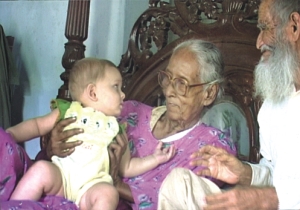
Dr Zohra (C)in a scene from the film |

