Shamsur Rahman: A tribute
Zillur Rahman Siddiqui
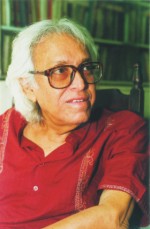
Shamsur Rahman left us on August 17. I am writing this obituary note on the 18th, barely 26 hours after his death. Ever since he was admitted to the Intensive Care Unit of the Bangabandhu Medical University Hospital he was in coma. There never was a doubt that he was critically ill. A Medical Board was formed and the Board kept us reassuring that the ailing poet was receiving treatment at the international level, whatever that might mean. The management of visitors, since access into the room showed a strange laxity, was far from being of that standard. I, myself, was astounded when I found a cameraman from one of our TV channels, sitting next to his bed, taking pictures from very close quarters, and in an unhurried manner, with nobody opposing or protesting. It cannot be said, from the overall situation prevailing during those days, in and around the Intensive Care Unit of the hospital, that the poet was allowed to die in peace. Shamsur Rahman became the leading poetical voice of our time. Quite early in his life, while still an undergraduate in the university, he made poetry the first vocation of his life. As a fellow student, studying the same subject, I can testify to this. During those early years, he quickly came to identify the latest trend in Bangla poetry, the trend of modernism set firmly by the group of poets conveniently called the Thirties Group. This group represented the cutting edge of Bangla poetry. The modern sensibility that marked his poetry almost from the beginning can be ascribed mainly to this early discovery. The fact that he was born, and grew up, in a city (not much of a city in those days by world standards but still a city) must have played its part in moulding the urban, and urbane, cast of his mind. Shamsur Rahman did not have to wait long before establishing a vital contact with the modernist poetry of the western world. The process was made easy by his access to English literature. Shamsur Rahman's transition, from an intensely private to a largely public mode of poetry, goes to explain his emergence as a public figure wearing a poet's mantle. This view about him has gained general assent. But this overlysimplifies the real fact. Even before he started coming out of his private groove he had established his claim as the up and coming poet of his time. The turbulent 'sixties' drew him out of his alienation. Slowly, but inevitably, he reached a stage when his pulse beat with the same rhythm as his people's did. But here he achieved something quite uncommon. As a poet he gained new ground without losing hold of his old domain, his private world where he still retained much of his basic alienation, and his refusal to come to terms with the world as he found it. To any one surveying the corpus of his poetry it is preeminently personal as opposed to public. A poet is his individual self most of the time, and public only on occasion. This is as true of Shamsur Rahman as it is of Pablo Neruda. True, his so called political poems have struck a sympathetic chord in the public mind.They enjoy a wider circulation among readers. But who can deny that the mystery lies in the poetic treatment of a popular theme, the very personal poetic attire that the poet was able to weave for the theme. This naturally leads on to the issue of form and style. As a major poet he developed his individual poetic language, flexible, versatile, flowing and, strangely enough, lucid. His metrical competence is amazing, though he was never bound to a strictly predetermined form. When he did submit himself to one, as when writing a sonnet, he managed to play with the set rules with a freedom which is striking. His diction varies according to the demands of the particular poem, moving from the rhetorical to the colloquial, never shy of using the strange, and the unexpected, word. And finally, he has his complete mastery over the language that he gained through sensitive, and particular, attention to its undiscovered nuances. In any one of his typical poems, one is struck by the clever intermingling of the strange and the familiar. He is able to impress, without trying to be impressive. When he is most personal, verging on the confessional, his disarming candor does the magic. It establishes a kind of rapport between the poet and his reader that largely explains his wide, and unfailing, appeal as a poet. Shamsur Rahman won the hearts of millions across national boundaries, and to his own people he became a sort of an icon. He did it through the magic of his poetry, and through the complete emotional identification with a people lost in the wilderness of political foolishness and failings. When he spoke out, as he did often enough, his voice was resonant. He was a source of moral strength to a people desperately looking for light and guidance. His death is a terrible loss for all of us at this hour of gloom and despondence. A bereaved nation has paid its tribute to its illustrious son in a manner which will be remembered for many years. Zillur Rahman Siddiqui is a renowned educationist.
|
|

