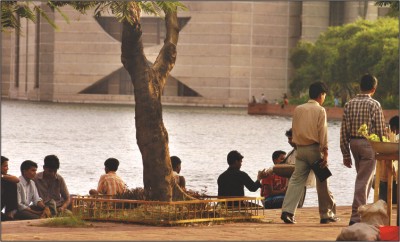
Dhaka: Yesterday, today and tomorrow
The Daily Star (TDS): What are your childhood memories of Dhaka?Prof Nazrul Islam (NI): When my elder brother and I arrived in Dhaka in December 1950 following transfer of my father, the city being the capital of the then East Pakistan was growing at a faster pace following the partition of 1947. Government officials from across the country were transferred to Dhaka to run the central administrative functions. This sudden influx of population in Dhaka made the housing problem acute. The government too did not have adequate accommodation facilities for its officials. We rented a two-room government-requisitioned house at Tk 14 per month at Kaptan Bazar, then a mixed area inhabited mainly by middle and lower-middle class people, some professionals and businessmen. We had no electricity. I used to study with a lantern. Most of the Kaptan Bazar residents had to collect water for domestic use from roadside hydrant provided by Dhaka Municipality. TDS: What did you do in your leisure time? NI: We used to go to Paltan Maidan, hockey stadium and the park in front of the Bangabhaban, to play. The Burignga was a live and active river. People used to bathe and fish in it and stroll on the bank. Ramna Park and the Race Course ground (now Suhrawardy Udyan), were the biggest open spaces in the entire city. People would either move on foot or by riding bicycles from one part to another. We used to walk a lot around the city from one corner to the other. TDS: Do you remember any special incident? NI: One day while walking in the Ramna Park in either 1959 or 1960, I happened to see the great leader of Bengal, Hussain Shahid Suhrawardy playing golf. When I sought his permission to take a photograph of him, he readily posed for it. But later he said that my way of taking the photograph was wrong with the sunlight behind and made me take the photo again. TDS: How do you see the development of Dhaka? NI: New roads and residential areas began to take shape following the adoption of master plan in 1959 and establishment of Dhaka Improvement Trust (DIT) in 1955. Jinnah Avenue (extension of Nawabpur Road), national stadium and Gulistan Cinema were landmarks of the development of Dhaka in the mid 50s. From 1971 to 2001, Dhaka as centre of education, commerce, employment opportunities and a growing economy witnessed another phenomenal influx of population. Rajuk has all along been a weak, inefficient and corrupt agency. It miserably failed to manage and guide the growth of Dhaka. Though Bangladesh had its constitution and a five-year development plan within one year of independence, successive governments failed to have a dynamic and visionary management for development of Dhaka. None of the governments paid due attention to the plan of the capital city of an independent country. TDS: What future do you see for Dhaka? NI: I am not sure whether there is any future of Dhaka. In any case, Dhaka must be made liveable, well functioned, economically productive, socially equitable, environmentally sustainable and culturally and aesthetically attractive. We badly need an efficient and visionary leadership in the government, civil society and the general public to achieve this. We must get rid of the accumulation and exhibitionism of wealth by a handful of affluent people of the society and overriding influence of a few commercial companies to turn the city into a liveable one. There is no alternative but to uphold good governance for a planned Dhaka City. Prof Nazrul Islam, honorary chairman of Centre of Urban Studies spoke to Tawfique Ali of Star City.
|