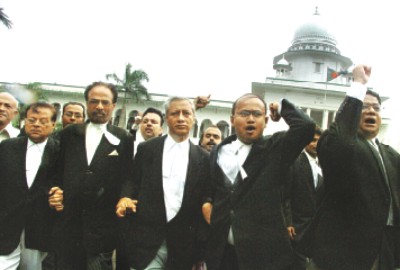
Judges' confirmation draws strong protest
Lawyers decry govt decision ignoring CJ's recommendations
Staff Correspondent
The 17 newly confirmed judges took oath yesterday amidst protest by a large section of lawyers at the government's ignoring the chief justice's recommended list in confirming services of the judges. The Supreme Court Bar Association (SCBA) demonstrated at the Bar building denouncing what they said is confirmation of judges on political consideration. Renowned legal expert Dr Kamal Hossain said he felt as if a grenade has been thrown on him when he came to know about the judges' confirmation. Talking to the press, he said, "This (confirmation of judges) is an attack on the judiciary and the constitution. This should be resisted." Former SCBA president Barrister Rokanuddin Mahmud said the government threw away recommendations of the chief justice. This is the saddest event in the history of the Supreme Court, he added. The government on Tuesday confirmed services of 17 additional judges of the HC, ignoring the chief justice's recommendations. There were 19 additional judges awaiting confirmation. The chief justice recommended confirmation of 15 on the basis of their performance over the last two years. But the government included two more judges -- Emdadul Haq Azad and Faisal Mahmud Faizee-- in the confirmation list. While the chief justice did not recommend these two judges, Faizee had triggered a controversy when he was appointed as an additional judge. The SCBA launched an agitation for his removal questioning the genuineness of his Bachelor of Law (LLB) certificate. But the government ignored its demand. And now the chief justice's recommendations have been ignored. But the practice of ignoring the chief justice's recommendations on appointment of judges continued unabated over the last four years that made the SCBA claim that incompetent people have been made judges. Before the controversy over confirmation of the judges, the government had also created a controversy centring appointment of the 19 additional judges two years ago. It was alleged that most of the appointments were based on political proximity to the ruling alliance. Staging a demonstration protesting this at the same time, the SCBA said the alliance government is making such politicised appointments to protect itself from the consequences of its misdeeds and corruption. The demonstration was led by SCBA President Barrister Amir-Ul Islam while former presidents Abdul Baset Majumder and Mahbubey Alam, former secretary Eneyetur Rahim, among others, addressed the demonstrators. SCBA Secretary AM Aminuddin told newsmen, "We have decided to refrain from attending Faizee's court." Later, the SCBA brought out a procession that marched to the Jatiya Press Club and then ended at the Bar building. On the other hand, pro-government lawyers under the banner of Jatiyatabadi Lawyers' Forum (JLF) hailed confirmation of the new judges at a meeting yesterday. The JLF leaders said these judges were confirmed as per the constitution. Those who are creating controversy over this are actually violating the constitution and committing contempt of court. The JLF meeting was addressed by Habibul Islam Bhuiyan, Jainul Abedin, Saidur Rahman, Humayun Kabir Bulbul and some others. POLITICISATION OF THE JUDICIARY
Since coming to power in 2001, the BNP-led alliance government has appointed 45 additional high court judges in the last five years. Of them, the government confirmed the services of 37. In all of these appointments there had been allegations of politicisation and nepotism. There are allegations that some of these judges had been active leader of the BNP. When the four-party alliance came to power, it did not confirm the services of 15 additional judges appointed during the previous Awami League rule. Yet most of the judges among these 15 had the chief justice's recommendations in favour of them. The present government's first instance of ignoring the chief justice's recommendation came in May 2002 when the chief justice recommended confirmation of three judges who were appointed during the Awami League rule. None of them were confirmed. In February 2003 when the chief justice again recommended confirmation of eight additional judges appointed during the Awami League rule, the government confirmed only two of them. The alliance government had appointed 11 additional judges in July 2002, nine judges in April 2003, six in August 2003 and finally 19 in August 2004. During all these appointments, the SCBA brought allegations of blatant politicisation. These appointments also triggered agitation on the High Court premises like never before. The trend was almost the same, though at a lesser magnitude, during the previous AL rule. At the fag end of the AL's tenure, the government refrained from appointing Justice KM Hasan to the Appellate Division although the chief justice had recommended in favour of him. KM Hasan was the senior-most judge. But the AL government had appointed his juniors above him at the Appellate Division. After coming to power, the alliance government took 'remedial' measures by alleviating his position. Eminent jurists of the country all the while had been vocal about the politicisation of the judiciary while Law Minister Moudud Ahmed defended the appointments and confirmations saying that all had been done in accordance with the constitution. Even a High Court Division Bench in 2002 recommended that the appointment of the judges should be kept above political considerations. It also observed that the Supreme Court recommendations on the judges' appointment must be made effective and meaningful. In April 2003, Dr Kamal Hossain in an interview said that appointment of judges should not be made on political considerations. The appointments should depend on merit and discussions with the Supreme Court judges and Bar members. The chief justice's recommendations should be respected, he observed. Dr Kamal cited an example of 1994, when the then prime minister Khaleda Zia had appointed six judges without consulting the chief justice. The Bar members then met Khaleda with an argument that although consulting with the chief justice is not constitutionally mandatory, it is a constitutional convention. Khaleda was convinced and cancelled the six appointments. She also gave fresh appointments to four posts instead of six in consultation with the chief justice.
|