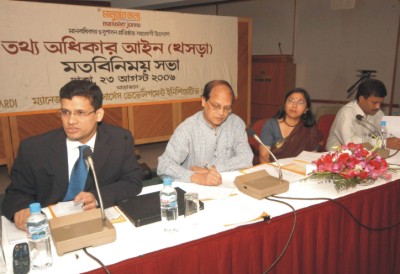
'Right to info law to strengthen democracy, curb corruption'
Speakers say at consultation meeting
Staff Correspondent
Speakers at a consultation meeting yesterday observed that ensuring the right to information would go a long way to strengthening democracy and curbing corruption through establishing transparency in the administration.They called on the people to forge a countrywide movement for immediate enactment of the Right to Information Act. They also urged the political parties to include the issue in their election manifestoes and work actively towards establishing the right to know. Management and Resources Development Initiative organised the consultation meeting on 'Draft Law on Right to Information' prepared by a law core group facilitated by Manusher Jonno Foundation. Dr Atiur Rahman, chairman of Unnayan Samannoy, presided over the meeting at Brac Centre Inn in Dhaka while Shaheen Anam, executive director of Manusher Jonno Foundation, discussed the context of the draft law. The draft law was made on the basis of a working paper on the proposed Right to Information Act 2002 prepared by the Law Commission. The commission recommended promulgating a law to make provisions for people's right to have access to records of the government, statutory bodies and the registered NGOs, enable the people to hold the government accountable for their actions and have access to information for redress of their grievances and to cast a duty on the government and NGOs to proactively keep people informed on issues important for their well-being. "There is no law in force in the country to recognise specifically people's right to information and providing a procedure for its implementation. Rather, there are certain prohibitory acts and rules to block the information," said Barrister Tanjib ul Alam, who played the key role along with Dr Asif Nazrul and advocate Shahdeen Malik in drafting the law. Giving examples of such acts, he mentioned Official Secrets Act 1923, sections 123 and 124 of Evidence Act, 1872, Rule 28 (1) of the Rules of Business 1996, Rule 19 of Government Servants (Conduct) Rules, 1979 and Oaths (affirmation) of secrecy under the Constitution. Dr Asif Nazrul presented the recommendations of the meetings on 'Right to Information Draft Law' held in Khulna and Chittagong recently. Defining the 'right to information', the draft law says every person shall have the right to information held by or under the control of any public authority. "The public authority shall maintain all its records and make available to any citizen requesting information from it and shall not withhold any information or limits its availability." The draft has separate sections on publication of information by public authority, duties of information officers, procedure for access to information, procedure for providing information, exemptions from disclosure of information, rejection of information, partial access to information, public interest disclosure, constitution of information commission, its powers and functions, appeal against information commission and penalty for refusing application. The draft law says there shall be no obligation to provide information of some particular kinds, including those which may affect the sovereignty and integrity of Bangladesh, security, strategic, scientific or economic interests of the state or relations with a foreign state or lead to incitement of an offence. It proposed that the president would appoint a chief information commissioner and up to five information commissioners to constitute an information commission and that a fine of maximum Tk 25,000 may be imposed for delay in providing information. At the meeting, lawyers, journalists, NGO representatives and human rights activists said ensuring access to information will not only benefit the press but also ensure empowerment of the people as well as improve their livelihood. The next consultation meeting will be held in Rangpur on August 30.
|