10th South Asian Games
Colombo 2006
BOA in total disarray
Who'll receive Dhaka Games flag?
Al Musabbir Sadi from Colombo
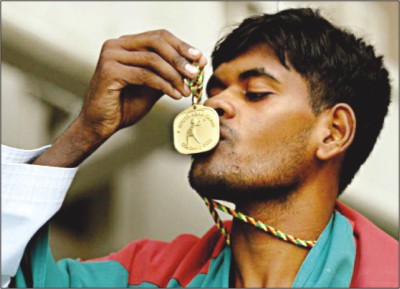
As the curtains on the 10th South Asian Games fall today, the strong contingent of Bangladesh officials will gather at the Sugathadasa Stadium to do one last ritual correctly after their innumerable questionable activities throughout the 11-day show of the biggest sports jamboree of the region.The issue is pretty serious because someone has to receive the Games baton since Dhaka will be hosting the next edition of the meet. But until now it was not confirmed who would take over the Games flag on behalf of Bangladesh. The host city mayor is the first choice and then a Bangladesh Olympic Association (BOA) official. However, it was learnt that BOA acting secretary general Kutubuddin Ahmed was on his way to catch the concluding ceremony bus. Not only that, the local organising committee was sweating to know even on Sunday when the Bangladeshi cultural troupe would arrive. As Bangladesh host the next Games in two years, they are to perform in the closing ceremony as the tradition goes. Besides, the BOA has yet to design and approve a logo for the 11th edition of the Games and present it at the closing ceremony, leading only to establish a total mismanagement that was embarrassingly evident in managerial skills both on and off the field. It was a shame that when Mahfuzur Rahman won the 100m hurdles gold there was hardly any official present to cheer him on Friday. Rather, most of the officials failed to resist the temptation of a trip to the picturesque Kandy to see the hockey bronze medal play-off. While the hierarchy watched Bangladesh being mauled by hosts Sri Lanka, a nation that had never won a hockey match against Bangladesh, Mahfuzur Rahman only received cheers from his colleagues. More interestingly there was no official to offer the hurdler hero a national flag for the victory lap. He had to content with a small flag brought by colleagues. It also looked very odd when two senior officials including a BOA high-up -- both enjoying a sound trip in Colombo -- even did not bother to clap and inspire swimmer Shahjahan Ali Rony when his name was announced over the sound-system prior to his gold medal triumph. Bangladesh contingent's general manager AK Sarker was without a cellphone for about a week after arrival, waiting for the 'company' (organising committee) to deliver him a free SIM card. Whenever he was approached for news about teams residing outside Colombo, like hockey or shooting, his repeated answers were: “I really do not know because I have yet to get a phone.” In a country ravaged by war, keeping contact with all the members of the team should have been his priority. Maybe, the cash-starved BOA had advised him not to waste 2,000 rupees (20 dollars) to buy a SIM card. But even after his mobile phone was activated, it was difficult to get a call through to him. Even funnier was the women's general manager Quamrunnahar Dana. She was mostly seen accompanying her relative, the only female physician -- a family planning expert whose knowledge about sports medicine is also questionable -- to find a place in the squad. There have been complaints of free mixing among the sportsmen and women in the hotel but Dana was more eager to fax reports to Bangladeshi news agencies or go shopping rather than keep a watch. Thankfully, there was no scandal in the end. The managerial skills or the lack of it definitely deteriorated in the absence of Zafar Imam, the former secretary general of Bangladesh Olympic Association (BOA) who died two years ago. Love him or loath him, Imam, affectionately called Zafar bhai, was the father figure of sports in the country and his ability to deliver in any Games was unmatched. He was a man with connections home and abroad. The addition of power and skill made him a renowned organiser the world over. His untimely departure has created a void, which was cruelly exposed in Colombo. It was not only in the Games but also during preparations the present BOA set-up failed to combine things together within the limited resources on offer. While bright prospects like swimming, athletics and shooting needed intensive training, the highest body of sports in the country not only failed to provide them with best of facilities but also could not hire foreign coaches. Shooting had a Chinese coach for less than two months before the competition, but his presence hardly helped the shooters as he could not speak English. And absence of an interpreter did more harm than good, leading the shooters to return home without a single gold. The athletes also suffered. One coach had to take care of the whole team although it is preferable to have different coaches for short distance runners, jumpers and hurdlers. The swimming team trained under two coaches at home but the federation had selected one man who failed to notice the swimmers' problem or correct them. Football paid the price for appointing incompetent and controversial manager and team leader. But the hockey federation was perhaps at its wits end by appointing the secretary of the athletics federation as manager of the hockey team.
|