Positive image key to luring tourists, investment
Speakers say at Branding Bangladesh Conclave
Star Business Report
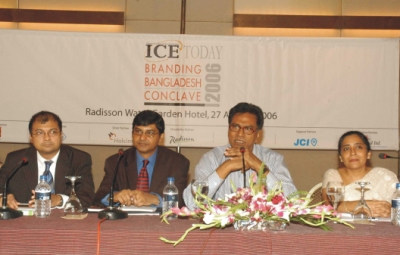
Speakers at a discussion yesterday underscored the need for building a positive image of Bangladesh by improving governance and bringing corruption at a tolerable level besides presenting local culture and heritage in the interest of luring tourists and foreign investment in the country. Bengal Foundation and its sister concerns organised 'ICE Today Branding Bangladesh Conclave 2006' at Radisson Water Garden Hotel in Dhaka. Kaiser Haq, member of the ICE Today editorial board moderated the discussion. Making a presentation on the topic, Dr Debapriya Bhattacharya, executive director of the Centre for Policy Dialogue (CPD), said the fundamental prerequisite for changing perceptions about Bangladesh would be a change in the unfavourable realities prevailing in the country. However, the improvement of the reality needs to be supplemented by an effective communication strategy, which will adequately project the primary strengths of the country to the world at large, he observed. Indeed, the concept of branding may be effectively utilised to address both the reality and perception challenges, which Bangladesh is currently confronting, he noted. If a country opts not to have a branding strategy, it does not mean that others will leave it alone, Debapriya said, adding that rather disadvantaged countries like Bangladesh will be left to the discretion of others and get branded based on limited and partial or biased information. Despite negative image some Bangladeshi organisations like Grameen Bank, Brac have helped improve the country's image globally, he pointed out. Prof Anisuzzaman, chairman of Jamini editorial board, underlining the need for organising cultural events in different countries said: "I don't think that we have done enough to present our culture abroad." Farooq Sobhan, president of Bangladesh Enterprise Institute, noted that image is a key factor in attracting tourists and investment in the country. "Perception about Bangladesh in our immediate neighbouring countries is not good which is very important," he said, adding that most of the regional countries like Nepal, Sri Lanka or Myanmar were able to attract tourists despite hostile political environment but it was not possible for Bangladesh. Bibi Russell, a fashion designer, emphasised improving rural economy and said: "It is essential to present our art, culture and people at the national level positively and then we can think about presenting ourselves in a positive way globally." Annisul Huq, former president of Bangladesh Garment Manufacturers and Exporters Association, said local exporters are forced to sell their products at prices lower than those offered by other competitors in the global market due to a bad image of the country. Wali Bhuiyan, former president of Foreign Investors Chamber of Commerce and Industry (Ficci), said Bangladesh has huge potential and it is essential to highlight positive things instead of presenting the country in a negative way all along. Mahfuz Anam, editor and publisher of The Daily Star, said in spite of bad image Grameen Bank and Brac had been successful in building a positive image of the country with their performances. "We need to acquire self-confidence based on our strength," he said, explaining that Bangladesh is known as a country of excellent disaster management and its participation in the UN peacekeeping operation is highlighted in a very positive way. Economist Atiur Rahman said there are lots of positive stories and it is essential to project local culture and heritage to build a positive image. On branding Bangladesh as a number one corrupt country, he said a section of political elites may be corrupt but the common people are not corrupt. In this context, he stressed the need for differentiating these two aspects. Ramendu Majumder, managing director of Expressions Ltd, said it is possible to build a positive image of the country by presenting local culture and heritage. "We should have good governance and keep corruption at a tolerable level to build positive image of Bangaldesh." Nasser Shahrear Zahedee, adviser of Roche, lamented that different organisations have already branded the country in a very negative way. Without improving overall governance, branding the country's positive image might be difficult on the private sector's part. Luva N Choudhury, editor of ICE Today, said a country's image plays a crucial role in its international dealings. To put things in a frankly pragmatic perspective, the better a country's image, the better the deal it gets in the global marketplace, she noted.
|