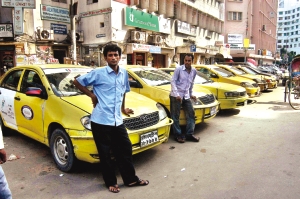
Anarchy reigns city public transport system
Errant taxi drivers show no respect for law
Tawfique Ali
To the unrelenting suffering of thousands of commuters every day, city taxi drivers, three wheelers and buses have created an anarchic situation in the public transport system, either refusing to go to destinations or charging exorbitant fares, which the public can hardly afford. The traffic police officials who are supposed to control the situation say that the mechanism to fight such irregularities in the public transport sector has failed. They say the 'wrong people' are driving taxis, buses and three wheelers with forged licenses. The police telephone numbers displayed on each taxi and three-wheeler for the disappointed commuter to lodge a complaint yield no result whatsoever in streamlining the unruly drivers. When a commuter threatens a defiant driver of police action, the usual answer is, "Do whatever you can but don't threaten me of police action, we buy them every hour." For the thousands of helpless commuters every day moving from one place to another within the city is getting increasingly difficult day by day. Many housewives, office goers, school children say that rickshaws offered an alternative mode of transport for them but many city roads are now off limits to rickshaws and they have no choice other than virtually begging of the taxi drivers to take them to their destinations. The Dhaka Metropolitan Police (DMP) Joint Commissioner (Traffic) Monjurul Kader said that this is not a new situation prevailing in the city's public transport sector. "It is a common phenomenon that drivers of various public transportation modes manipulate certain situations to extract undue fares and harass the passengers in different manners." "It is not possible on part of the police alone to streamline the entire traffic system," said Kader, "The process of issuing driving license is faulty and situation is such that the wrong people who even do not know the ABC of traffic rules obtain driving license quite often." Lack of proper education is a major factor that contributes to the situation, he said, the DCC too has its responsibility to enforce traffic rules in the city. "Powerful associations of drivers and owners of the public transport vehicles often override the normal enforcement of law," said the joint commissioner. The common excuses that the drivers of various public transport modes make for their errant behaviour include high amount of daily deposits to the vehicle owners and price hike of essentials. When it comes to travelling a short distance the drivers almost invariably refuse to go saying, "the fare won't be viable for me". City commuters by buses and different kinds of human haulers are also frequent victims of more fares than fixed by the government. Having finished a banking job at Bakshi Bazar, a teacher and mother of three children from Dhanmondi, Nasira looked for a transport to return home on a Wednesday afternoon. She said that about a dozen taxicabs stood at an intersection but none of the drivers agreed to take her to Dhanmondi. As she approached a CNG-run auto rickshaws nearby, the driver demanded Tk 150 --- three times more than the fare. At one stage, Nasira waved to a police sergeant on a motorbike who ignored her saying he would come back later. She then approached another sergeant, who said, "The yellow taxi drivers are on a strike today." But in fact, there was no strike of taxi drivers that day. "I was so exhausted under the scorching sun I felt I might collapse and lost my strength for bargaining with them any longer," said Nasira. She helplessly boarded the CNG three-wheeler. The punitive measures against the violators of traffic rules are so insignificant that this punishment can hardly make the offenders abide by the law, said the traffic joint commissioner, drivers become all the more arrogant having paid the fine once or twice. As per existing rules, police can fine an offender between Tk 50 and 500. In serious traffic offences when police file cases against the offenders, they get immediate bail. A lecturer at Bangladesh University of Engineering and Technology (Buet), Mizanur Rahma on Friday set out to find a taxicab or CNG run three-wheeler to go to Gulshan. "I found a number of empty CNG auto-rickshaws around the main entrance to the Buet," Rahman said, "But, as I approached them one by one, they either refused to take me to my destination or demeaned money on top of the meter." He walked up to the Polashi intersection where he had to face a similar situation though there were quite a few vehicles standing around. "Angered and disappointed, I then walked down to Dhakeswari taxi stand where again I had to undergo a similar hassle," he said, "At one stage, I had to hire a CNG auto rickshaw agreeing to pay Tk10 in addition to the metered fare." "This is obviously a lawless situation with none in sight to bring the culprits to book," Rahman said. This correspondent in the guise of a Gulshan-bound passenger at 9:00 in the morning on Sunday approached a number of CNG-run auto rickshaws at Karwan Bazar. Driver of the CNG auto rickshaw no- Dhaka Metro Tha 14-0907 demeaned Tk 20 more. Normally, the metered fare from Karwan Bazar to Gulshan circle1-1 is around Tk 35. Driver of another auto rickshaw (no- Dhaka Metro Tha 12-7056) Mahbub Khan said that he would not go anywhere other than Mirpur. Asked why, he said, "I have some business there." The joint commissioner of traffic said that they need at least 600 police sergeants to tackle the city's traffic movement but they currently have around 400.
|